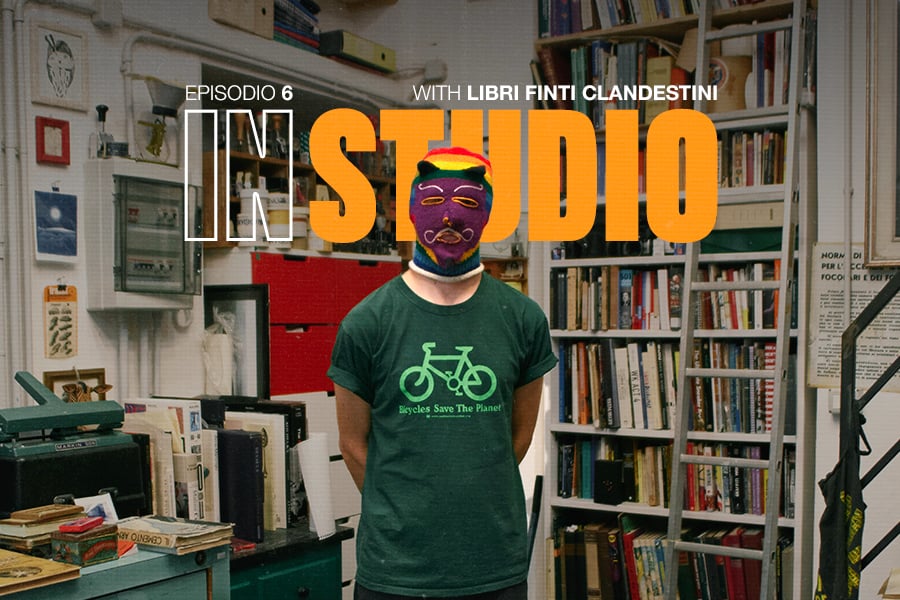
For the sixth episode of IN STUDIO, we went in Milan, to Isola area. Here is the small studio of the collective Libri Finti Clandestini. It’s a cosmopolitan artistic collective comprised of artists El Pacino, Aniv Delarev, and Yghor Kowalvsky, centered around their work and research on artist books. Libri Finti Clandestini project originated in Rome in 2012 with the aim of creating books solely using “found” paper, typically regarded as trash. Using diverse materials sourced from various “marginal” places like abandoned factories, flea markets, warehouses, libraries, and print shops, the collective manually assembles, binds, stamps, and numbers books and sketchbooks. Ultimately, it’s up to the audience to determine their fate: ready to be written, drawn upon, or given any other meaning the possessor desires.

The studio
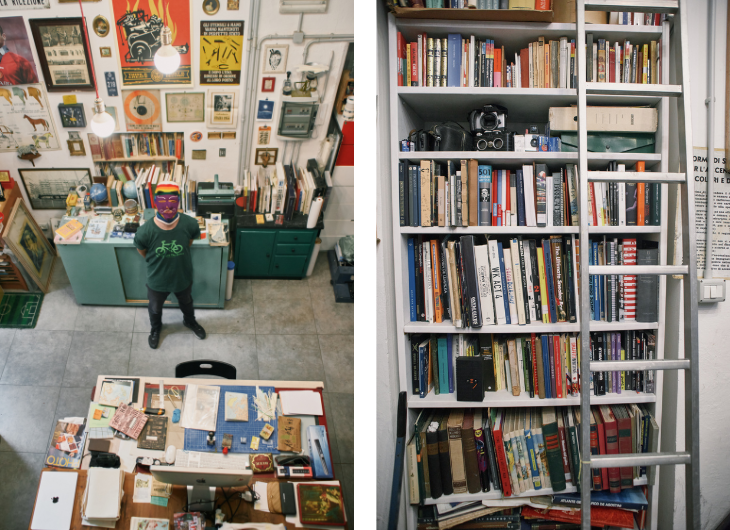
We’re in Isola, a buzzing Milanese neighborhood. Here lies one of the Libri Finti Clandestini locations, the smallest but also the most artisanal. The collective, due to both their creative approach and practical necessity, doesn’t confine themselves to a single location but rather disperses their production across various sites. The Milanese studio serves as their primary base, housing their archive and where all manual production takes place. In Saronno, they rely on a much larger workshop, home to their collaborators 5XLetterpress, housing some of their printing machinery including the German Heidelberg Windmill letterpress, an FTC press, and other manual presses. Another significant place for them is in Garbagnate. It’s the headquarters of Spazienne, another collective they collaborate with, equipped with a small darkroom useful for developing their photographic projects. Let’s delve deeper into this small magical space, redolent of paper and harboring forgotten memories.
Let’s start from the beginning. How did it all come about?
Sometime between 2010 and 2011 – when concepts such as upcycling and the circular economy did not yet exist – we began to follow a “degrowth,” even though it is a not-so-nice term. In short, we started to approach recycling in publishing. The great thing is that we were among the first to start such a project. We have never stopped, we are constantly evolving and experimenting with various branches of the project but with the same ultimate goal, which is to create the editorial object.
What project did you start with? How did everything then evolve and materialize?
For several years the project has been based on the creation of sketchbooks, all made from different scrap papers and then bound. Thought to be written or drawn. For example, we did a project for an exhibition held in 2016 at the Demetra bookstore-gallery in Brera that consisted of giving one hundred artists a sketchbook. Each of them could fill it as they wanted, according to their style. Once drawn by them they became real artist’s books. In general, the Libri Finti Clandestini project then evolved into something else as well. We started to create one-off copy books, no longer just sketchbooks but also pop-up books created with the kirigami technique. Unlike classic pop-ups, here we make everything from a single sheet, without removing or adding anything except small characters we found in books from flea markets or old encyclopedias.

How important is the studio dimension to you during the creative phase?
Actually the creative phase, as well as the design phase is nomadic. Likewise, this studio is not the only one but we have many. Some still unexplored. We are not forced into this space but rather, the research phase takes place outside. Every product we make is created in the world dimension. The idea, as well as the content, happens outside during our “urban explorations“. From the spaces we visit, which are often abandoned, we collect real material but also stories, which is what we then want to convey. We care much more about the content than the container. We treat the book, it is true, but we are at the antipodes of the classic book. We try to be as precise as possible but we like the improvised approach.
What do you mean by an improvised approach?
The improvised approach goes hand in hand with our ideology related to reuse. We start with, “Okay, we have this kind of paper, how do we process it?” whereas in 99 percent of publishing it’s “I have to make this thing, then I need this paper.” Somehow, the paper we find relies on us to be reborn. We adapt to it and get inspired by its identity. The only stake we have is to try to do everything by hand and (as much as possible) with reused material.

Here, however, in this study, what happens? How do you experience it?
Here is our entire archive. All the material we have collected over the years also becomes a bit of an inspiration for us. As I said before, it is the paper that leads us to new projects. This is where the most manual part happens, with cutter, thread and needle. Whenever we want we come here, very often even on weekends. Doing what we love to do, we find ourselves working all the time, from 00:00 on Monday to 23:59 on Sunday. A real separation from work and study is actually never there, it is just a physical separation.
Being a collective and therefore working in threes, it was not physically possible to have the work place coincide with your home. How do you cope with having a studio outside the home and in the city center?
At first we were outside Milan, obviously economically it was another thing. However, we realized that being in the city was almost essential. We are physically present, and for those who want to visit us it is more immediate. Personally, the idea of keeping the studio separate from the house became a necessity. The very first years I started, when I did everything from home, it became almost alienating. Even just riding my bike twenty minutes to come here serves to clear my brain.

Choosing, would you leave this study tomorrow or have you put down roots here?
Choosing no. Also being accumulators would be difficult, we have so much here.
What tools cannot be missed in the study?
Of tools here there are few really. Doing everything by hand, there are cutters and scissors. Then the whole part you need for binding: the awl, the thread and the needle. I would tell you
also the ruler and the knitting needle – for homemade “creasing” of paper – with these you can do everything. While everything on the printing level is done in the workshop in Saronno or Garbagnate.

We have noticed the recurring presence of the Atlas. Is this an obsession of yours or is it simply the most readily available recycled paper?
Half and half I would say to you. On the one hand it is a great object of inspiration to imagine.
On the other hand, the atlas is a bit anachronistic. For example, in the East of the world with the breakup of the USSR, atlases change and people throw them away. Also we really like them because of their very thick weight. They keep very well over time.

Last off-topic question. What are you working on at the moment? We know you have just returned from Asia. Are you going to spoil anything for us?
We have just churned out a new project, made on site in Taiwan! It’s called “UFO! UFO! Taiwan Race” and it was a bit of a challenge against time. On October 31, 2023, we left for Taiwan together withLuogo Comune with the goal of exploring the island and creating a self-produced zine with the material we would collect in the days immediately following our arrival, to be presented at the Taipei Art Book Fair, starting November 3, 2023. Documenting it all with iPhones, handheld scanners, and cameras, we collected graphic and visual material on the streets of Taipei and in an abandoned village toward the East China Sea. Then, in a total of 96 hours, we edited, typeset, and printed and bound the zine.

Somewhat in the same manner as the book made by train in one night, which we have already told you about here.


Ph Credits Andrés Juan Suarez