Andrea Ucini, Florentine, 42 years old, emigrated to Denmark in search of fortune or to pursue the promise of a fertile environment and hospitable policies, it began as a composer.
Always interested in any artistic medium, Andrea through his portraits spreads ideas, words and feelings that are difficult to express.
Almost like a latent love that has always been there, but no one knows what name to give it, Andrea, as he tells me, decided to gather its work and try with the illustration in the literal sense.
His drawings have very iconic titles that recall the movie’s one, but especially television; just think of the dystopian nouvelle vague on Netflix that in the TV series staged neuroses and conflicts of modern man – and there are many questions that Andrea arises through his drawings and the titles he chooses.
“I am very interested in how the world works,” he says, “and I am very critical and curious in all respects. My works take shape from a message that I try to make visible and consistent with the reality that surrounds us, without falling too much in the Surrealism “.
In the illustration that takes as its subject an invisible Trump evoked only by the title and its foreign policy, Andrea tells me about how he “tried to make the concept “real“, in the way that if every action creates a consequence, an itch – in this case Mexico for Trump – becomes something that annoys and everyone try to eliminate (the shoe that rubs the other one leg).”
But there is a certain underlying melancholy in his drawings.
And we can feel it by the dark colors.
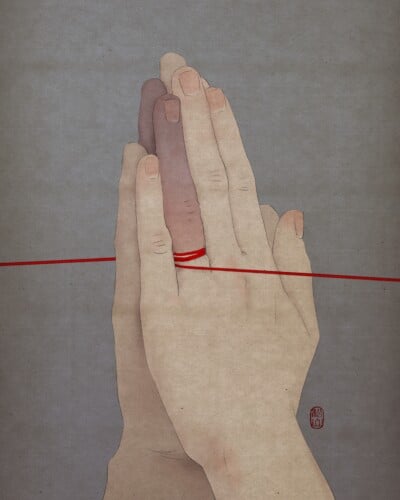
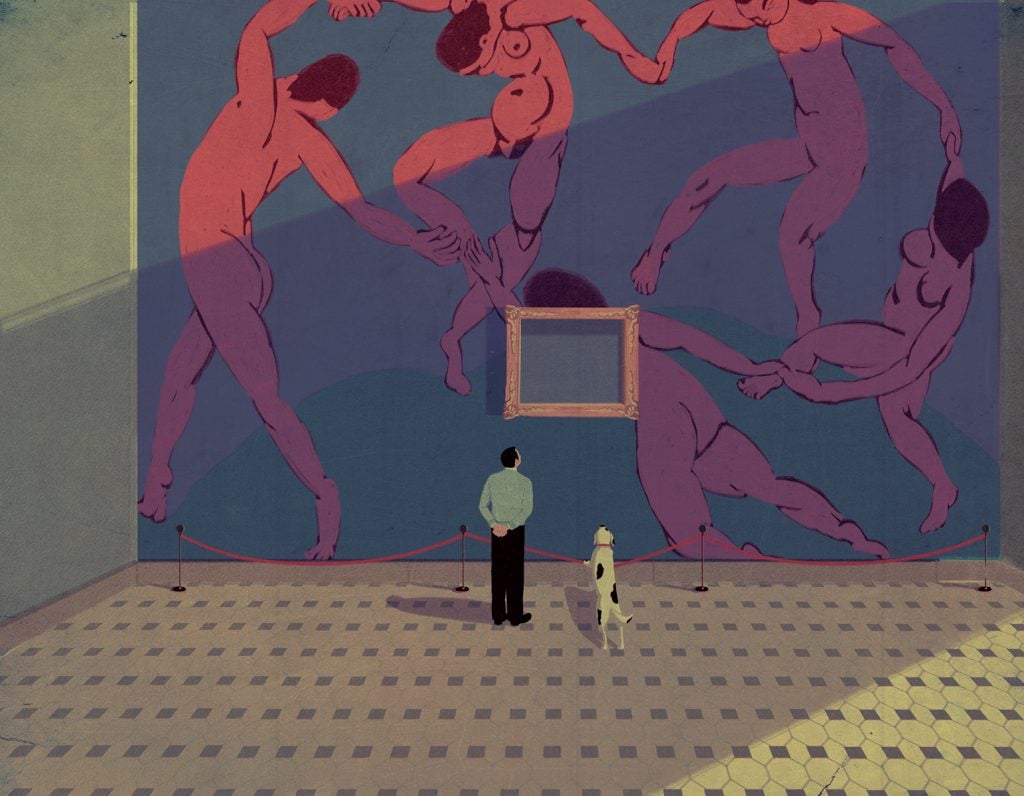
Compared to the current trend, especially in drawings, which wants to be a part of a direct and uncompromising black and white, and other pastel colors, so unnerving for the delicacy they carry with them, his illustrations seem to talk to vintage photographs, to newspaper clippings and faded performance posters.
The choice of colors is not random and Andrea answer by saying that create “too much distance between an object and another through the colors bringing life to “a puzzle where you realize that the pieces are assembled to form an image, but only if it is observed at a certain distance “.
“The desaturated colors have the power to condense everything and make it uniform to the eye. The eye glides looking message more easily and more naturally. ”
Are the colors and the modern conflicts staged gently, to make the work of Andrea something you never tire of watching.
It comes to my mind a truth unearthed by chance in a text by Albert Camus – The Rebel – to describe the work of Andrea: “Beauty, no doubt, does not make revolutions. But a day will come when revolutions will have need of beauty.”
That in the Andrea drawings never misses.