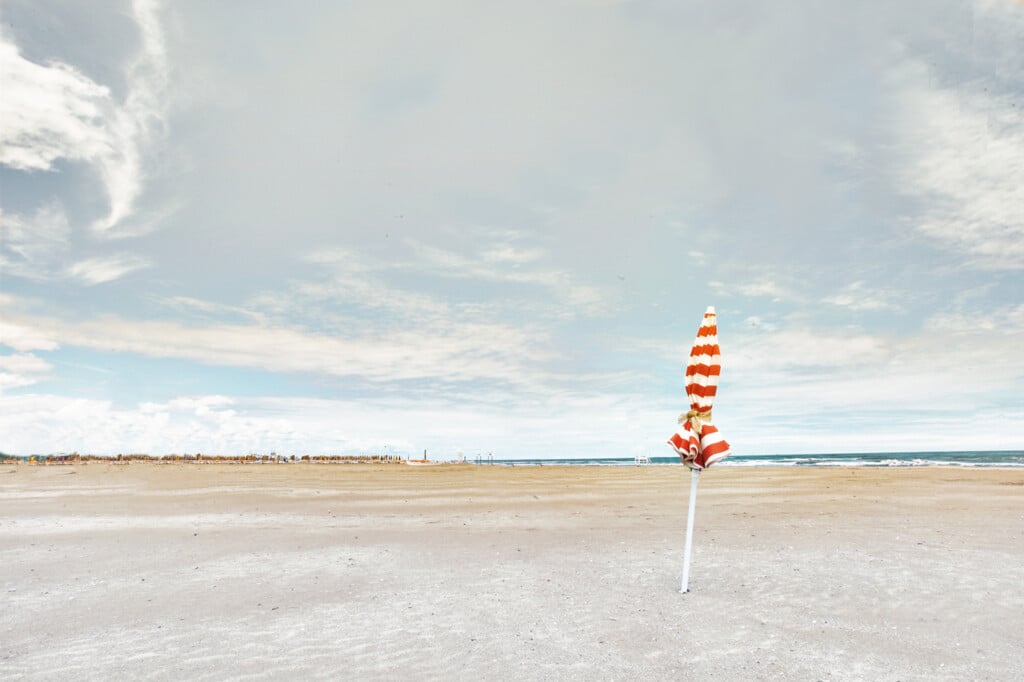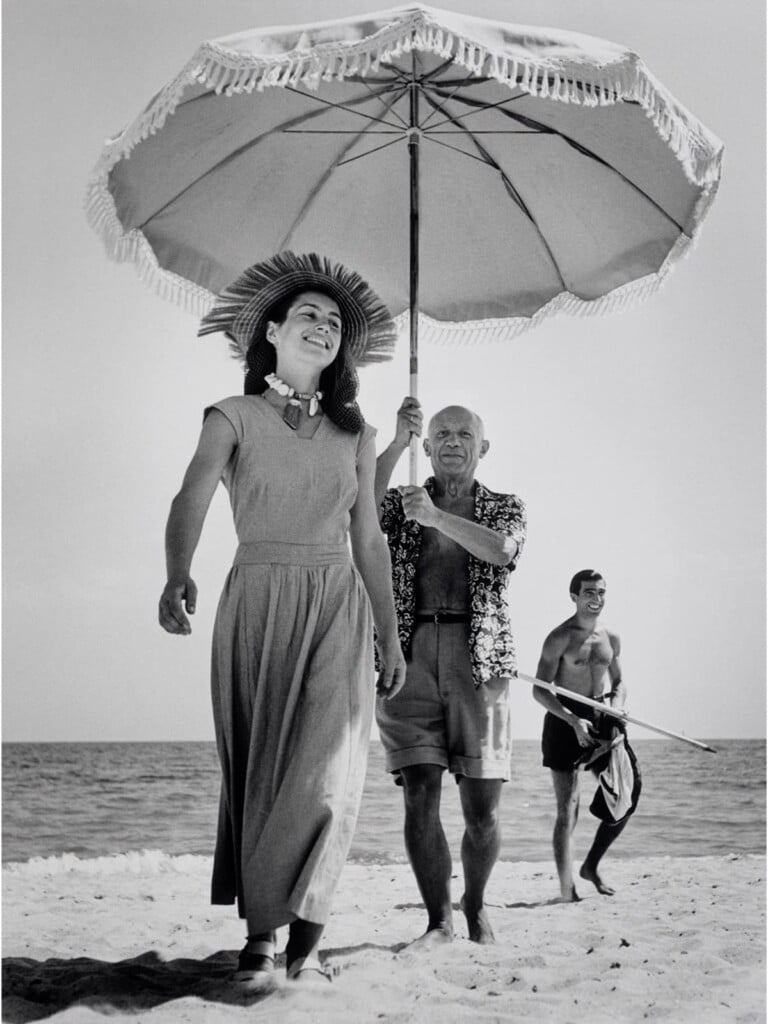
There is an object that has reshaped the Italian coastal landscape more than any urban planning initiative. It has appeared in every photograph, every film, every postcard of the Adriatic summer. It has crossed sixty years of national history — the economic boom, mass tourism, the rise of the middle class, the obsession with luxury — without anyone ever claiming authorship: the beach umbrella has no author.
This is no minor paradox. In a design system where every chair, every lamp, every door handle proudly bears the designer’s name, the most reproduced, most photographed, and most immediately recognisable object of the Italian summer floats in total anonymity. No original patent, no signature — just the structure: a pole, some ribs, a coloured fabric. And yet, like the white plastic chair that Pierre Castignola dissected to reason about copyright, the beach umbrella too is an archetype, an object that exists in a million copies because no one owns the idea.

The invention no one claims
It is 1928. Romagna was inventing something it did not yet know it was inventing: mass seaside tourism. Along the Riviera (from Rimini to Cervia, from Riccione to Cesenatico), the first equipped beach establishments were emerging, and with them the need for shade from the sun that went beyond simply spreading a cloth on the sand. The beach umbrella was born here, as a pragmatic response to a practical need. But who designed it? The answer is: no one knows for certain. Or rather, everyone copied it so quickly that the original design evaporated in the multiplication. At first glance, the beach umbrella appears simple. In reality it is a small treatise in material engineering applied to the most aggressive environment in existence: the beach. Wind, salt air, UV rays, sand that seeps into everything. The professional beach umbrella — the one Romagnan lifeguards open each morning with the distinctive metallic click that has become, over time, the soundtrack of summer — is built to withstand all of this for at least ten years.
Even the object’s morphology has developed its own glossary: with panta or without (the flaps hanging from the fabric’s edge), with soffietto (the open top to let wind through) or without, panelled or solid-coloured, classic or pagoda-shaped. Details that distinguish one model from another like stylistic variations in a haute couture catalogue, yet almost no one knows them by name.


The boom, the ritual, the territory
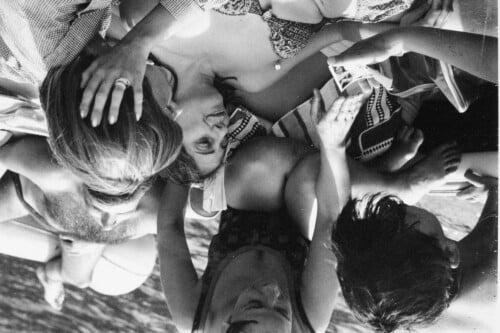
In the 1960s, with the economic miracle and the rise of mass tourism, the beach umbrella became the symbol of the new Italian middle class that could finally afford holidays. No longer just the nobility and the bourgeoisie in their seaside villas: now everyone was there, packed into parallel rows of colourful umbrellas along the Adriatic shore. What had seemed a simple functional object became a tool of social demarcation. The colour of the fabric identified the establishment; the row number identified the degree of seasonal tan accumulated (those in the front row are regulars, veterans); and planting the umbrella — this assertive, almost atavistic gesture — became a ritual with implications reaching far beyond securing a patch of shade.
It is territory. It is a flag driven into the sand. Some use a spade to reinforce the base, some seal the hole with a bucket of water, some manoeuvre the pole like a lever. A small comedy of the absurd that repeats itself every day on every beach in Italy, and that says far more than it appears to about the way we inhabit shared space.
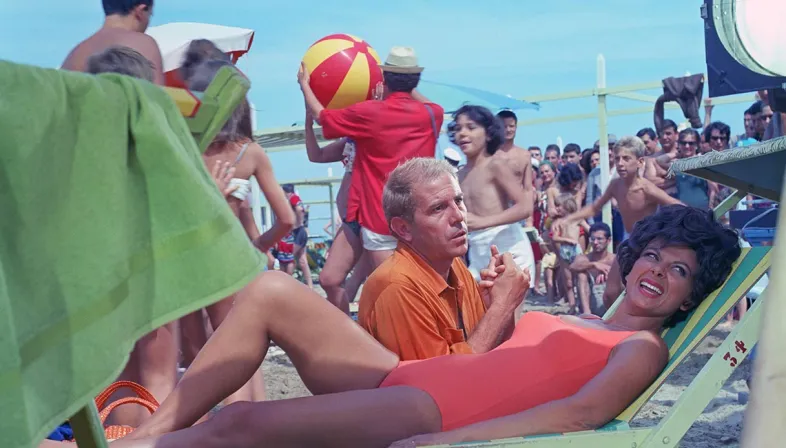
Dino Risi understood this perfectly as early as 1965. His film L’ombrellone with Enrico Maria Salerno and Sandra Milo, set on a midsummer Adriatic, uses the object as a microcosm: the shelter beneath which indiscreet glances, erotic fantasies, and petit-bourgeois hypocrisies nest. The beach umbrella is the territory of the holiday, the shifting boundary between the private self and the public performance the beach demands. As in Il Sorpasso, Risi portrays prosperous Italy as a comedy of the absurd; here the instrument is a wedge of coloured fabric against a backdrop of water.
The beach umbrella as photographic subject
No one has understood the visual power of the beach umbrella better than two photographers who come from opposite worlds.
Massimo Vitali spent decades photographing Italian beaches from an elevated vantage point, transforming expanses of umbrellas into sociological cartographies. In his images — often large-format, almost painterly in their density — the beach umbrella becomes the unit of measurement for a human geography: each coloured circle is a cell, and together they form a social fabric legible from above in a way it never is from below. There is no judgement in Vitali’s photographs, but there is an almost surgical clarity in showing how much the Italian beach landscape is, at its core, a matter of occupied space, of one body within the body of others.
Slim Aarons captured the same summer from a diametrically opposite angle. His umbrellas belong to the terraces of Positano, the villas on Lake Como, the pools of Capri. They are linen, silk, woven straw. Surrounding them are women in oversized sunglasses and tanned men in white trousers. The Aarons umbrella is a status symbol, an accessory of the international elite that has chosen Italy as the backdrop for its own aspirational self-presentation.
The luxury that wants to forget its origins
Today the beach umbrella lives its third life: that of the luxury rebrand. More and more beach establishments are choosing to brand their fabrics with high-fashion signatures — Louis Vuitton, Missoni, Dior, Jacquemus, Paul & Shark. The idea is to elevate the beach experience into something editorial, aspirational, photographable. A Missoni umbrella on the Riviera is not just shade from the sun: it is an aesthetic, a statement of intent, a piece of social media content.
Yet there is something profoundly paradoxical in this operation. The beach umbrella was born without a signature, without an author, as a collective and radically democratic object. Placing a luxury monogram on it is precisely the opposite gesture: restoring an exclusive identity to something whose power has always resided in the absence of a fixed identity. It is the same mechanism that overtook the sneaker, the blue jean, the white T-shirt — objects born outside the fashion system that the fashion system absorbed, transformed, and reissued as desirable through the brand.


There is something profoundly Italian in the idea that the most representative object of our summer has no name, no creator, no one’s signature. In a country where design is often celebrated as an authorial gesture — where every chair has its monograph, every lamp its museum — the beach umbrella exists outside this system. It is the design that worked too well to need an author.
And perhaps that is its most elegant lesson: that certain objects belong to everyone because no one had the presumption to keep them for themselves. The truly necessary things — those that enter the daily lives of millions of people and become their emotional backdrop — often do not arise from the intention to make design, but from the urgency to solve a simple problem. How to make shade on the sand, by the sea, in summer.