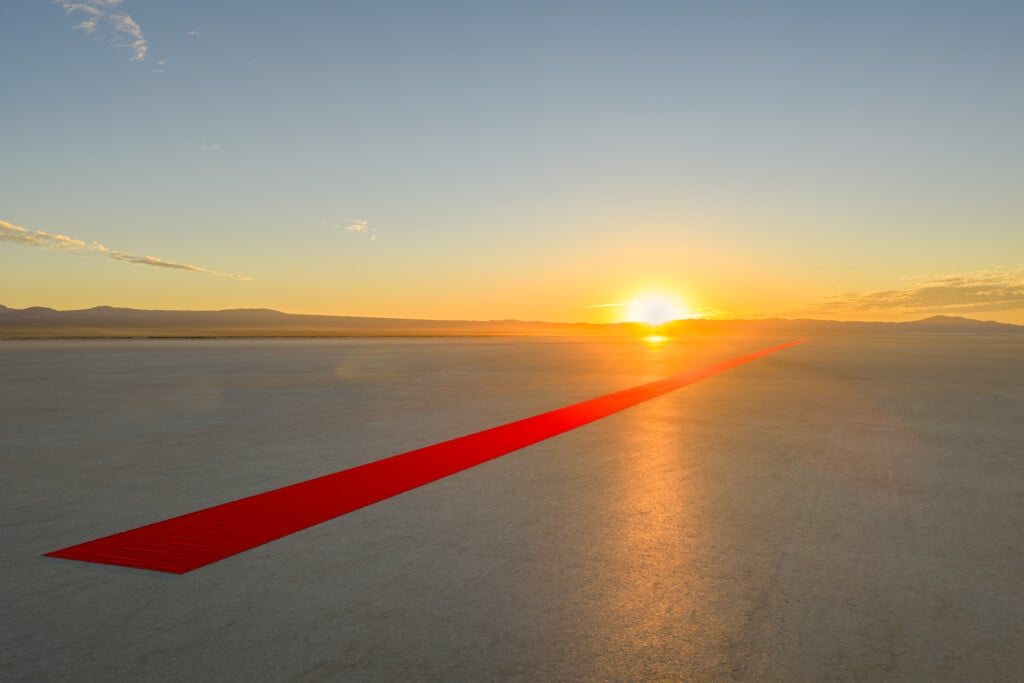
In the dry lakebed of El Mirage, in California, a red line cuts across the horizon. It is El Mirage, the site-specific installation by Gregory Orekhov, a one-kilometer-long strip of polypropylene that follows the east-west axis, tracing the sun’s movement from sunrise to sunset. A perfect geometry crossing the cracked desert surface, creating a dialogue between the human scale and the infinity of space. Just as he did four years ago in Moscow.
Orekhov’s red line is not just a mark, but a gesture that measures time. At dawn, it stands out sharply against the pale ground; at noon, it blends with the reflected light; and at sunset, it becomes almost luminous, capturing the warm tones of the low sun. It is a presence that changes with the passing hours—a line that breathes with the light. Photographs by Rafael Gamo and Studiolandon capture its variations, documenting how the perception of the same work shifts depending on the hour, temperature, and distance.

With El Mirage, Orekhov continues his exploration of linear form and spatial continuity. The line, a primary and universal element, becomes a way to measure the world, to define direction, and to perceive the passage of time. In this sense, the project dialogues with Nowhere (2022), the intervention realized in Malevich Park, where a red line crossed a snow-covered forest. There, the mark was ephemeral—a gesture lost in white; here, in the desert, it becomes a structural axis, a stable reference that defines orientation and presence.
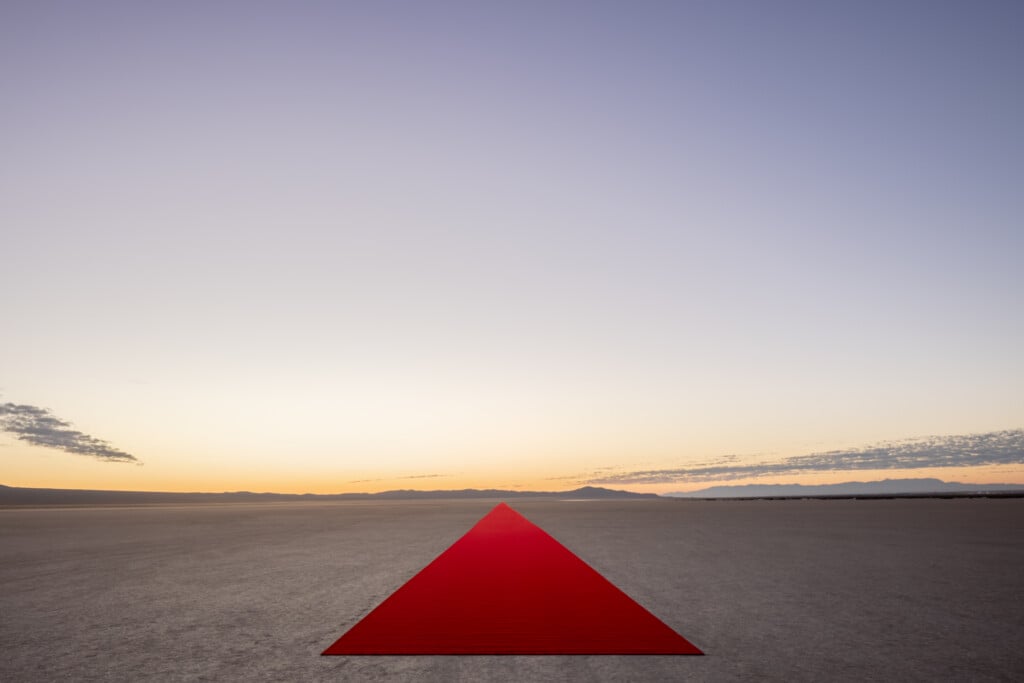

El Mirage transforms the landscape itself into part of the artwork, merging environmental observation with conceptual expression. A single line becomes the boundary between sky and earth, between measurement and infinity, between humankind and the surrounding space.
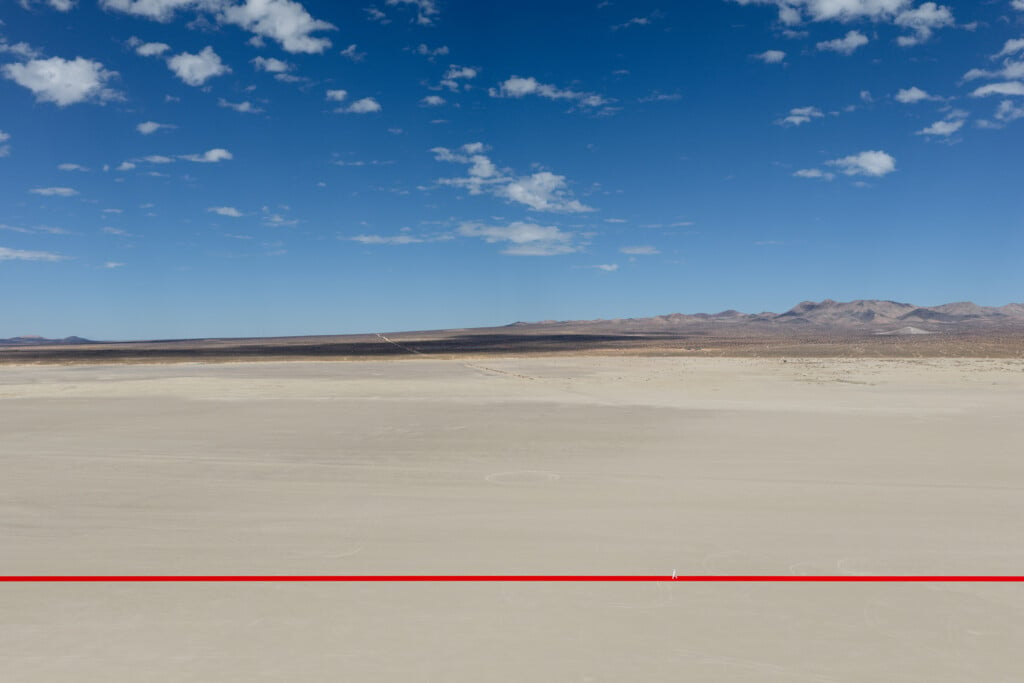


ph. © Rafael Gamo