In the vertigo of the human condition, it is abundantly clear that time and space are all too often channelled along the routes of wickedness and a drama so breathtaking as to silence every other possible initiative in the realm of leisure and disengagement.
As the 61st edition of the Venice Art Biennale unfolds, the decisive impossibility of experiencing the space of art (and its market system) in clear separation from the warlike spirit and the deeply unsettling certainties of the most ardent advocates of war’s inevitable necessity remains. Amid the many questions and a priori criticisms of an evergreen chauvinism — concerned solely with tallying the national origins of as many artists as possible — the text that follows returns to draw from the pages written in 1967 by the young students of the School of Barbiana.
In Letter to a Teacher, Don Milani’s young and spirited family observed:
black power
Stokely Carmichael was imprisoned twenty-seven times. During his last trial he declared: “There is not a single white person I trust.” When a young white man who had devoted his entire life to the Black cause cried out: “Not even one, Stokely?”, Carmichael turned to the audience, looked at his friend and said: “No, not one.” If the young white man took offence, he proved Carmichael right. If he truly stands with Black people, he must swallow it, step aside, and keep on loving. Carmichael had perhaps been waiting for that moment.
In the grip of a ruthless and criminal time that razes towns and entire cities to the ground, the Cameroonian-born curator Koyo Kouoh (Douala, 1967 – Basel, 2025) chose, for the exhibition In Minor Keys, to return to the majestic and unforgettable work of James Baldwin. A few passages from the magnificent autobiographical novel No Name in the Street (1972), handled with delicacy and the deepest love, set in motion what remains of her guiding hand in the press release drafted just months before her untimely and deeply mourned passing:
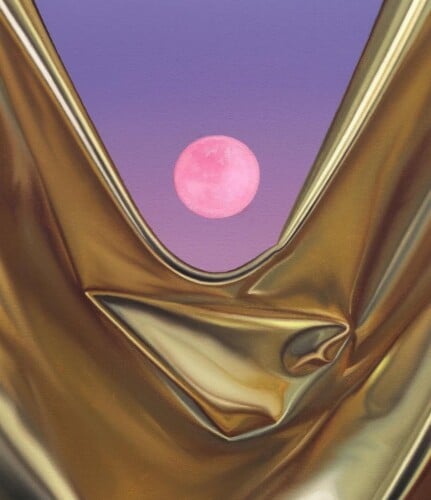
There is a reason, after all, that some people wish to colonize the Moon, and others dance before it as before an ancient friend.
The brief illustrative sections that follow offer a fully personal and heartfelt selection of artists participating in the Venice event.
Ayrson Heráclito: (s)objects of enchantment
A large part of the films that, from the 1950s onward, mythologised the adventure of the new conquistadores in the lands of Native Americans was also peculiarly complicit in casting the most abominable stereotyped veil over the countless — and far older — enterprises of the sword and the cross that had already laid waste to Latin America.
With the plundering of raw materials from the most vast and unspoiled territories came the rapid trafficking of men torn from the African continent in service of the most lucrative new form of bondage. The slave subjugated by violence and chains was the dramatic harbinger of what would befall the lives and frightened bodies of the indigenous peoples as well. Together, those bound and tortured hands formed the labour force of the quarries and immense fields seized from the forests for monoculture. Religious practices such as Candomblé were born from the hopeful longing of those who refused to sever the thread of tradition — one that still offered the heart the living pulse of the homeland. In the harmonious encounter between the gods of Africa and the saints imposed by the religious congregations that arrived alongside the armies of Europe, Afro-Brazilian enslaved people and their descendants gave a spiritual home to the nostalgic dream of a possible future return.
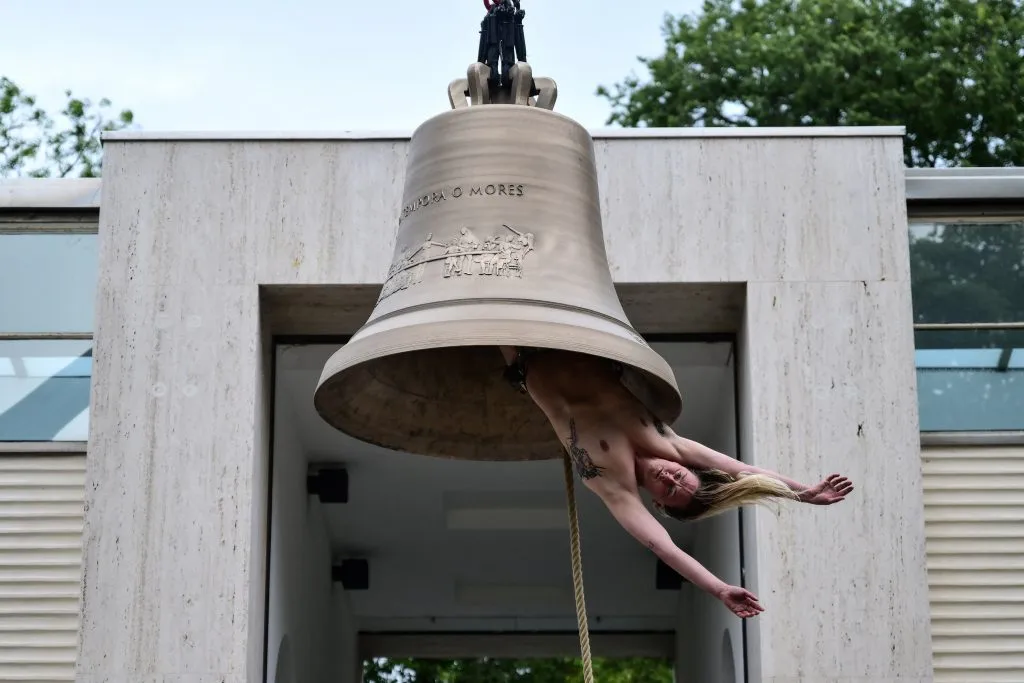
The artist, filmmaker and performer Ayrson Heráclito (Macaúbas, 1968) arrives in the Lagoon with a series of works and interventions that culminate in the performance Feed the Head (part of the Bori series 2008–22), evoking the full significance and spiritual essence of the Yoruba tradition.
As the artist confided in a 2024 interview with Laura Burocco:
I stopped painting for political reasons. […] As a professor, I have always preferred, rather than teaching methodologies, to introduce students to in-depth and, above all, anti-colonial knowledge. As an artist and as a curator, all these aspects converge, since I understand art from a very broad perspective, outside the standards established by the Western school of thought. These functions are connected as an indivisible whole, as has always been conceived by the cultures of pre-colonial indigenous peoples and African peoples who arrived in the Americas as enslaved people. […] I have always been a painterly artist, far more than a linear one. I have always sought to reach the different senses of the observer so that the reception would be broader, synaesthetic, engaging for more than one sense.
In Feed the Head, the officiating Heráclito nourishes the heads of twelve participants with a profusion of foodstuffs — raw and cooked — paying full tribute to the sacred figures (orishas) who mediate thought and speech with the supreme, abstract and ungraspable deity known as Olodumare. In the enchantment of the ceremony, the synaesthetic evocation of matter, food and colour renders graceful homage to the chromatic palette in tribute to the artists who shaped the history of artistic practice in the West as well. Building bridges through the sole possibility of listening and respect, Ayrson Heráclito contemplates the multiplicity of thresholds that together constitute what we define as art — no differently from life itself.
What I argue is that we must acknowledge that there are different artistic systems and different ways of understanding art, and that these artistic systems cannot be univocal. There are ways of making art that follow a kind of regime of visibility different from the Western one. There are things that can be shown, things that cannot be shown, things that can be evoked and things that cannot be evoked. I believe that this is where the great threshold lies: respect. […] I believe that each of my works acts upon a space, upon the observer, as a form of magic, a form of enchantment.
Seyni Awa Camara: souls of the earth
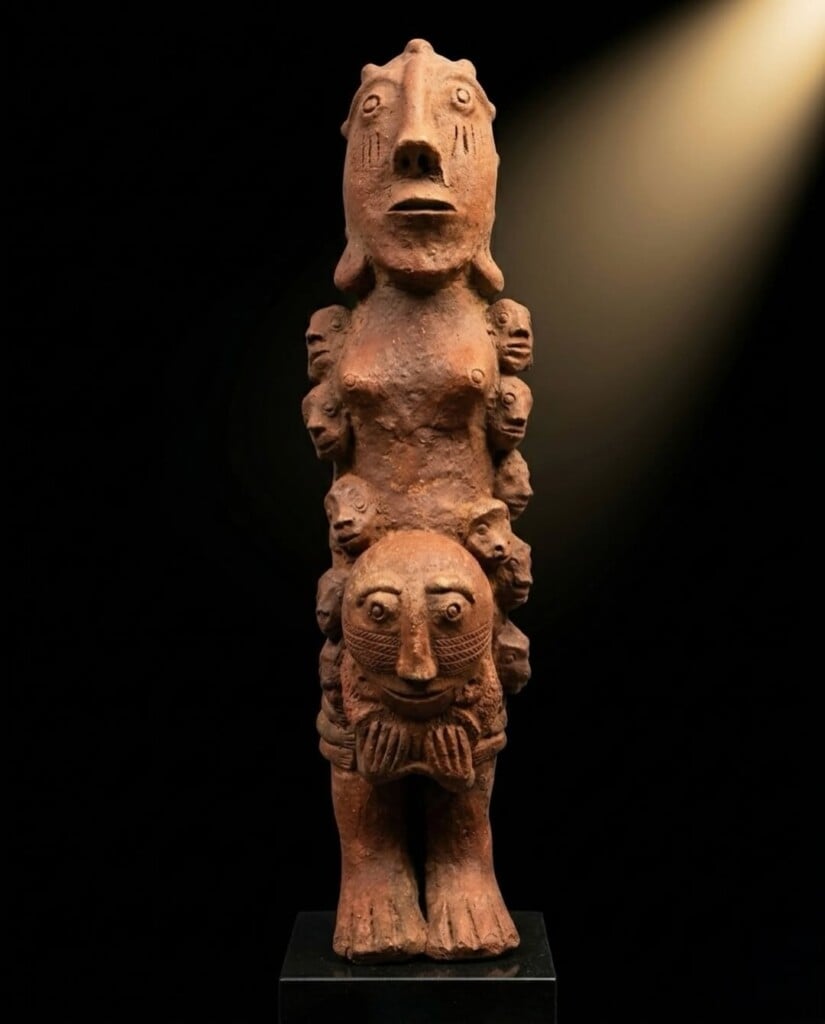
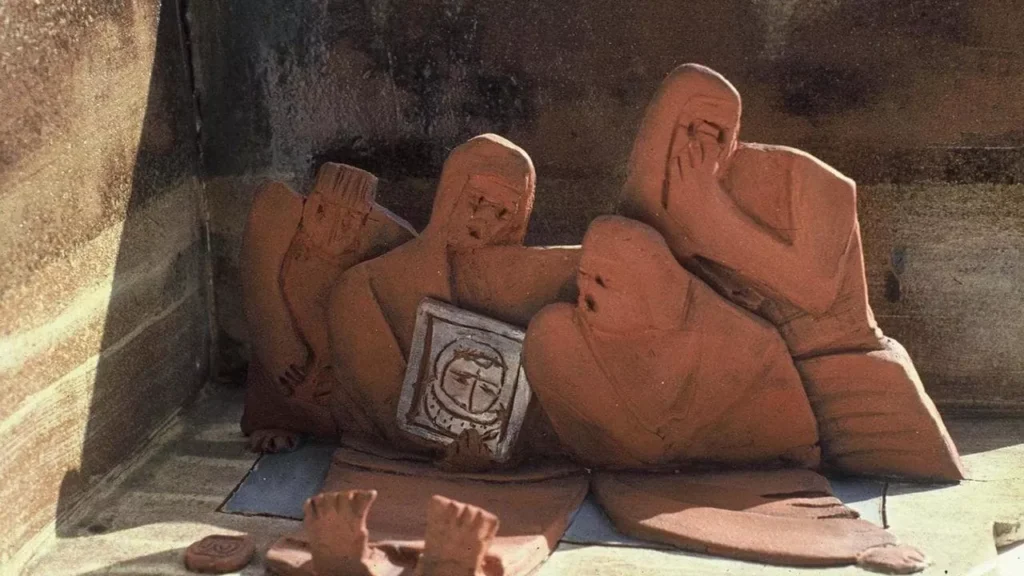
The primordial vision of the immense Seyni Awa Camara (Bignona, Senegal, 1945–2026) arrives at the Central Pavilion of the Biennale just months after the return to the earth of an artist who, in the name of the most heartfelt and pure art, chose never to leave her community or the rich forests of Casamance, from which everything springs. Her totemic sculptures — figures of mothers, layered bodies, mouths that are born and cling to the body that nourishes them — reach the Lagoon as living presences, born from the kneading of earth and the firing in the sacred forest. Among the most beautiful pages that over time, at least in Italy, have managed to capture Seyni’s presence are those traced by the pen and memory of photographer Paola Mattioli:
[…] I knew little about her — and she nothing about me […] completely indifferent to fame — she has never even been to Dakar — she has never changed her daily life: “She kneads the earth, gives it a shape and lets it dry; then she takes a wheelbarrow and, with her son or husband, goes into the sacred forest where she digs a hole, fills it with bundles of wood, lays the sculptures in, covers them with more bundles and then, like a madwoman, like one possessed, sets fire to it, walks around it, moves the wood, throws herself into the flames. When it is all over she grows calm, takes out the sculptures, cleans them and carries them away. Her every gesture is that of a priestess.” Her knowledge comes from Diola culture, a deep root of which she is an expression, a shamanic mystery passed down to her by her grandfather, which she continues to embody as a mother of a thousand children who nourishes the entire village. (Mattioli; 2023)
When Seyni led Mattioli into the earthen and corrugated iron barn that housed her creatures, what struck the photographer’s eyes was an abundance of the feminine and the maternal — mouths that are born and cling to the body that nourishes them, almost Great Mothers, trees of life surrounded by foetuses, human and animal, in homage to the archaic, primordial feminine and its generative power.
In a mysterious bond that ties the most powerful figurative creativity to the anarchic endlessness of a forest understood in its freely meandering possibility, the self-determination at the heart of Camara’s work aligns with the luminous ode of the thirsting Bacchae in Euripides’ tragedy. Celebrating the force of a matter that cannot be separated from the earth that produced it — except by constantly remembering its soul — the eternal presences of Seyni Awa Camara arrive in the Lagoon to the vivifying intonation of a different and visceral belonging.
Vera Tamari: clay for the homes you carry inside
“The anguish of Palestine” — noted Tano D’Amico in Sotto le mura di Gerusalemme (2023) — “is the unpresentable scar that joins the two centuries. A scar that cuts through us, that calls us to account, that stirs the same thirst for justice we felt as children. […] Palestine today has no more images to defend it because in every domain the image without life, without abstraction, without music, without voice has prevailed. The dead image; the image-as-thing. That can be used at will, reassembled however one pleases.” His pained and engaged analysis, and those photographs that restored a palpable existence and incomparable beauty to the Palestinian people, resonate emotionally with the breath of resistance gently evoked in the work of artist Vera Tamari (Jerusalem, 1944). Between destruction and dispossession, the artist’s steps trace the paths of a memory mixed with blood and an infinite, collective longing.
As she confided in a recent interview with Germano D’Acquisto:
Art is never neutral. If it is authentic, it always takes a position, even without declaring it. […] I created an installation starting from the image of a woman in Jerusalem, standing at the foot of the steps of her home, now occupied. From there I began to think of the dwelling as something fragile, something that can be taken away. Another time, with my sister, we tried to draw the house of our grandparents in Jaffa, which we barely remembered. As we reconstructed it, it became real again. When we finished, we wept. That is when I understood that home is not only where you live. It is something you carry inside, and that, in some way, you can always rebuild.
The monumental sculptures Tale of a Tree and Mantra, with their remarkable clay reliefs at the Giardini, endlessly intone the presence and traces of hearts torn from their land of origin, from the primordial idea of home and lived experience. The kneaded earth, rendered as a clay puzzle assembled and disassembled time and again into new configurations, carries with it the full weight of a collection of wounds that never cease to bleed. The creative approach and modus operandi embody the precariousness of thousands of lives consumed by an uncertainty that alone suffices to evoke the dark image of a torture without end.
I remember when we returned to Jaffa after 1967: seeing my family walk through those places was devastating. I understood what had been broken. That is why loss, belonging and resistance are not concepts. They are experiences.
In a mediatised, informatised world — where indignation and protest tend to be directed less at the violent and endless civilian deaths than at the outrage over a desecrated symbol (one need only consider the widespread public outcry following the destruction and desecration of statues of Christ and the Virgin by certain IDF soldiers) — the thought that Vera Tamari directs toward the olive tree of Palestine is the finest figurative rebuke to the self-righteousness and hypocrisy of an unbearable time:
The olive tree is a living presence more than a symbol. I never separate it from the human being.
Matías Duville: on a terrain of white salt
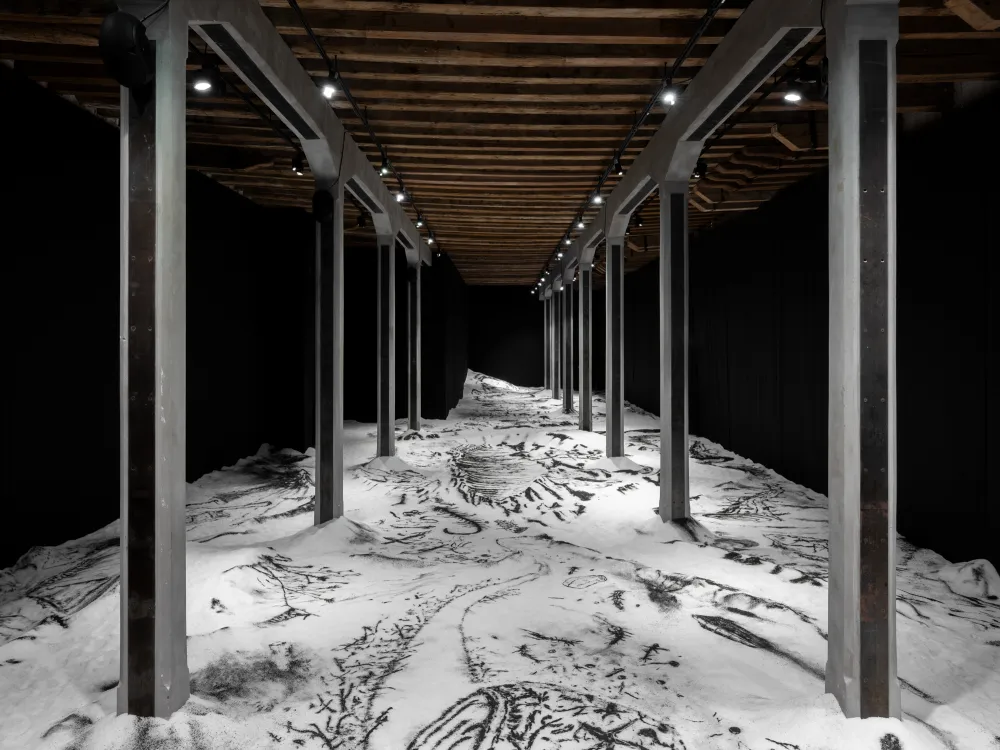
A trail of salt, subject to a filing of charcoal intent on restoring living and mutable traces, takes possession of the floor of the Argentina Pavilion fifty years after the seizure of power by the military junta led by General Jorge Rafael Videla. The arrival in the Lagoon of Matías Duville (Buenos Aires, 1974) — partly, and despite himself, anticipated by the controversies that followed the cuts imposed by the current Argentine government on cultural funding — shines with the most remarkable and significant choice on the part of the artist: to invite participation from the body of presences and footsteps that will traverse that space throughout the duration of the Biennale.
With Monitor Yin Yang, Duville traces a path through the centuries-old history of salt mounds — one that speaks sociologically of men, myths of greatness and colonial violence. From the wounded and suffering backs of enslaved people brought from Africa, to the taste of saltwater that defines the ocean (which for a period became the site of the death flights and the scattered bodies of the desaparecidos), the subversive choice to channel powerful charcoal marks configures the essence of an alternative and new landscape.
Devoted to drawing and keenly aware of the essential weight of a contour that marks the world — our world — Duville has conceived a canvas space that, in a participatory and sensory form, opens onto the necessity of a traversal left free to experiment and pass through. As one explores the field, what emerges is a sonic landscape that, alongside the white of the salt and the grey scale derived from the displacement and flow of marks, constantly accompanies the creation of luminously precarious imaginary landscapes — and for that reason always new, generous, open and unexpected.
Alfredo Jaar: monument to the end of the world
“In the colonial and neocolonial alchemy” — Eduardo Galeano observed sardonically — “gold is transformed into scrap metal and food into poison.” The history of the underdevelopment of the so-called Third World is also the history of a continuous violence and theft that has criminally allowed other lands and territories to prosper, as if nothing were amiss, on mountains of corpses and women and men reduced to starvation. In the wake of the nightmare, with the taste of a red sea, a tiny monument evoking the arrogance of capital has descended to inhabit a corridor stretching twenty-one metres through the Arsenale.
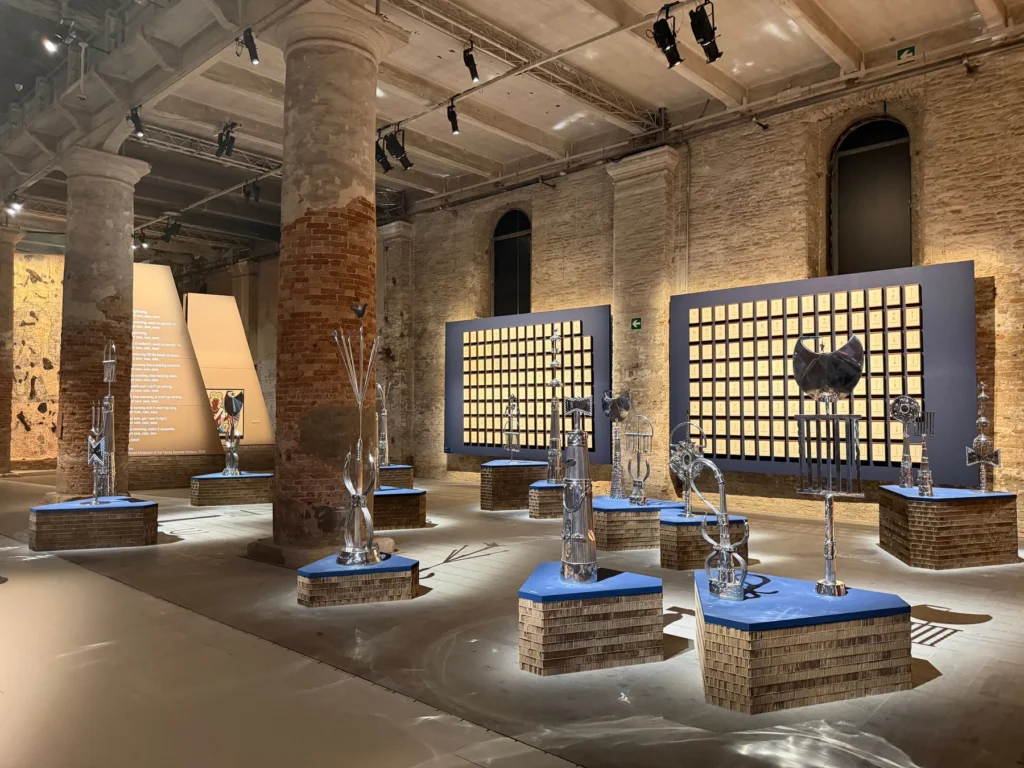
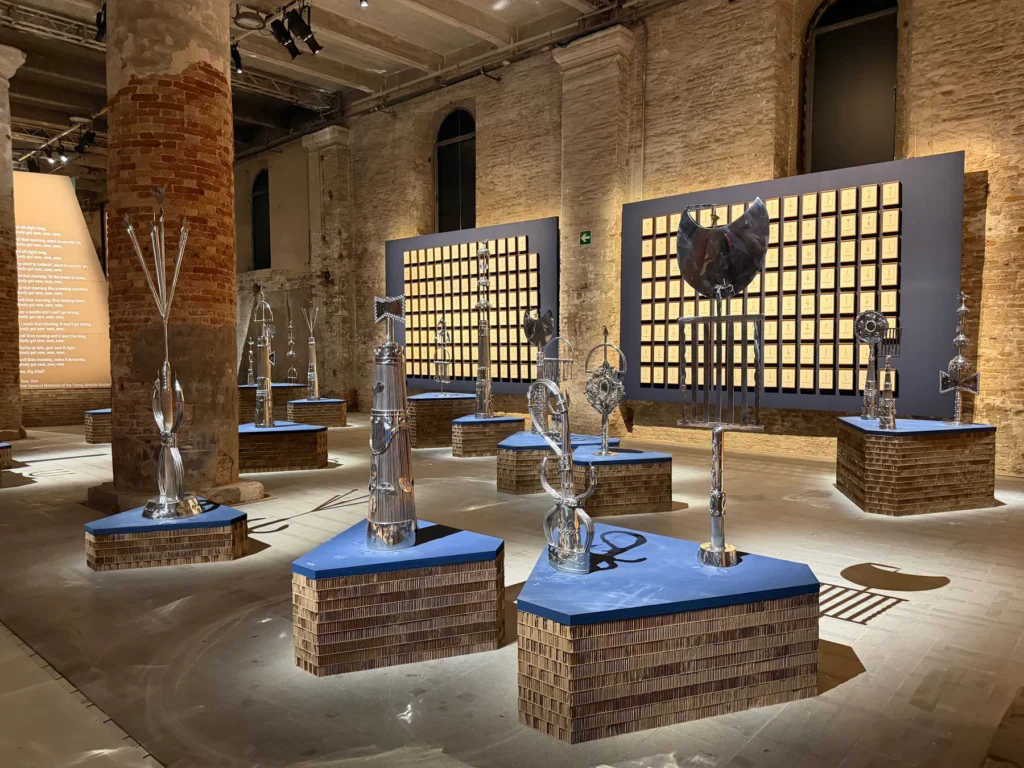
The End of the World (2023–24) by Alfredo Jaar (Santiago, Chile, 1956), housed within a vitrine enclosing the elegant form of a cube barely ten centimetres across, marshals the most refined and urgent denunciation against a world-system — art included — that cradles itself and finds self-satisfied comfort in its ten lacquered layers of wealth, indifference and endless exploitation. The vivid red, projected along the entire dystopian corridor, leads the visitor toward a final altar where a carefully composed text on the wall activates as a mantra, listing those commodities — cobalt, copper, tin and lithium — which, beyond the jingling of money and the beauty of an illusorily gleaming surface, drive the most harmful and lethal practices of this poor and indifferent corner of the universe.
An incisive, disorienting, unsettling monument to the end of the world.