Desert X 2025 officially opened on March 8th (and will run until May 11th), the artistic festival in the Coachella Valley that every year brings a series of site-specific installations to the California desert landscape, which will never be decommissioned. This year’s exhibition, directed by Neville Wakefield and co-curated by Kaitlin Garcia-Maestas, reflects on the deep-time evolutions of the desert, reframing ideas of wilderness and exploring themes such as indigenous futurism, design activism, the imprint of humanity on the land, and the role of emerging technologies in our contemporary society. This weekend, the collection of artworks expanded, welcoming nine new installations. Let’s discover what they are.
Agnes Denes – The Living Pyramid
The Living Pyramid is a monumental sculpture and environmental intervention created by artist and activist Agnes Denes. The work unites Denes’ public landworks with her ongoing exploration of the pyramid, a form central to her career spanning over fifty years.
The pyramid represents both a symbol of hierarchy and an evolving organism, constantly changing due to the native vegetation planted inside it. Over six months, the plants will grow, bloom, and some will die, illustrating the natural desert cycle and continuous change.
Thus, the work becomes a social and educational experience, promoting environmental awareness and conservation. Through its programs, The Living Pyramid transforms into a microsociety responsible for its construction, planting, and ongoing care.


Muhannad Shono – What Remains
Muhannad Shono explores themes of identity, memory, and cultural heritage through large-scale installations, transforming common materials into complex works. Inspired by his experience in the Arabian Peninsula, he combines traditional and modern techniques to address the concept of transformation and instability.
In his work What Remains, the wind becomes part of the installation, moving strips of fabric impregnated with sand to represent a constantly evolving landscape. The work reflects a mutable land, symbolizing a home and a narrative that cannot be fixed.


Alison Saar – Soul Service Station
Alison Saar weaves personal and cultural narratives, drawing from spiritual traditions, myths, and stories from the African diaspora. The concept of recovery is central to her work, both as an artistic practice and as a metaphor: she transforms waste materials into works laden with memory and meaning, with a particular focus on Black feminine identity.
Soul Service Station reinterprets a 1986 installation inspired by American gas stations. Here, however, the energy offered is spiritual: a place of healing, hope, and reflection. Inside, a carved female figure acts as a guardian, surrounded by votive objects and medallions created with local students. A repurposed gas pump reproduces poems by Harryette Mullen, enriching the experience. The work presents itself as a refuge for travelers, an oasis of strength, memory, and renewal.


Sanford Biggers – Unsui (Mirror)
Sanford Biggers is a multidisciplinary artist who intertwines history and cultural symbols to redefine established narratives. His practice, influenced by street art in Los Angeles and his experience in Japan, merges tradition and innovation.
For Unsui (Mirror), Biggers presents two towering cloud sculptures covered in sequins, over 30 feet tall, shimmering in the desert light. Inspired by the Buddhist concept of unsui (“clouds and water” in Japanese), they represent freedom, change, and interconnectedness.
Located at the James O. Jessie Desert Highland Unity Center in Palm Springs, the work reflects on memory and identity, situating itself within the context of a historically segregated Black community still engaged in reparations efforts.


Ronald Rael – Adobe Oasis
Ronald Rael, architect, artist, and activist, recovers and reinvents ancient craftsmanship techniques in wood, stone, earth, and textiles, integrating them with modern technologies for sustainable solutions. Rooted in the indigenous construction tradition of the San Luis Valley, his work explores over 10,000 years of earthen architecture as an ecological alternative to contemporary building practices.
Adobe Oasis embodies this vision, using 3D printing and robotics to create structures entirely from mud, inspired by the palms of the Coachella Valley. The design creates passageways that frame the landscape, offering a space for connection and reflection. This solar-powered project is both a work of art and a research on sustainable housing, with each structure perfecting the previous one.


Sarah Meyohas – Truth Arrives in Slanted Beams
Sarah Meyohas combines analog and digital technologies to explore the systems that shape contemporary society, investigating the aesthetic potential of science and technology. Her immersive installation uses light to create luminous patterns generated by refraction or reflection on curved surfaces.
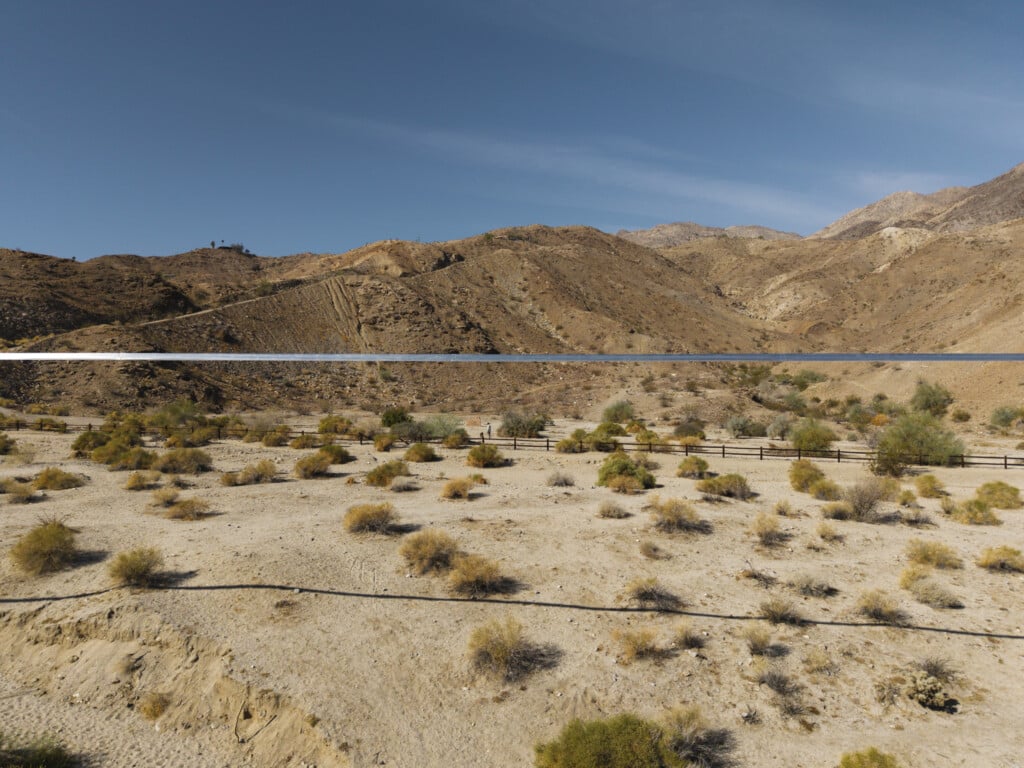
In this work, Meyohas transforms a natural phenomenon into an interactive artwork, allowing visitors to project sunlight onto a ribbon-like structure that extends across the desert. The mirrored panels, designed with algorithms to manipulate light, form the poetic phrase “truth arrives in slanted beams.”
The installation recalls ancient time-measuring instruments and 20th-century land art. Following the sun’s path, visitors can adjust the reflections, discovering optical illusions that evoke water in the arid landscape.


Raphael Hefti – Five things you can’t wear on TV
Growing up in the Swiss Alps, Raphael Hefti, fascinated by the horizontality of the desert, in Five Things You Can’t Wear on TV explores perception and immateriality through science, repurposing industrial technologies and materials for unexpected effects.
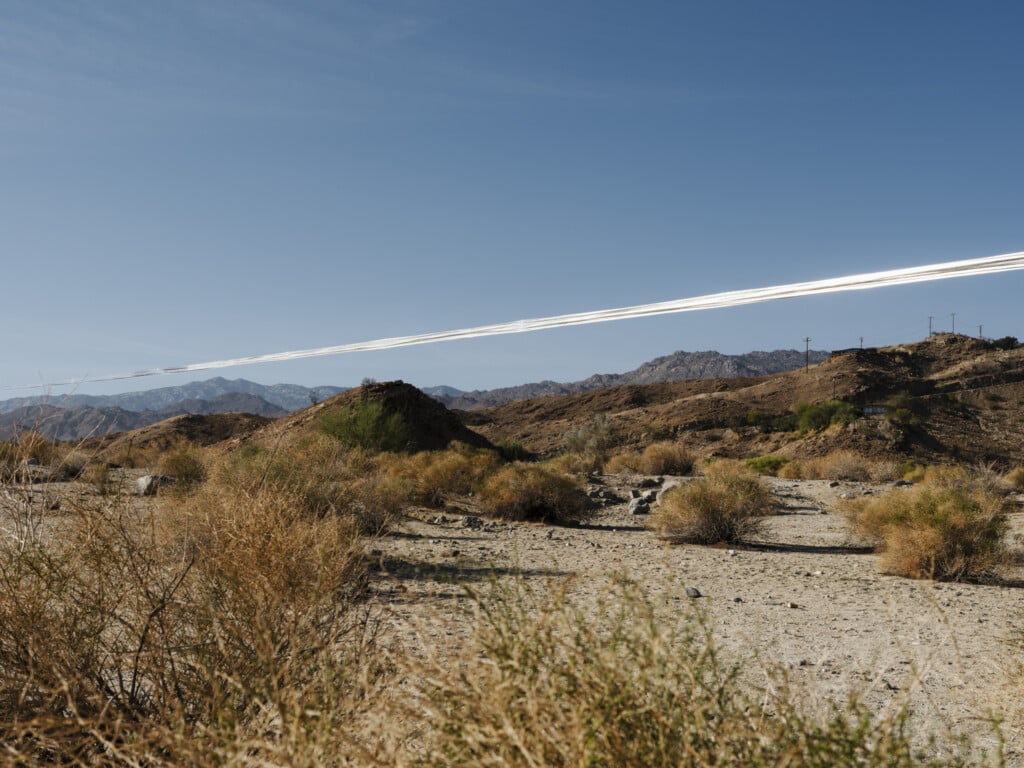
The work uses a woven polymer fiber, typically used for fire hoses, with one reflective side. Tension holds the material overhead between two distant points, forming a single horizontal line that oscillates with the wind, resembling the vibration of a guitar string. This movement alters spatial perception, creating an optical effect reminiscent of the shimmering desert horizon under the heat.

Cannupa Hanska Luger – G.H.O.S.T. Ride / (Generative Habitation Operating System Technology)
Cannupa Hanska Luger blends visual storytelling and Indigenous perspective to redefine the concept of collective humanity. Born on the Standing Rock Reservation, his work mixes traditional and contemporary materials to explore connections between ancestral knowledge and modern material culture.
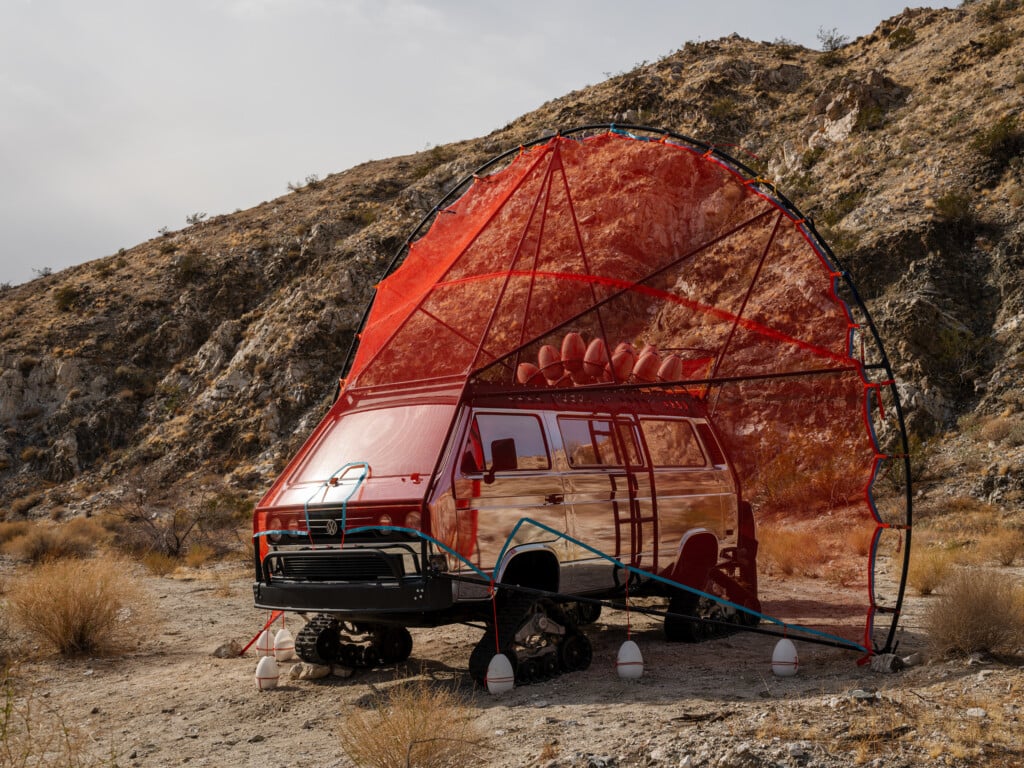
G.H.O.S.T. Ride expands his Future Ancestral Technologies series, imagining sustainable futures based on land and water. For Desert X 2025, Luger transforms his iconic Repurposed Archaic Technology vehicle (RAT Rod) into a nomadic installation that traverses the Coachella Valley for nine weeks. The vehicle, camouflaged in reflective vinyl, blends into the landscape and incorporates industrial detritus, ceramics, and a tipi, alongside experimental systems for collecting water and light.
Visitors may encounter its occupants, a family from an undefined future, offering alternative survival visions. The work invites a rethinking of the relationship between humans and nature, learning from the desert and its deep-time resilience.


Jose Dávila – The act of being together
Jose Dávila explores material density, gravity, and time through sculptures that balance opposing forces. For Desert X 2025, he created a work using raw marble blocks extracted from a quarry across the U.S.-Mexico border, creating a dialogue between absence and presence.
Inspired by Robert Smithson’s site/nonsite dialectic, Dávila connects the stone’s origin with the new context of the Coachella Valley. In their journey, the blocks cross both physical and symbolic borders, evoking the passage between the visible and the unseen, past and future.
Arranged like ruins in progress, these forms suggest a continuous cycle of transformation. The installation invites visitors to reflect on their existence within the vastness of space and time.