Every November, Black Friday turns consumption into a race of discounts, countdowns and seemingly unrepeatable deals. But what happens when a brand decides to step away from this logic? In recent years, some companies have chosen to distance themselves from promotions, temporarily closing their e-commerce sites, encouraging people to repair what they already own, or supporting social and environmental initiatives. Different strategies, united by the desire to challenge a model that pushes us to buy more and more.
Saying no to Black Friday, in these cases, also means questioning the value of objects, their durability and the responsibility of those who make them. It is not only about giving up a discount, but about imagining a different relationship with consumption. It is not necessarily about giving up commerce or questioning the value of one’s own products, but about trying to change the meaning of a day built around consumption. Some close their e-commerce sites, some turn their stores into places dedicated to solidarity, and some invite people to repair, swap or simply make better use of what they already own. Different initiatives, united by the desire to interrupt, at least for a moment, the mechanism of buying at all costs.

The Ordinary: a day dedicated to blood donation instead of discounts
Among the most unusual initiatives is that of The Ordinary, the skincare brand belonging to the DECIEM group, which over the years has built a rather clear stance on Black Friday. Its history of opposition to the day dates back to 2019, when it decided to temporarily close its online store, inviting people to buy less and to choose more consciously.
For 2026, however, the brand has decided to shift its focus even further. On November 27, the websites of The Ordinary and of the other DECIEM brands, together with the single-brand stores, will remain closed. Some physical spaces will instead be transformed into places dedicated to blood donation: in New York and Toronto, actual donation drives will be organized, while in the London and Copenhagen stores people will be able to find out their blood type and receive useful information on taking part in future donations. It is an interesting change of perspective: on the day when the market invites us to fill our carts, The Ordinary proposes devoting time to something that cannot be bought. The gesture takes on a particular meaning for a brand that operates in the beauty sector, a field in which the desire for self-improvement is often fueled by the continuous introduction of new products.

Oway: add nothing to the cart
Oway, the Italian professional haircare brand, has also chosen not to take part in Black Friday. With the campaign Nothing to Add. Nothing to Cart., it has announced that on November 27, 2026 its stores will close and online sales will be suspended for the entire day.
The decision, carried forward for six years, is this year accompanied by a broader reflection on our relationship with objects and on our buying habits. The project invites us to look again at what we already have before searching for something new. A half-used product, a forgotten bottle in the bathroom, an object that still performs its function perfectly: these small everyday situations are the starting point of the campaign.
The message also focuses on the way purchasing occasions are constructed. Countdowns, timed offers and limited promotions often turn a decision into a race against the clock, leaving little room to understand whether something is really needed. For one day, Oway therefore chooses to remove its website from its commercial function, replacing the online store with a manifesto dedicated to the value of conscious choices. Value doesn’t expire at midnight is the principle behind the initiative. A simple statement, but one that overturns one of the most effective mechanisms of Black Friday: making us believe that the value of a purchase depends on being able to get it before a certain deadline.
Patagonia: repair, reuse, give a second life
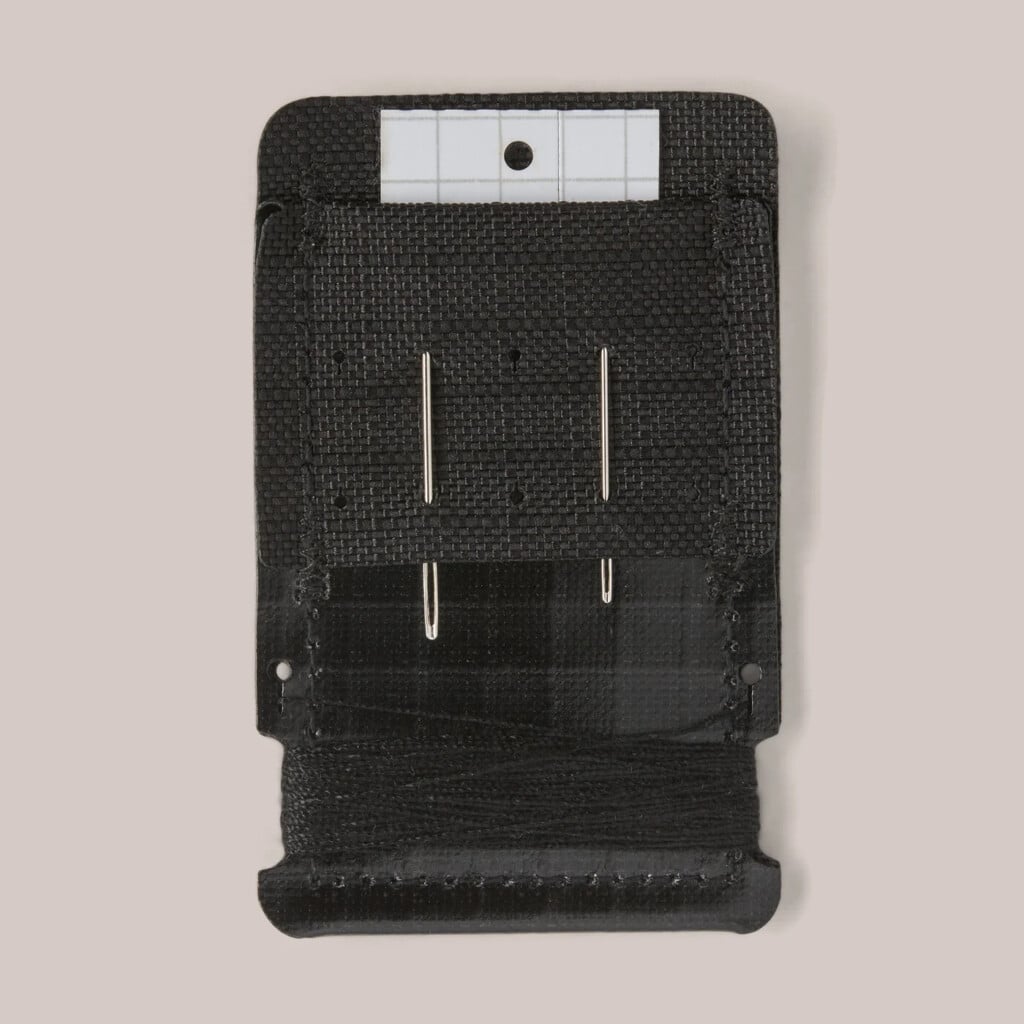
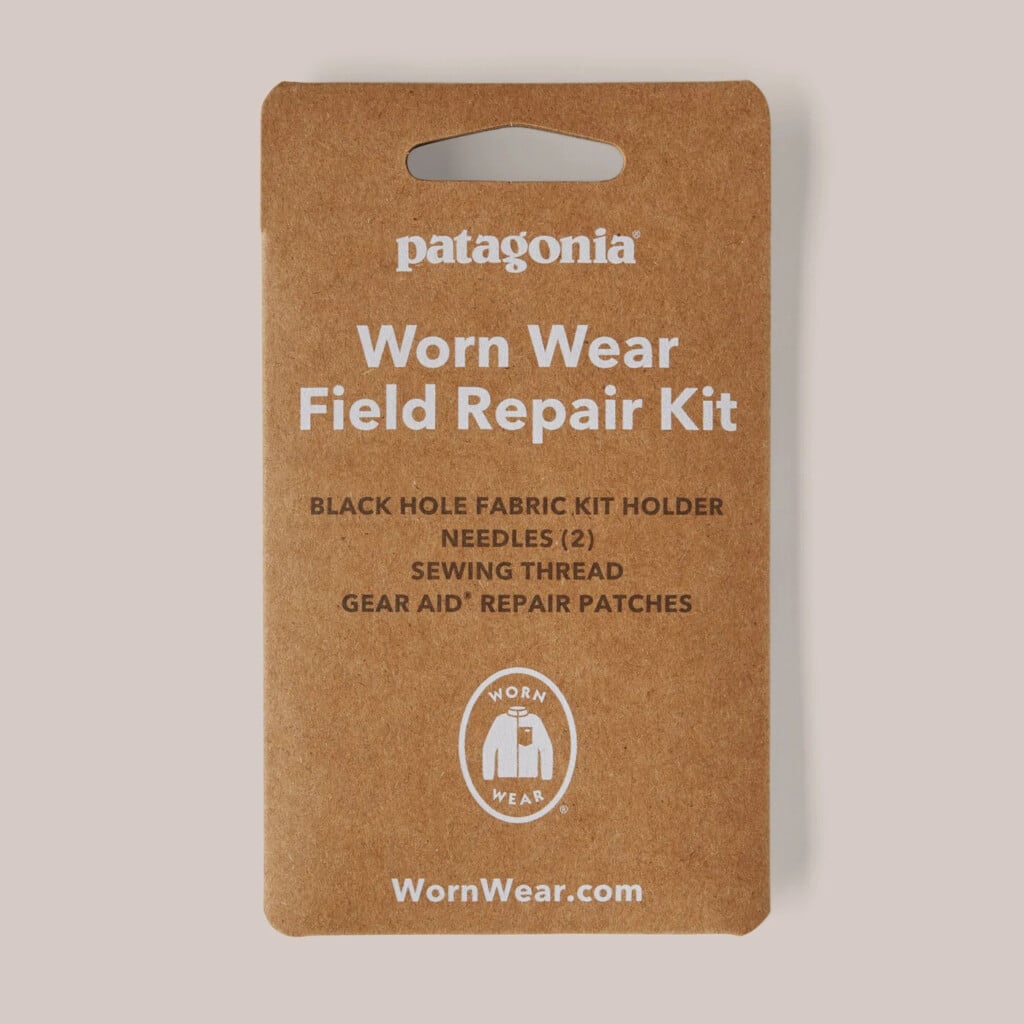
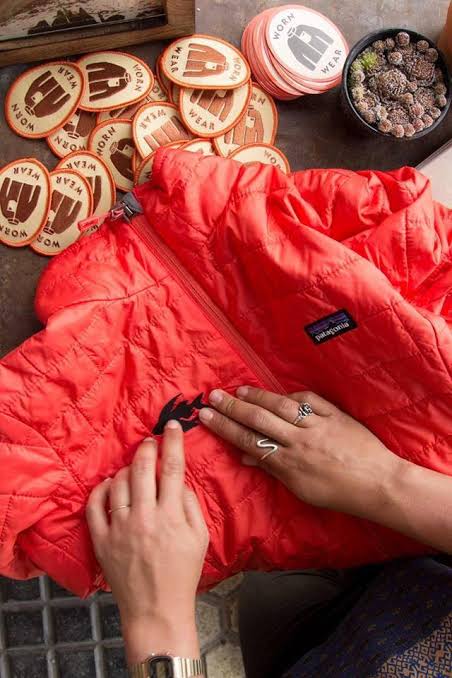
For Patagonia, the reflection on consumption is not limited to the Black Friday period. For years the brand has pursued a philosophy that puts product durability, repair and reuse at the center, through initiatives such as Worn Wear. In 2026, this vision also takes shape during the discount weekend with the campaign Down for a Better Way.
From November 27 to 29, the Worn Wear program will arrive in some European stores, including the one in Milan, with an offering dedicated to used garments and their maintenance. In the Lombard capital, on November 27 and 28 it will be possible to bring clean technical clothing of any brand to the store to receive free repairs, with some exclusions. Over the weekend, a selection of refurbished Patagonia garments will also be available, ready to be purchased and worn again. It is a concrete way of shifting attention from buying something new to the possibility of extending the life of what already exists. In a sector like outdoor apparel, where durability and performance are fundamental, repair also becomes a matter of consistency: a product designed to accompany us for a long time should be able to be maintained, mended and put back into circulation. Black Friday thus becomes an opportunity to talk not about how much we can buy, but about how much we can avoid replacing.

PINKO: the value of a product beyond its price
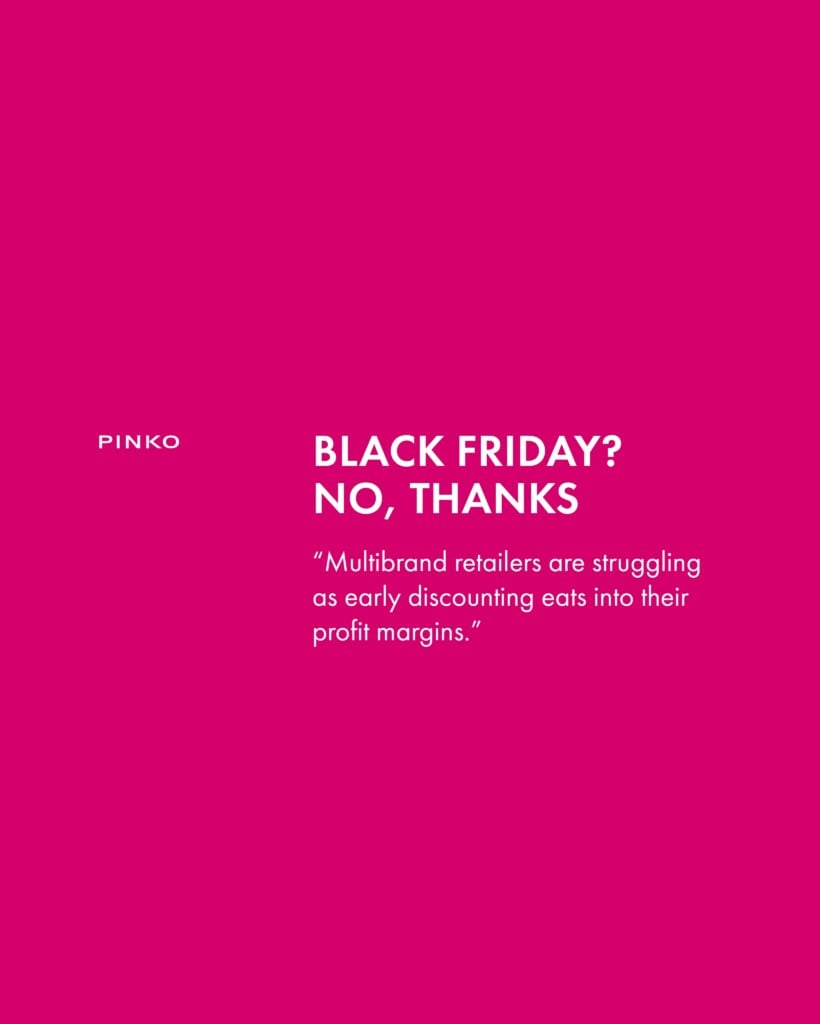
PINKO has also decided not to take part in Black Friday 2026, forgoing discounts on its collections in Italy and in other European and Middle Eastern markets. The choice is accompanied by the manifesto Black Friday? No, thanks, which invites reflection on the consequences of continuous promotions on the perceived value of products.
The point is not only to avoid a markdown, but to question what happens when price becomes the main criterion by which we judge a garment. If a product is continually presented as a bargain to be bought at a lower cost, its value risks being associated more with the convenience of the moment than with the quality, the work and the research that went into making it. PINKO’s decision also concerns the relationship with those who buy and with the network of professionals who contribute to the production and distribution of the collections. During the Black Friday weekend, the brand will also offer in its boutiques PINKO Christmas Dream, a path dedicated to discovering the collections. A choice that tries to replace the pressure of the discount with a different experience, bringing attention back to the product and to the relationship we build over time with what we wear.
REI: Black Friday spent outdoors
Then there is REI, the American cooperative specializing in outdoor gear and clothing, which since 2015 has run Opt Outside, an initiative created to invite people to spend Black Friday outdoors rather than in shopping malls. A choice that in 2022 became a permanent commitment: every year, on the day of the discounts, the company closes its stores and gives its employees a paid day off.
On November 27, 2026, too, REI will keep all of its stores, distribution centers, call centers and headquarters closed, leaving its employees free to dedicate themselves to personal activities. The website, however, will remain accessible for online orders, which will be processed starting the following day. The initiative does not merely offer an alternative at the moment of purchase: it tries to change the very meaning of the day. For a brand that works in the outdoor world, inviting people to go out, walk, hike or simply spend time in the open air means bringing attention back to the experience its products are meant to accompany. You don’t need to buy anything to experience the world outside.


When stopping becomes a choice
These initiatives are not interchangeable, and they do not all have the same impact. Some give up discounts, some temporarily halt sales, and some use Black Friday to promote repair or solidarity activities. But precisely in their differences a common point emerges: the possibility of not considering purchase as the only answer to every desire. Of course, a campaign is not enough to make a business model sustainable, and a day without sales does not erase the contradictions of the production system. It is therefore important to look beyond the message and ask whether the words are matched by consistent practices over time. Nevertheless, initiatives like these open up an interesting space for reflection: they remind us that the value of a product does not necessarily coincide with its discounted price and that, sometimes, the most conscious choice can be to add nothing to the cart.
Perhaps, then, the question to ask is not only what is worth buying during Black Friday, but also what we could do with the time and resources we save by choosing not to. And what if, instead of spending the day looking for something to buy, we simply returned to living what surrounds us, rediscovering the pleasure of being outdoors and the value of nature?