For the fourth episode of IN STUDIO, we visited product designer Astrid Luglio. Co-founder of The Ladies’ Room collective along with Ilaria Bianchi, Agustina Bottoni and Sara Ricciardi, Astrid specializes in a specific branch of design, that related to culinary culture. Coming from a family of restaurateurs and following a year-long trip to Australia, Astrid comes increasingly into contact with the restaurant industry and in particular with ingredients in the world of gastronomy, which inspire her in the creation of objects aimed at their enhancement. We visited her at her studio in Milan to find out more about her journey, research and methodology.

Who is Astrid Luglio?
Class of ’88, Astrid Luglio was born in Naples and then moved to Milan to study Product Design at the New Academy of Fine Arts (NABA). The dimension of travel was an integral part of her education, particularly the one in Australia that led her to interface with the world of catering. Back in Italy, after living for three months in Vietnam, Astrid began collaborating with TourDeFork in Milan, a design studio inspired by food and culinary culture. In 2018, she opened her own independent studio and began teaching Design of Small Objects to international students in NABA’s three-year program. With the collective The Ladies’ Room she starts a reflection on contemporary design to investigate the need for sensory involvement. Precisely on sensoriality, Astrid Luglio develops her research related to culinary culture. Starting from the study and in-depth knowledge of a precise ingredient, she designs a series of objects that can enhance the properties of the product and, in a broader sense, be able to generate a perceptual experience.

The studio
We are located at the end of Via Padova, on the Martesana. A neighborhood a bit far from the center that undoubtedly leaves room for concentration. Astrid Luglio’s studio is actually a hybrid, here she works with her collaborators and lives with her partner Sirio Vanelli, Director of Photography, and their little daughter Lea, Blu. The complex that houses the home-studio is itself very curious. It is the former Gio’Style factory renovated by architect Gianluigi Mutti. The identity of the place has been maintained, from the large industrial windows to the small details, such as the doorbells that are real buttons. As soon as we enter the apartment, we are surprised by the brightness and breath of the spaces. Background music and plants scattered here and there welcome us into a relaxed and serene environment, which projects us into the designer’s micro ecosystem.

How long have you been in this study? How do you conceive of it?
We have only been here a short time, a year and a half. We are still figuring out how to organize ourselves; it is all in the making. With Sirio, we looked specifically for a space that could be home-studio. I used to work in a co-working space at Fabbrica del Vapore, but I felt I needed more space, both to photograph and in general to expand. So we looked for a space that could be versatile. For example, I specifically designed tables with wheels to make the space adaptable to our needs. It is a convivial environment, always evolving, and that is exactly the characteristic that for me the studio must have.
How was the transition from outside studio to home-studio?
At first it was a bit difficult because I am a bit jealous of my space-time. As life has evolved, however, I have found it a super advantage because first of all I have the ability to manage space as I want. Then the fact that we also experience it in a very familiar way is something I really like. I like the idea of creating an environment where those who work with me feel at home. With the fact that we have a daughter this aspect becomes crucial. Being a freelance mother in a society that does not put us in a position to make the work aspect and the family aspect coexist is not easy, so we have created for ourselves a dimension where it becomes manageable instead. I recreate that micro society that you would want in macro, with its own rules.

In concrete terms, how do you experience the practice? Do you enjoy having visitors?
We have divided the work area so that there is always a super flexible space in the central part. When we have to shoot, we use the tables for still life, while in other situations they become a place for dinners with friends, designers and creative people in general. The setup is also hybrid because of this, those who come, come to eat in a studio house that is also a productive and working environment. Those who come by maybe also enjoy working here, that’s the idea. The door is always open.
Does this home dimension make you feel alienated in this space?
This is a bubble, I completely lose my conception of time and space here. Maybe it’s the architectural context that invites isolation. The Martesana dimension is a bit apart from the rest of Milan. For me this whole area is a bit of a bubble in which I sometimes lose myself. I lose the dimension of time and space but the beautiful thing is that, in little, if I want to reconnect with the world I can do so. This is new for me because before we were in Sarpi, in the Chinatown neighborhood, in the middle of the mess. Undoubtedly a more lively neighborhood, however this for me is a temple of concentration within which I work very well. Then actually the distractions catch up with us.

Speaking more about yourself instead, what was the project that marked a turning point in your career?
There are two actually. The first is the initial one that made me realize that I could have a vision on this niche and that it could work. It is the Camere Olfattive project, an olfactory tasting glass that I designed for the Consorzio Tutela Aceto Balsamico Tradizionale di Reggio Emilia DOP. It is basically a glass that emphasizes the organoleptic properties of traditional balsamic or any liquid poured into it, such as fragrances, oil, coffee and wine. The significant thing about this project is that it was my first stand-alone. The Consortium had issued a call for proposals for which you had to design experiences around traditional balsamic. The first thing I noticed was that the tasting was happening in wine glasses or in plastic spoons, so with instruments that were not designed for this function and were not suitable to emphasize it. So I proposed this goblet which is actually a borosilicate glass bubble. The interesting thing was that they were particularly impressed with how the smells were able to express themselves. With this experience, I realized how there are a number of ingredients that belong to our culinary culture that lack a set of proper instrumentation, so what better pretext to design right from their study and get to emphasize some of their qualities.

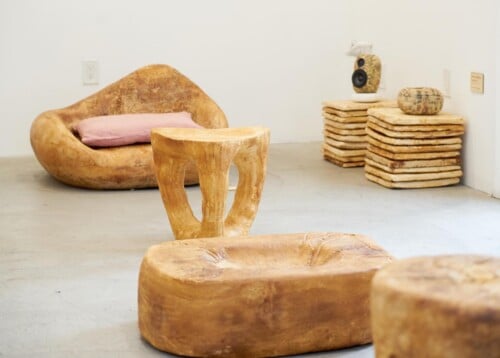
The second project that marks a turning point is one of the last ones I did, in which there was a complete change of scale. I start as a product designer, however, Davide Longoni’s Bakery asked me to tackle a larger scale design, rethinking a space within the bakery. Actually, the creative process is the same because I always start from the research of the ingredient, in this case bread. We started from the back of the warehouse, which they use for baking. Here was an unused space in which Longoni wanted to create a situation of exchange and intimacy around the theme of baking, which we called The Bread Circle. A kitchen where they could invite very few people, have dinners, talks and workshops. The starting point for this project was to figure out how to express the bread mix through materials, while also expressing the Milanese nature of the bakery, Longoni being a reference point on Milan. So we went to investigate a little bit what is the technique of variegated Lombard terracotta, which mixes different clays. With this technique, we made tiles that are the basis of the kitchen design, which was made with Very Simple Kitchen. The aesthetic result sees the mixture of three ingredients that symbolically refer to flour, water and wheat. Among other things, the tiles cut just like slices of bread. It is a block of clay in which all three are mixed and then sliced. This project opened up a whole other world for me, which is space design, something I hadn’t considered until now. It felt like another turning point because there was a shift from product to space, and I realized that if you still start with one ingredient, eventually the design can evolve in other ways.

How does your research phase take place?
If you talk about ingredients, very often you have to go and find these ingredients in their natural habitat or at least where they are born and produced. For example, a project I designed two years ago for the enhancement of extra virgin olive oil required that there be research work starting from the olive mills. Instead of starting here from the desk, we went to the Coast where the Campania olive is grown and processed. There is a part of the work that has a very artisanal output and then there are also projects that are completely industrial, mass products that need a different design. In both cases I always try to keep a common storytelling and poetics, despite the different production processes. In addition to the field part, it is very important for me to have a bibliographic and material reference, each project involves buying a multitude of books on the subject, as well as curious objects related to it.

Going back to the study, what is the tool that cannot be missed here?
The thing that I can call indispensable is the archive of samples, of materials that I have collected over time. I need them so much from time to time to create material moodboards from which inspirations for projects start. Then also my father’s old transistor radio, whose randomness with which she chooses songs I love.
Although the answer seems obvious, we ask you anyway: would you leave this study tomorrow?
Actually I will surprise you, yes. I like to think that this is the space that’s good at this time in my life. One day it may no longer comply with my methodology. I am very open to change from the work environment. In fact, I get bored a lot, which is why the tables have wheels, because everything has to be able to change all the time, including just where I position myself in the space. Too rigid methodology doesn’t belong to me, although I feed on a number of obsessions as far as the research method is concerned, however, then I like to be able to mix them more randomly. I like to think that there is always an evolution.

As a final question we want a little spoiler. What are you currently working on?
I am working for the Italian team of the Bocuse d’Or, a haute cuisine competition held every two years in Lyon. Each team studies and designs a large tray with fourteen courses, which they parade in front of a panel of expert judges. The tray must be very sumptuous and have a close relationship to what the chef is going to cook. Every year there are up-and-coming chefs who present themselves to international audiences for the first time. If they win the Bocuse d’Or, it’s a bit like winning the Compasso d’Oro for us. For this year’s project, we started with research on Florentine mosaic, its origins and its application technique. What happens in this competition is that by participating a little bit from every country in the world, it is important to enhance the country of origin. From time to time, there is specific research on a technique or a world of reference that can recall Italian-ness in a fine way, without being too didactic.


Ph Credits Andrés Juan Suarez