Within IN/FORM, the project transforming the spaces of Sebino into a territory of dialogue between art and industry, the intervention imagined by artist Riccardo Ricca moves along a deeply symbolic dimension, building a narrative that crosses myth, matter, and fire.
Visualizza questo post su Instagram
Starting from the company’s very mission — a leader in the design of fire protection systems — Ricca identifies fire not only as a technical element to control, but as an archetypal, living, almost sacred presence. From this perspective comes the reference to Prometheus, the central figure of the entire project: the one who steals fire from the gods to give it to humanity, transforming a divine element into something knowable, manageable, and human. A gesture that becomes a direct metaphor for Sebino’s work and for the contemporary relationship between technology and nature.
The installation unfolds as a three-part journey within the industrial nave, transforming the warehouse into an experiential and ritualistic space. The first section, The Threshold, introduces visitors to an almost primordial dimension: long sheets treated with bitumen and marked by fire descend from the shelving, while charred floral sculptures emerge from wooden crates like remnants of an ancient combustion. Here, fire still appears as an uncontrollable force, a destructive and mysterious element capable of generating fear.
Visualizza questo post su Instagram
The presence of bitumen, a recurring material in Ricca’s practice, becomes fundamental: a dark, dense surface capable of absorbing light while unexpectedly reflecting it back. The flowers, despite appearing fragile, seem to preserve a latent tension within them, as if the fire continued to exist in the form of material memory.
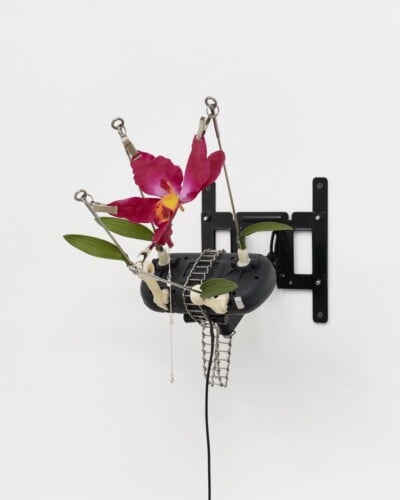
With the second phase, Prometheus, the landscape gradually changes. New organic elements begin to emerge among the shelves: flowers constructed from the company’s sprinklers rise from wooden crates and spread through the space like a spontaneous germination. Technology stops being a mere industrial infrastructure and instead becomes an organism, a living form, a presence capable of growing and multiplying within the productive architecture.

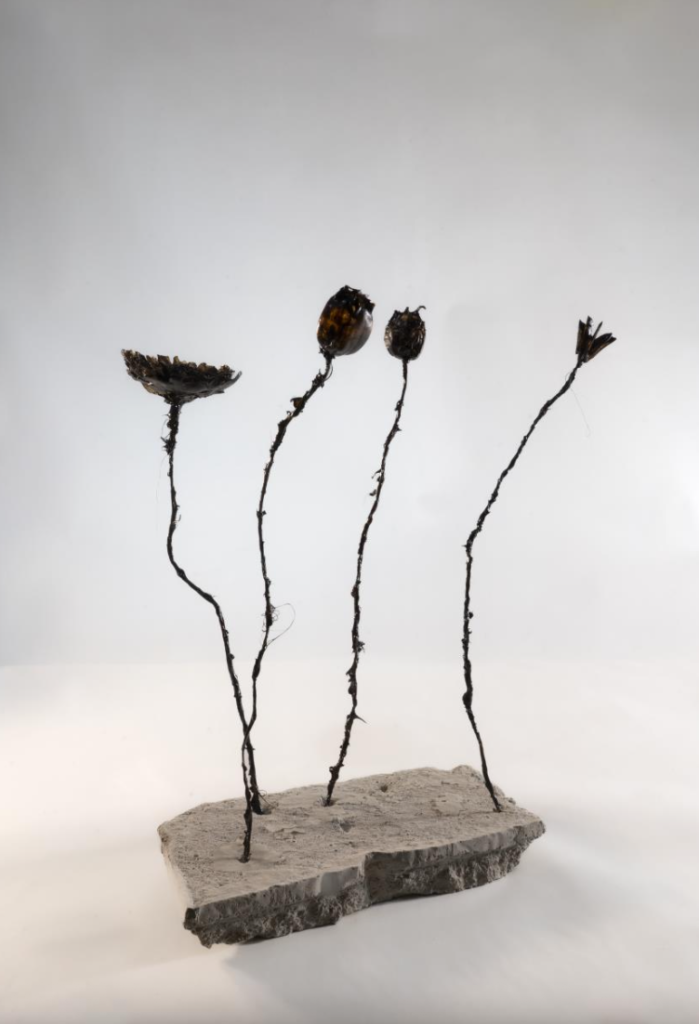
It is precisely here that the project creates one of its most compelling short circuits: sprinklers, symbols of control and safety, are reinterpreted as botanical elements, transforming into metallic and semi-transparent flowers. Nature and artifice stop opposing one another and instead begin to contaminate each other.
The journey culminates with The Staircase, perhaps the most evocative image of the entire installation. At the center of the nave, an industrial staircase — referred to internally by the company as a “cemetery staircase” — becomes the symbolic axis of the work. At its summit, unreachable, a single large white flower made of transparent resin turns into a luminous relic suspended between desire and contemplation.

The tension between high and low, between the accessible and the inaccessible, creates an almost sacred image. The flower — a universal symbol of life — is placed upon a device associated with death, generating a constant shift in meaning. It is a conclusion that perfectly synthesizes the entire project: humanity’s attempt to tame a destructive force without ever fully eliminating its mystery.
Alongside the intervention inside the nave, Ricca also developed Desierto Florido, a large sculptural installation conceived for Sebino’s second location. A triangular concrete structure hosts dozens of flowers made from resin, wire, and bitumen, some directly derived from industrial sprinkler molds. Illuminated by light, these semi-transparent elements appear to contain small living flames within them, transforming the entire composition into a landscape suspended between ruin and rebirth.
More than a simple site-specific intervention, Riccardo Ricca’s work becomes a poetic crossing of industrial space. The naves, crates, staircases, and fire protection systems cease to be merely functional tools and instead become narrative matter, elements capable of telling the ambiguous and deeply rooted relationship between humanity, fire, technology, and the very possibility of transforming the world.