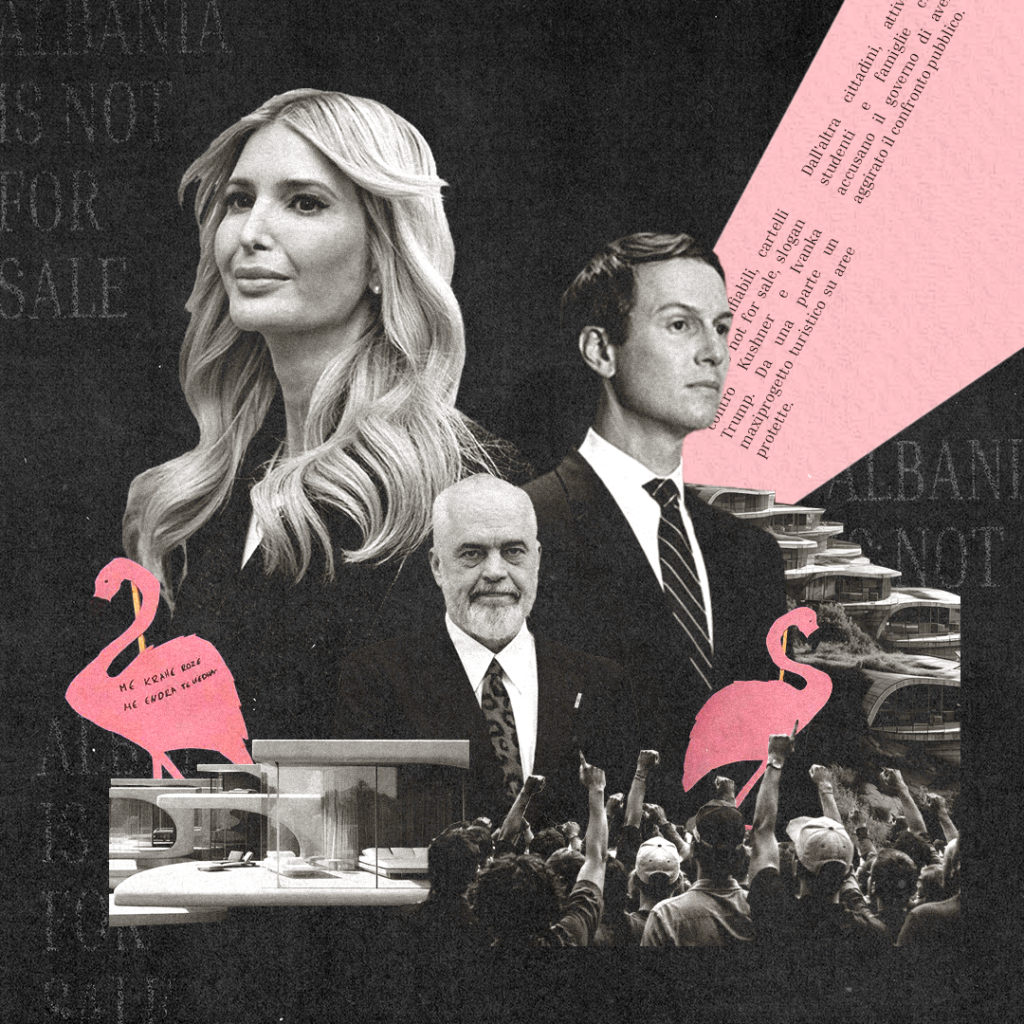
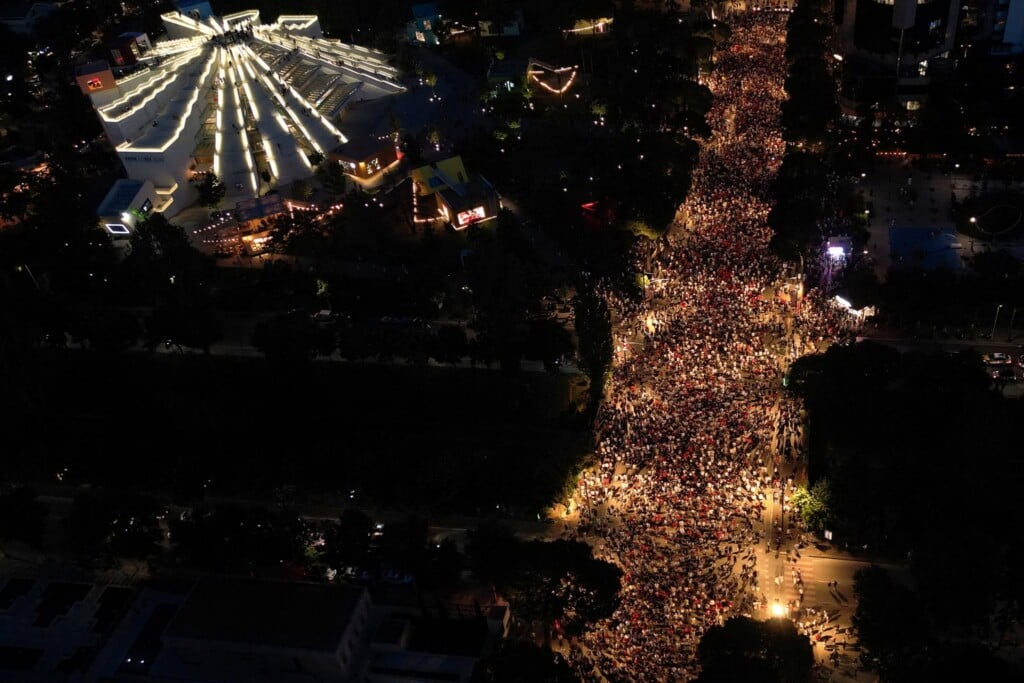
While half the Mediterranean seems to be turning into one vast and unrealistic luxury postcard, in Albania thousands of people are taking to the streets to demand something very simple: the right to participate in decisions about the place where they live.
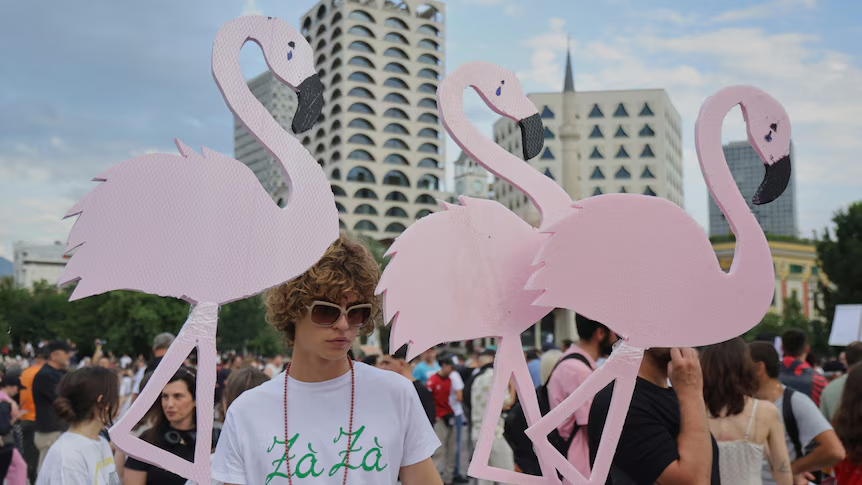
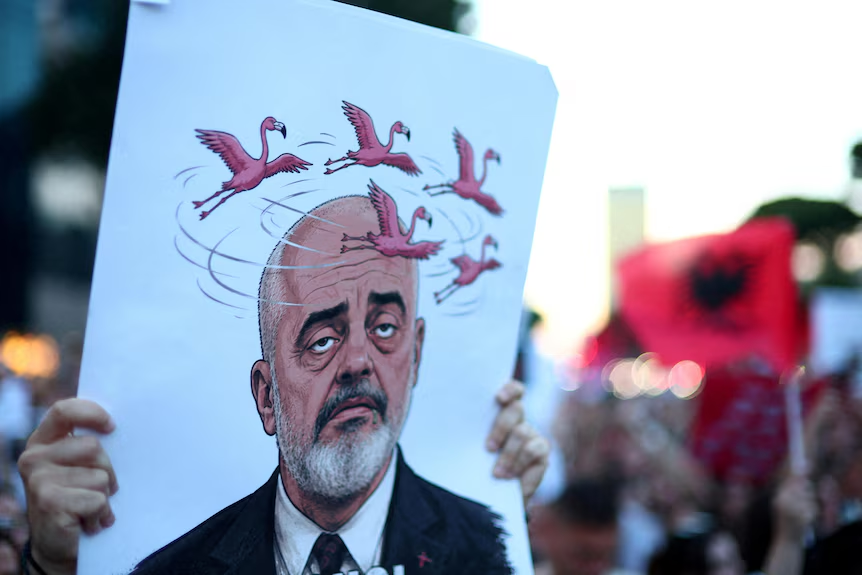
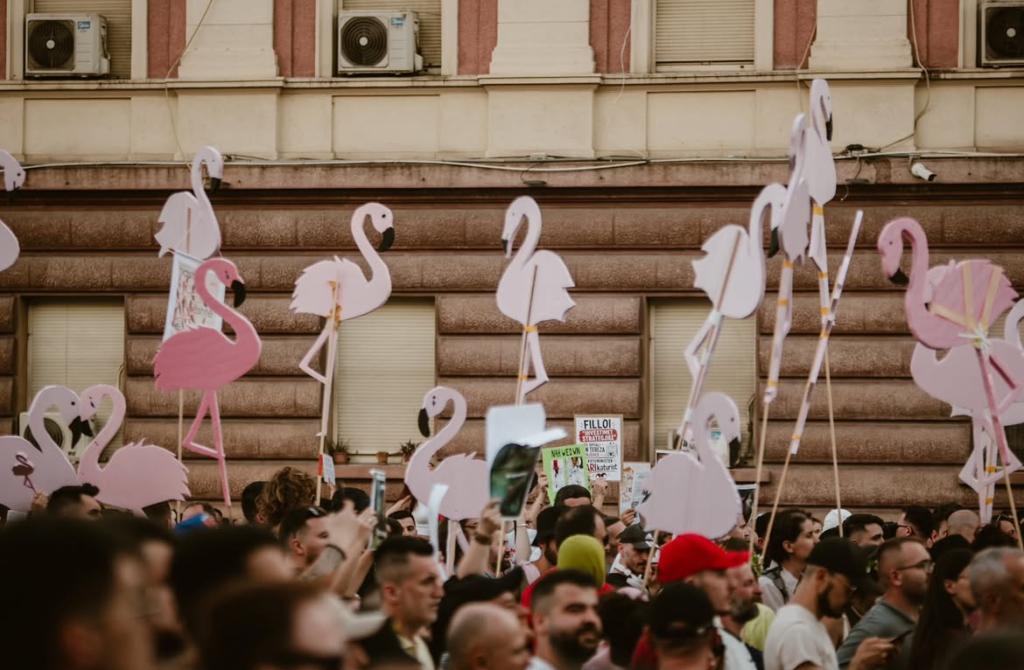
The images from the protests of recent days have already circulated across international media: inflatable flamingos, signs reading Albania is not for sale, chants against Jared Kushner and Ivanka Trump, calls for the resignation of Prime Minister Edi Rama. On one side stands the large-scale tourism project backed by a company linked to Donald Trump’s son-in-law, set to be built between the island of Sazan and the Narta lagoon. On the other, citizens, activists, students, and families accuse the government of bypassing public debate and sacrificing protected areas in the name of foreign investment.
The Albanian situation speaks to something broader about how change is imagined today. Development is increasingly presented as a technical process: urgent, inevitable, to be entrusted to exceptional procedures and specialist language that reduces dissent to an obstacle. Decisions arrive pre-packaged, accompanied by the promise of growth and the reassurance that no concrete alternatives exist. The question posed by the Albanian squares is both elementary and radical: who has the right to decide the future of a territory?
The environmental context makes this question all the more pressing. On the beaches around the delta of the Vjosa — the last wild river in Europe — bulldozers have begun uprooting trees and erecting fences. The area of Zvërnec, near Vlorë, is home to hundreds of bird species, many of them threatened with extinction. For environmentalists, the project represents a possible point of no return for a Mediterranean ecosystem of extraordinary fragility.
Yet the strength of this mobilisation does not rest on ecological urgency alone. What stands out is the way the protest has rapidly built a shared language, one capable of holding together different registers without reducing them to interchangeable slogans. Environmental protection is woven together with questions of democratic representation; the defence of landscape with historical memory; the critique of decision-making processes with a reflection on the very meaning of belonging. To grasp its full significance, one must step back, at least briefly, from the pace of the news cycle.
Albania is one of the few European countries where the word “people” still carries both political and emotional weight. The Rilindja Kombëtare — the Albanian national awakening of the nineteenth century — was first and foremost a cultural project. Before the state came the poems, the folk songs, the shared alphabet. Poets such as Naim Frashëri imagined a dispersed community held together by language, land, and a form of mutual responsibility. In Bagëti e Bujqësi (“Flocks and Fields”), landscape and identity are one: mountains, rivers, and countryside become the means by which a people learns to recognise and narrate itself.
It is hard not to think of this tradition when the fate of a lagoon is now being debated.
There is also an interior landscape — built across centuries of crossings and ruptures — that continues to shape the Albanian relationship with territory. Foreign occupations, linguistic contaminations, the suppression of religious practice, shifting borders, departures. The Arbëreshë have preserved for centuries, in southern Italy, a language and rituals born on the other side of the Adriatic. Centuries later, the prolonged isolation imposed by the Enver Hoxha regime turned the land into one of the last spaces beyond total state control. When in the 1990s thousands of Albanians boarded ships bound for Italy, a new form of belonging was born: that of distance. Nostalgia ceased to be a private feeling and became a shared and distinctive cultural trait. Those who left continued to reconstruct their country in imagination; those who stayed lived with the constant presence of elsewhere.
The writer Ismail Kadare returned many times to this tension between rootedness and openness, between the desire for Europe and the fear of dissolving oneself in the process of transformation. In his novels, Albanian history often takes the form of a long negotiation: welcoming what arrives from outside without relinquishing the possibility of assigning it one’s own meaning. A living identity coincides neither with defensive withdrawal nor with the willingness to become a neutral surface onto which others may project their interests.
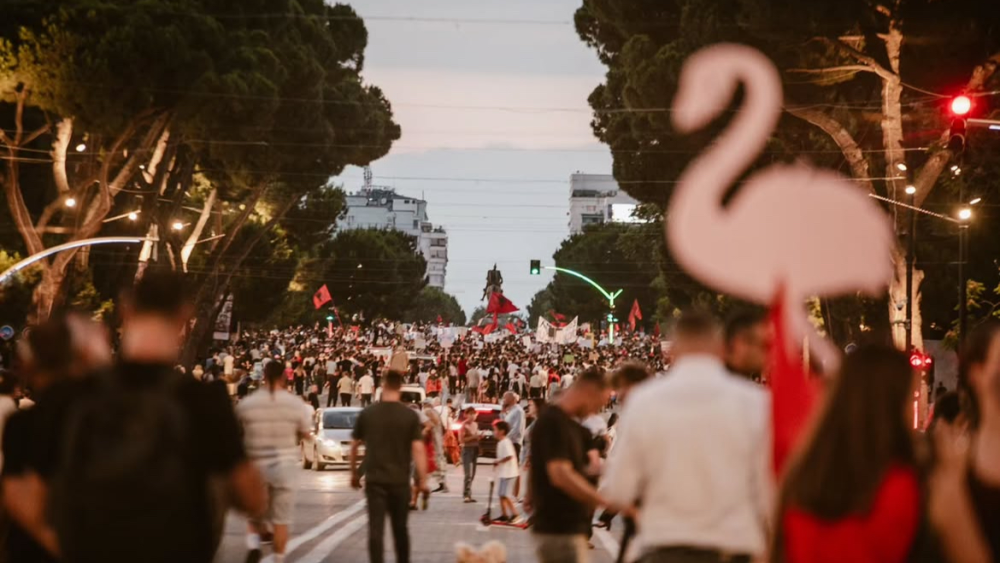
This is also why the protest against the resort assumed such a broad, cross-cutting character from the outset. The demonstrations feature inflatable flamingos — now the symbol of the Narta lagoon — alongside Palestinian flags. To some observers this combination may seem out of place; in reality it reveals how many of the protesters interpret what is happening. The presence of Jared Kushner — a central figure in the Abraham Accords and in the normalisation strategies promoted during the Trump presidency — is read as a signal of networks of influence that extend well beyond the local level. All of this reflects the historical positioning of Albanians: much of Albanian civil society perceives environment, democratic sovereignty, and geopolitics as aspects of the same question. The international connections of capital, the balance of power between global actors, and the concrete fate of territories appear inseparable.
Nor is this the first time the country has seen forms of mobilisation capable of articulating such wide-ranging questions. Between 2018 and 2020, artists and citizens occupied the National Theatre of Tirana to prevent its demolition. Then too, what was at stake was the right of a community to decide what to preserve of itself, what legacies to pass on, and which transformations to accept in the name of progress.
For years we have observed Albania through predictable images: the country people leave, the country chasing Europe, the Mediterranean’s new low-cost paradise. Today’s squares offer a different picture: that of a people capable of developing a complex political discourse, in which the defence of the environment is not a luxury for the few, democratic participation is not an institutional technicality, and collective memory is not a sterile nostalgia.
Edi Rama continues to defend the project as a necessary step to attract foreign investment and advance the country’s path toward European Union membership. But the question emerging from the squares of Tirana concerns the very idea of Europe. Does integration mean adopting a model of development that has already been defined, or does it mean strengthening the democratic capacity to discuss and negotiate it?
What remains of democracy when landscape is treated primarily as an economic asset? When a coastline is above all a destination, an island a real estate opportunity, a lagoon an entry to be reclassified in administrative procedures? Some places hold something that escapes the language of the market: memory, relationships, symbolic continuities, the possibility of recognising oneself as part of a shared history. Protecting them means defending the right of a community to take part in the decisions that will shape its future. It means preserving the faculty — always fragile, always political — to choose who one wishes to become.