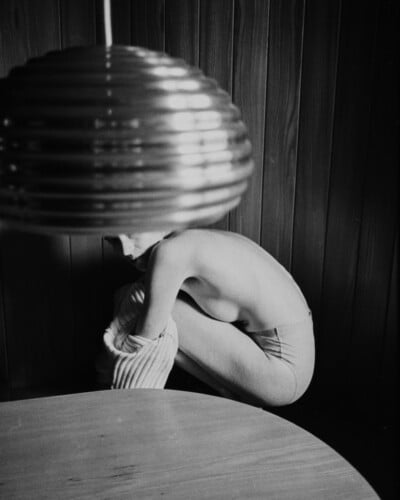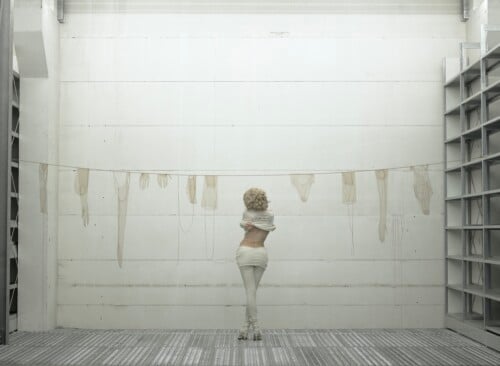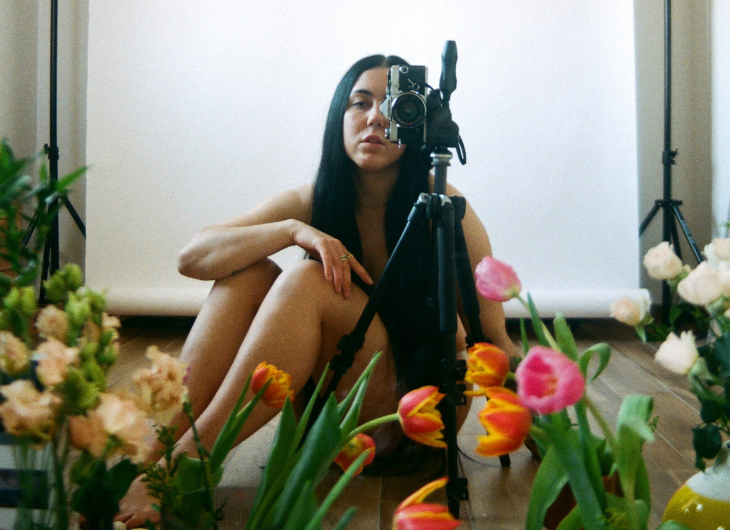
In the era of social media, selfies and pure, unbridled hedonism, where we are taught that ‘first impressions are everything’ and that ‘a good appearance opens every door’, the other side of the coin, the dark, inner side, is becoming more and more complicated and worrying. Our image reflected in the mirror becomes almost an obsession, a continuous quest towards what is socially considered ‘perfection’, which inevitably passes through the images conveyed by the media and social media. Lean and toned bodies, smooth skin and shiny hair go hand in hand with defect ‘removal’ products, suggesting the elimination of pimples, hair, cellulite and whatever else, communicating – more or less indirectly – that this is wrong, that it is something to be eliminated and to be ashamed of.
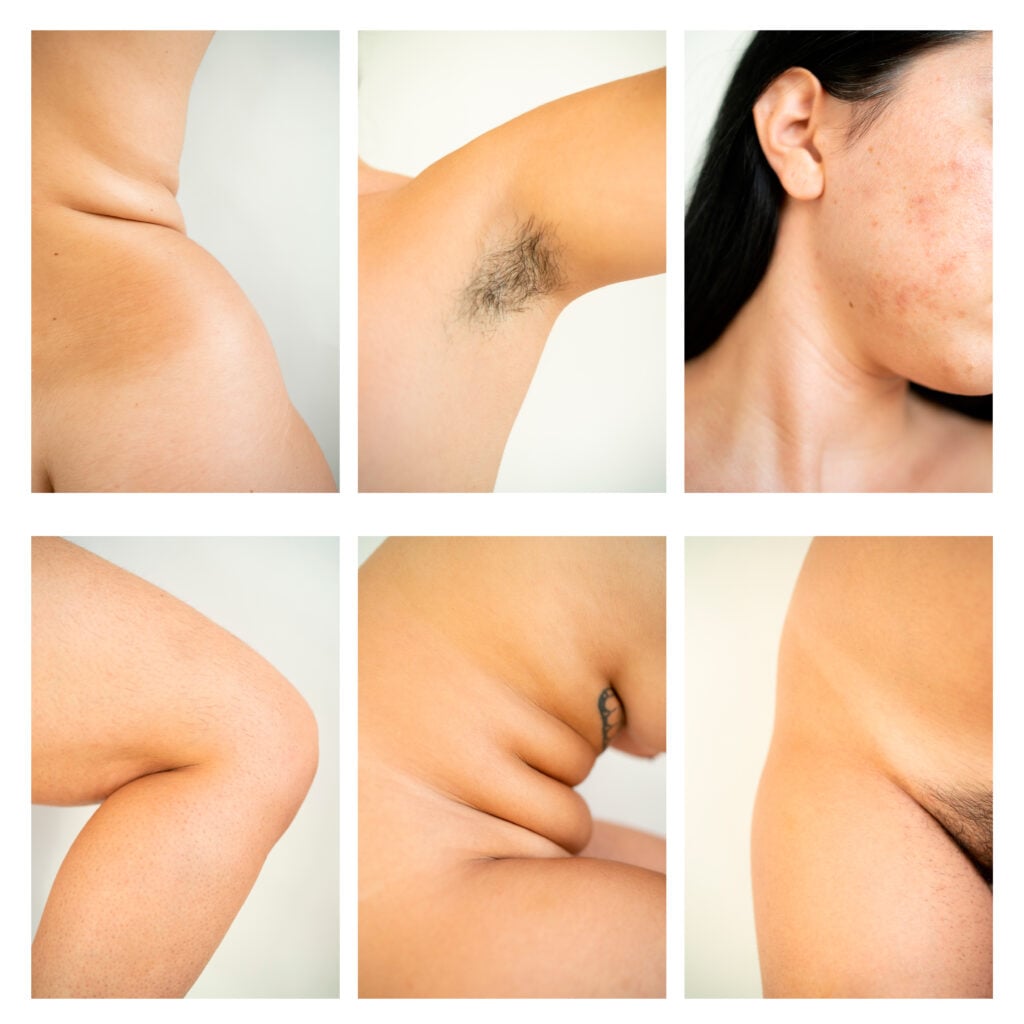
Photography – and art in general – in recent years has increasingly fought against stereotypes of beauty, helping to initiate a process of normalisation. The young photographer Alexa Sganzerla (1990, Bologna) is part of this movement that is making its way within a patriarchal society intent on imposing canons of female beauty. “I spent my entire childhood, my adolescence, and even now that I am an adult, being bombarded with images that do not resemble me in any way. As a photographer, I want to be at the forefront of creating images that allow people to feel represented and play their part in having a different awareness one day,” she tells us.
Dysmorphobia, a disorder concerning the perception of one’s body that leads to an excessive preoccupation with a physical defect, real or imagined, is increasingly widespread. Alexa herself has suffered from it for years, finding her cure in the practice of self-shooting, as well as a course of psychotherapy. We met with her to learn more about her story and her artistic practice, which focuses on the photographic restitution of the truth of bodies. What Alexa Sganzerla practices on herself, she also applies to her subjects. Like a godmother, she takes people by the hand and accompanies them on a photographic and human experience, which does not aim for people to necessarily accept themselves but “to be more forgiving of what is their natural form and to recognise that every aspect of the self deserves respect, love and consideration“. Her aim is to render a transparent and undistorted image, looking at the essence rather than following a socially shared and accepted aesthetic.
“I know well the difficulty of being on the other side of the lens, and the idea that someone trusts me so much to allow me to work on one of the most vulnerable aspects of manyə of us is something that fills my heart immensely. To then see the reactions to the photos is truly incredible, I am moved every single time to read the words of amazement at seeing themselves beautiful for themselves, without having had to try to be someone different.”
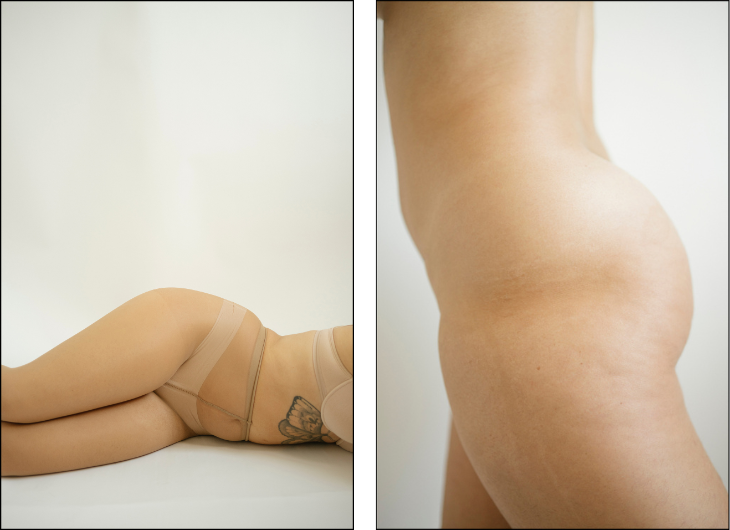
Many of Alexa Sganzerla’s projects put her own body in the foreground, in an act of extreme courage, revealing without deception those ‘flaws’ that for years she tried to mask, hide and suffocate. “The self-portrait therapy came about a bit as a necessity: everything was closed because of the Covid, contacts and my work were reduced to zero, I was the most comfortable and available subject.” – Alexa tells us – “The very first shots were a terrible experience, I think I deleted them straight out of the camera without even looking at the computer, I was appalled at how ugly I saw myself, my dysmorphia was through the roof. After a while I decided to try again, and I did it several times, unfortunately always with very bad results, I even talked about it in therapy. My body was changing and it was as if I had completely lost control of it. One day I decided to give it a try and strip myself completely, of everything, concentrating almost surgically on the parts I hated the most.“
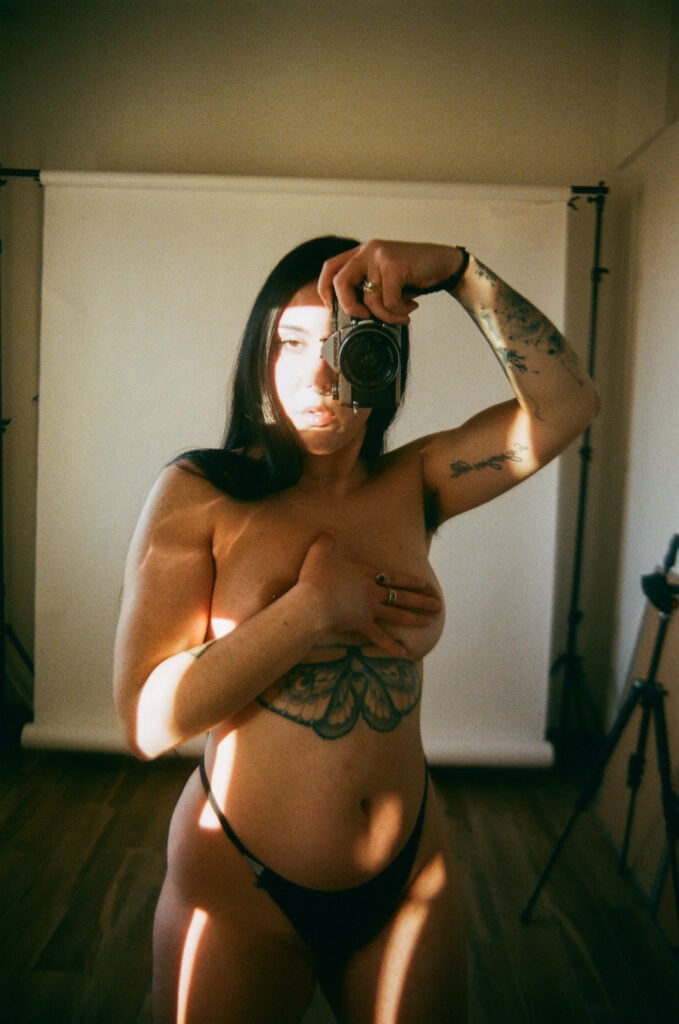
“The idea was to shoot a few details, but in the end I got into the frame too, with portraits and whole figures. I was not happy with the result, but I felt somehow less overwhelmed by my image. With time I realised that perhaps the problem lay in how I had been taught to consider my body beautiful, and I felt deprived of something. Deprived of my freedom to consider myself deserving of love even when I was not made up, shaved and dressed; deprived of my ability to assess what is really best for me; deprived of years spent trying to make myself acceptable to a society that would never accept me anyway and that had taken away my ability to decide for myself from the day I was born. As Naomi Wolf also states in ‘The Myth of Beauty’, the problem has never been whether to wear make-up, shave, dress feminine or not, the problem is the lack of choice, it is the knowledge that without those practices I will not be respected within my society. It has been incredibly liberating and extremely revolutionary for me to learn to use make-up, or clothes, and anything else related to my appearance as a mode of expression and not oppression. Today, self-portraits have become a more everyday practice, but no less interesting: I always learn something new as I watch my body create new angles and shapes, finally letting my gaze linger on the normality of reality and caress every ripple without wanting to smooth it out.”

What is interesting to observe is the media Alexa chooses to use for these self-shots. She does not always use her camera, but sometimes she also uses her mobile phone. The spontaneity of the shots, when it does not involve premeditation, leads her to prefer her smartphone, which indirectly communicates that this ‘therapy’ can be practised by everyone. “The practice of observing oneself is something that can be achieved with just a mirror, you don’t need a camera. For me as a photographer, it is a tool like any other, and specifically the phone is practical and quick, considered ‘unprofessional’ whereas I find it incredibly versatile.”
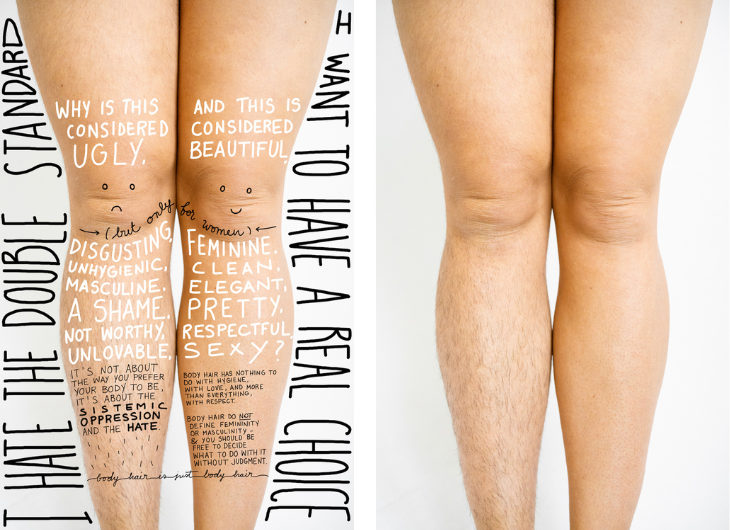
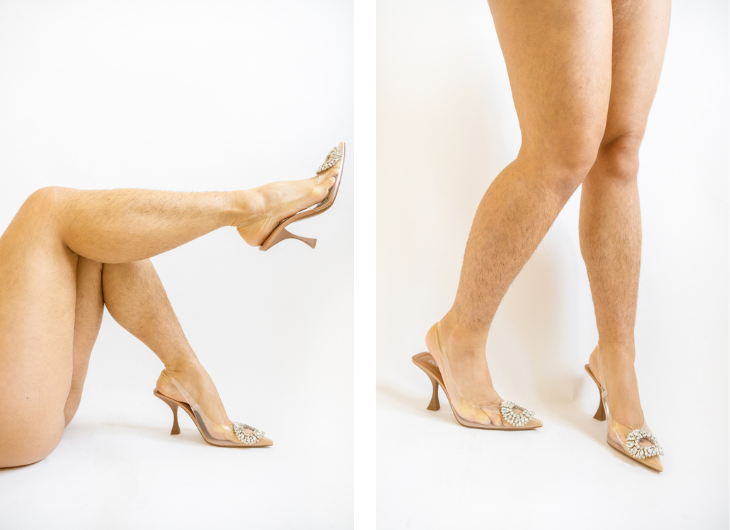
The series “Am I pretty now?” is emblematic of her research. Alexa Sganzerla focuses on the issue of hair and epilation, a widespread obsession that in some cases causes great shame and generates psychological and social problems. Through a true photographic narrative, Alexa shows how even today the concept of hair is at odds with that of femininity. First by wearing very feminine shoes, with heels and sequins, combined with natural, unshaven legs. In this way, the photographer reveals how this association can cause a certain discomfort. In a second moment, she chooses to shave only one leg. Comparing them, she points out how they are the same thing but how our minds see them as quite different. A wrong ‘before’ and a right ‘after’. Finally, he shaves both legs and photographs the waxing strips after epilation. The latter form the backdrop to the words “Am I pretty now?“, leaving the answer in the hands of the audience.

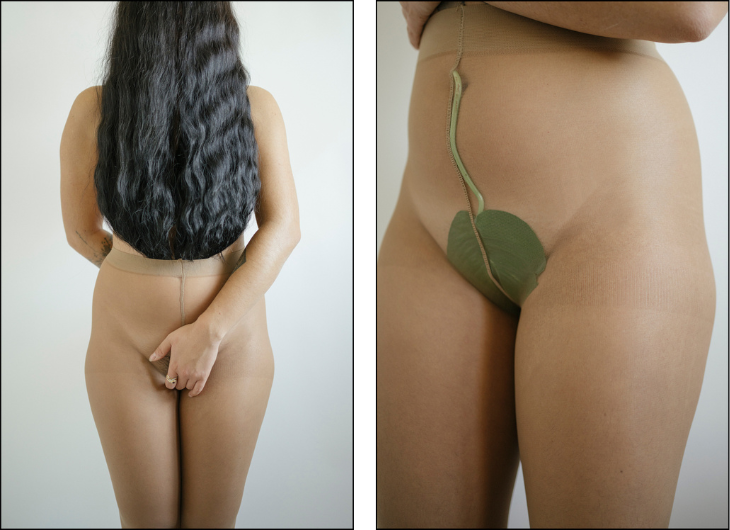
More recently, menstruation has become an object of research for Alexa, for whom she feels the need to “contribute as much as possible to the normalisation of something that is so natural and present, something that cannot be relegated to a supermarket shelf and the concept of shame on which we have founded our society.” Unfortunately, in a society that considers itself advanced and progressive, there is still a senseless silence on the subject, leading to a lack of knowledge of the anatomy of one’s body, diagnostic delays and the radicalisation of shame from a young age.
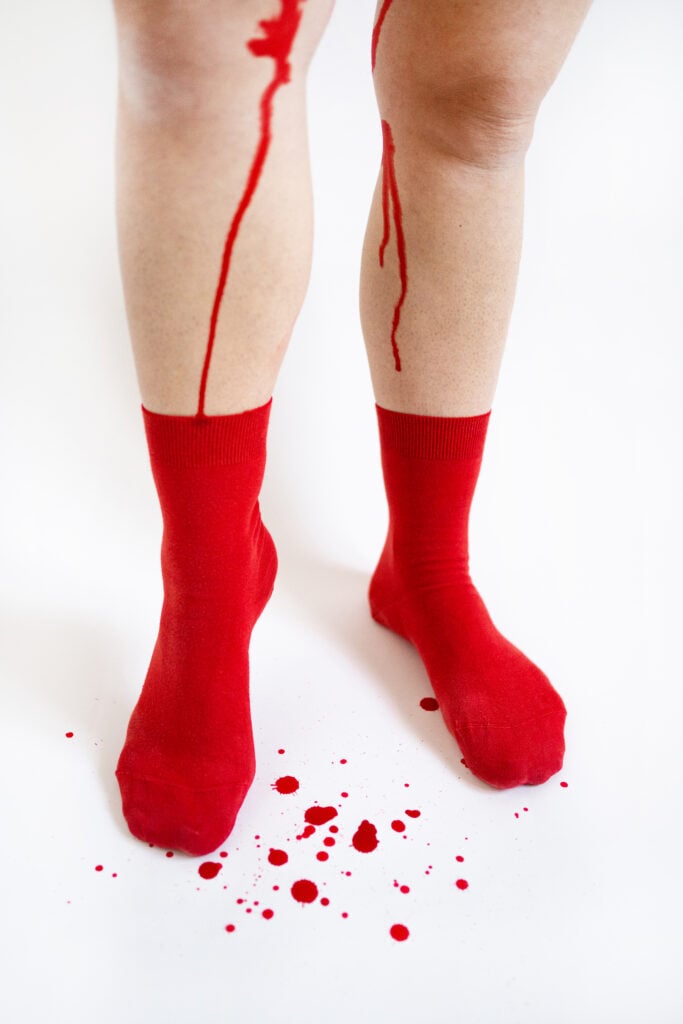
“In my opinion, talking about menstruation is fundamental to ending the stigma on the subject. Over the years I have represented it in many ways, but the response has always been very strong, and often negative, especially from men. The most complete work, however brief, are the three photographs taken for the exhibition ‘seXY period’. In those photos I represented three aspects that are very underestimated for me and considered as aberrations: the presence of menstruation in people who do not identify themselves as women, sexuality and intimacy on menstruation days, and lastly the representation of blood with a colour that can be traced back to reality. This is definitely something I will continue to create material on for a long time. I like the cyclical nature of the menstrual cycle, as natural as the natural cycles of the seasons, plants, water, oxygen, and so on.”

The terribly ingrained work that has been done on our bodies for hundreds of years will not go away so easily, but the encounter with Alexa Sganzerla makes us reflect on how deserving we are of love regardless of how we feel about our bodies.
Alexa’s photographs, with their direct and easy-to-read language, come straight to the audience, crumbling, piece by piece, every stereotyped form that inexorably attempts to cling to free thought.
Courtesy Alexa Sganzerla