At a time when the normalization of violence goes hand in hand with the increase in armed conflicts -which has inevitably resulted in the rapid expansion of the global arms market and war industries – Milan’s ArtNoble Gallery is talking about disarmament with the group exhibition Theater of Dis-Operations (Act I. A Disarmament). The project, produced in collaboration with Sa.turn and curated by Arnold Braho with Stefano De Gregori and Giordano Cruciani, is open until September 27th. The exhibition critically engages with the concept of “theater of war” (theater of operations), the geographical area where military strategy operations are conducted. The goal of the artists involved – Agnese Barbarani, Arijit Bhattacharyya, Paolo Ciregia, Critical Art Ensemble, Gaia De Megni, Thiago Dezan, Shadi Harouni, Délio Jasse, Infinite, Zazzaro Otto, Stefano Serretta and Francesco Vullo – is to propose artistic processes and practices capable of offering new strategies to sabotage violence through a repertoire of potential devices and acts. A sabotage that attempts to evade, to make dysfunctional, also proposing strategies of escape, “to weaken from below the war paradigm.”

What does it mean to disarm?
Building on these considerations, Theater of Dis-Operations (Act I. A Disarmament) attempts to offer techniques and tactics of disarmament while extending its practical limits. Does disarming mean «merely exonerating the subject from the use of the weapon device, or is it necessary to undermine those economic macrosystems that help fuel a pro-profit market of death? Can desertion be a strategy of sabotage? Finally, disarmament of whom and in favor of what?»


Artists’ tactics
The “tools of resistance” proposed by the artists point in various directions but with two strategies, sabotage and escape. On the one hand, speaking of sabotage, Critical Art Ensemble denounces the use of chemical weapons by the U.S.; Infinite reveals propaganda in the commercials of warmongering industries; Agnese Barbarani documents the boycott of ships carrying weapons to the Middle East; Delio Jasse uses postage stamps of the Angolan revolution. On the other hand, symbolism also plays a crucial role. Arijit Bhattacharyya reappropriates cultural symbols with the protest costumes of Bangla communities in India; Gaia De Megni empties the symbolism of uniforms and guns, while Paolo Ciregia depicts bodies sacrificed in imperialist wars. Francesco Vullo makes work on the flag, the quintessential symbol of a state’s strength, by making a flag out of circular saw scraps. On the other hand, the escape strategy is deepened by Shadi Harouni, who narrates the last day in Iranian Kurdistan; Zazzaro Otto, on the other hand, enhances the imagery of the child for an escape to new worlds. Thiago Dezan‘s works depict indigenous women in Zapatista Chiapas engaged in new forms of self-management, while Stefano Serretta documents international solidarity networks for desertion.
Fleeing and desertion are presented as ways to weaken the war paradigm and as the only way of salvation, highlighting the bottom-up resistance and political will of the communities involved. «The refrain is always the same: ‘it is necessary to establish a practice of intolerance, towards all passive and inhuman situations.’ Here and now.» the critical text reads.

Stefano Serretta’s provocations
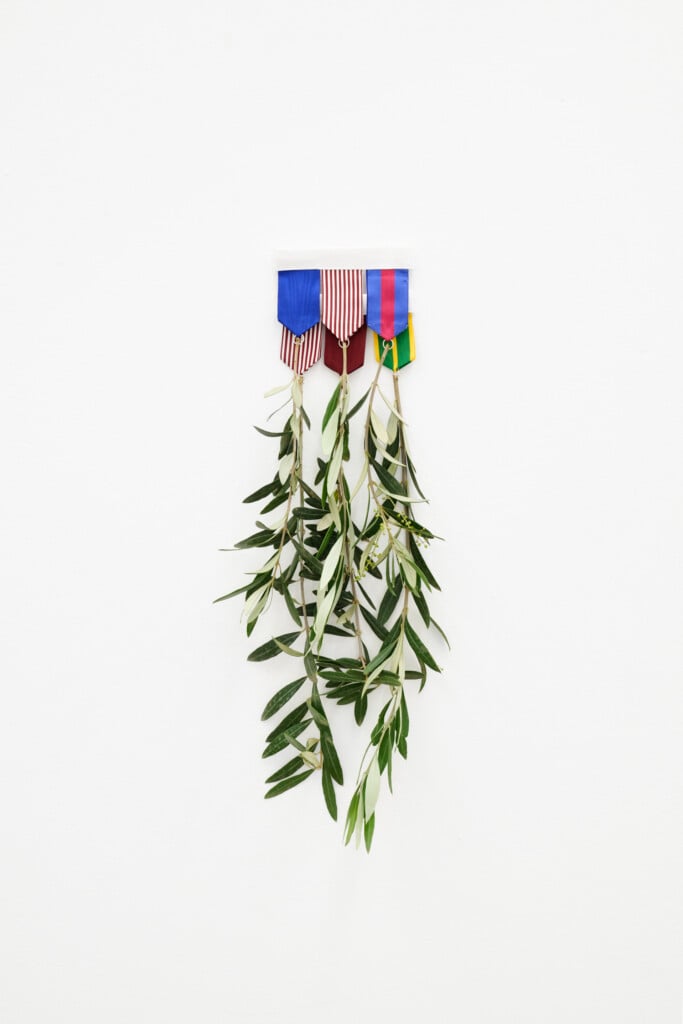
Particularly striking to us was the work of Stefano Serretta. Supported by a rigorous historical and analytical framework, Serretta’s work aims to highlight the fragile self-celebrating foundations of globalized capitalism and the communicative machine that governs it, of which man is both protagonist and victim. With an inquisitive gaze, Serretta highlights the contradictions and schizophrenic aspects of our post-ideological present. By dissecting the communication mechanisms and economic systems that perpetuate a cycle of violence, Serretta’s work challenges viewers to reconsider their concept of disarmament and its broader implications. His art provokes a necessary dialogue about the role of the individual and the collective in confronting and dismantling these entrenched systems of power.