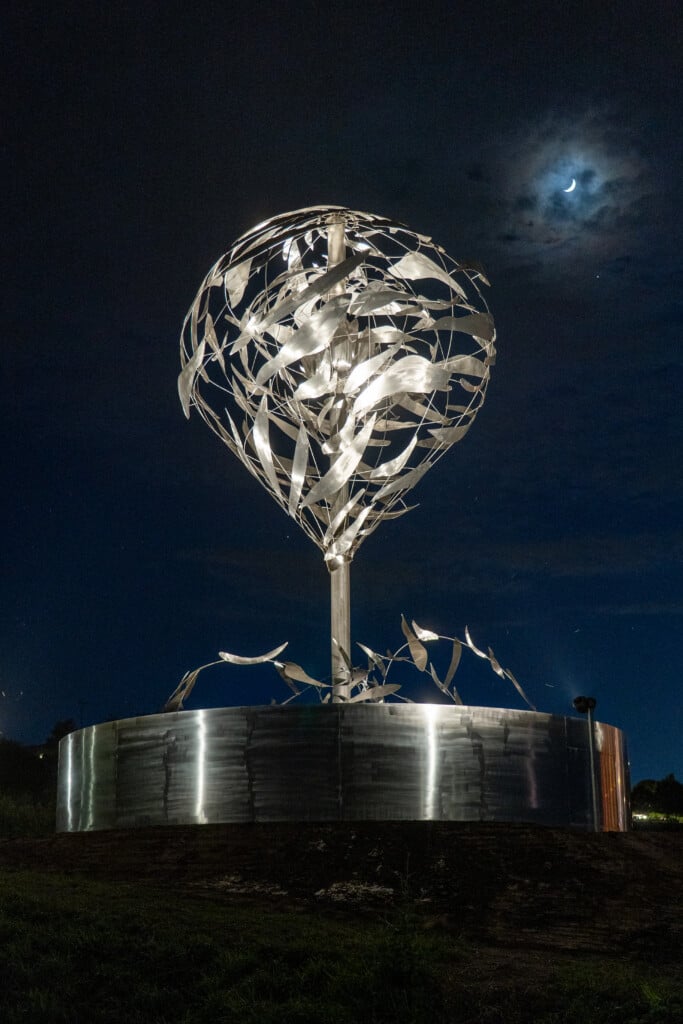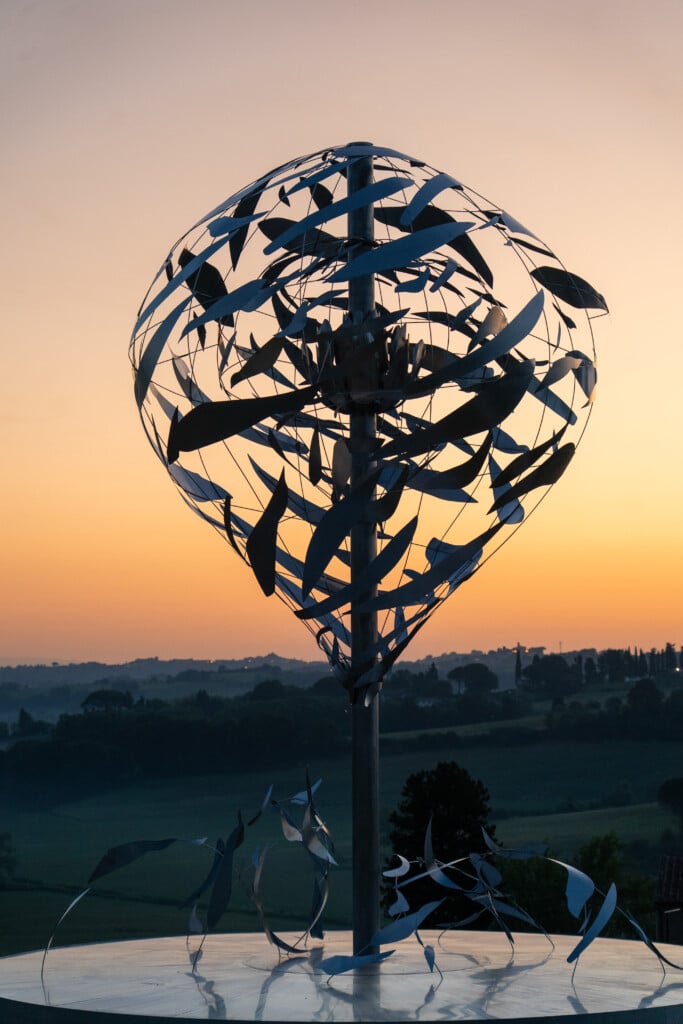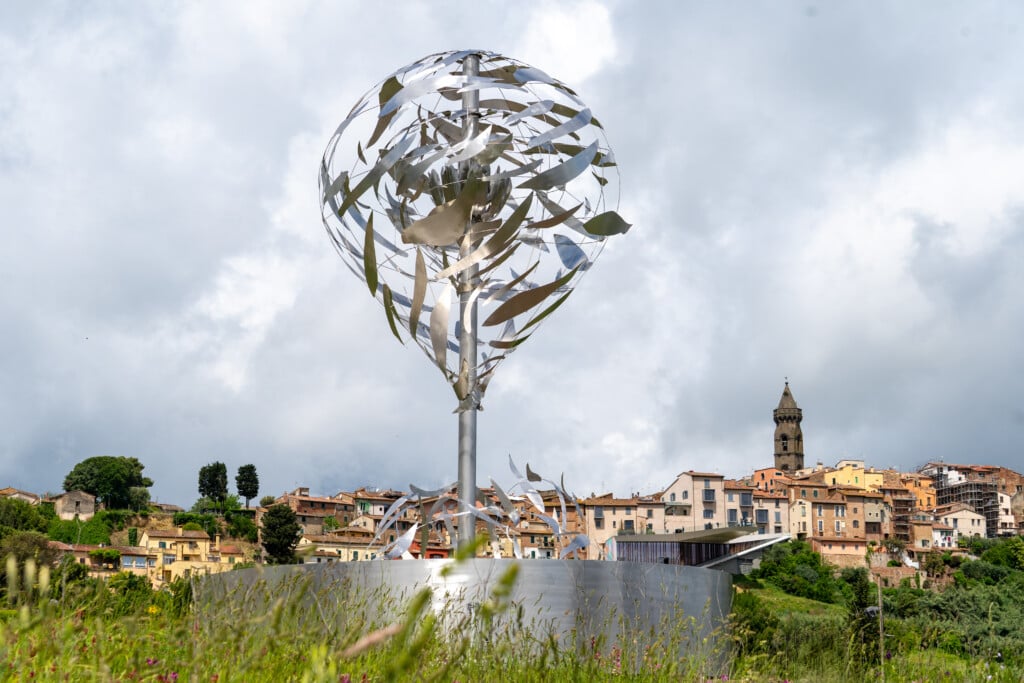
There are places you don’t expect to move you. Peccioli is one of them. A hilltop village in the province of Pisa, just over four thousand inhabitants, the kind of place you might pass through without stopping. Yet, if you arrive there at dawn on a May morning, you find a group of people sitting on the grass watching a ten-meter-tall sculpture that slowly opens with the morning light. That sculpture is called Breath, and it was created by Emiliano Ponzi and Dario Spinelli.
Peccioli and the MACCA: a museum without walls
Before talking about the work, you need to understand the place. Because Peccioli is not just a backdrop: it is a cultural project that over the past few decades has transformed a small Tuscan municipality into one of the most talked-about cases of public art in Italy. The mechanism is as simple as it is visionary: the resources generated by Belvedere S.p.A. — the company that manages the local waste cycle — have been progressively reinvested in culture, infrastructure, and contemporary art.
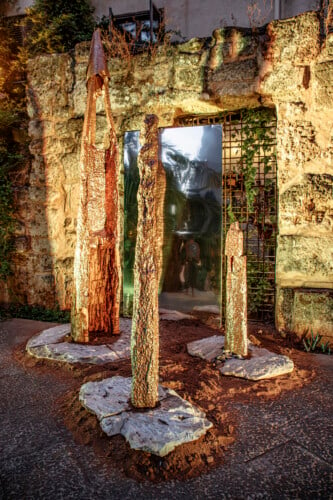
The result is the MACCA, the Open-Air Museum of Contemporary Art: a distributed collection that today counts over seventy works spread across the territory, signed by artists such as Daniel Buren, Alicja Kwade, and Patrick Tuttofuoco. There is no ticket office, no reception desk. The museum is the landscape itself.
“Peccioli has built a common thread within diversity” — says Cristiano Seganfreddo, director of Flash Art and curator of Breath — “populating year after year, with great consistency, this unique territorial example. This is not a two- or three-year project. It is a twenty-five-year project. For twenty-five years, this municipality has changed its face through the transformation of the landfill and has used contemporary art as a tool for the evolution of the territory.“
A pin between two worlds
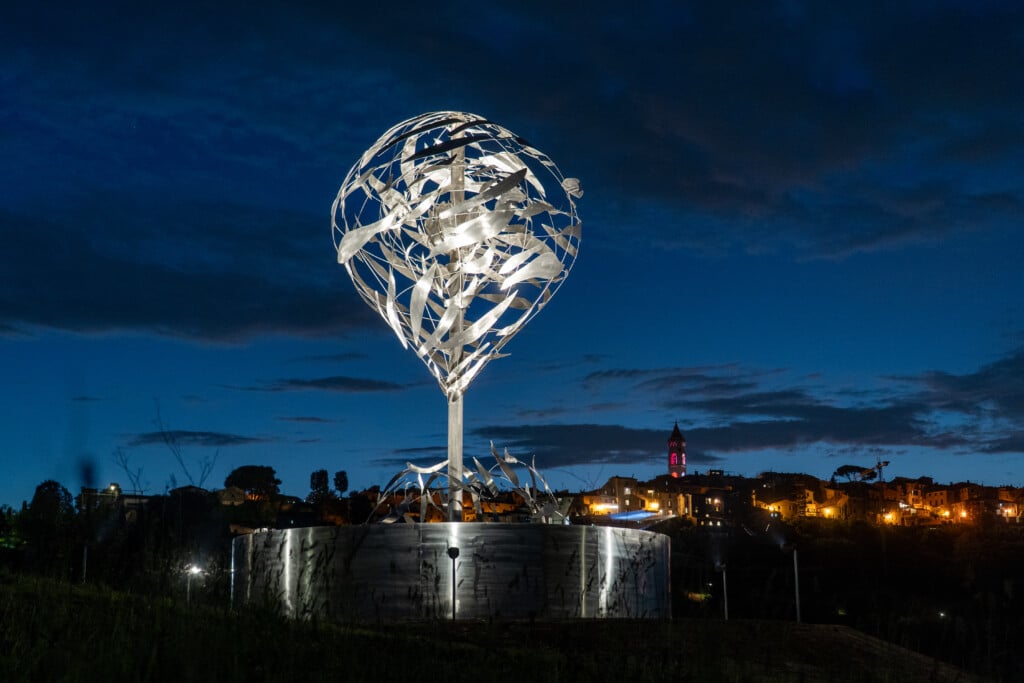
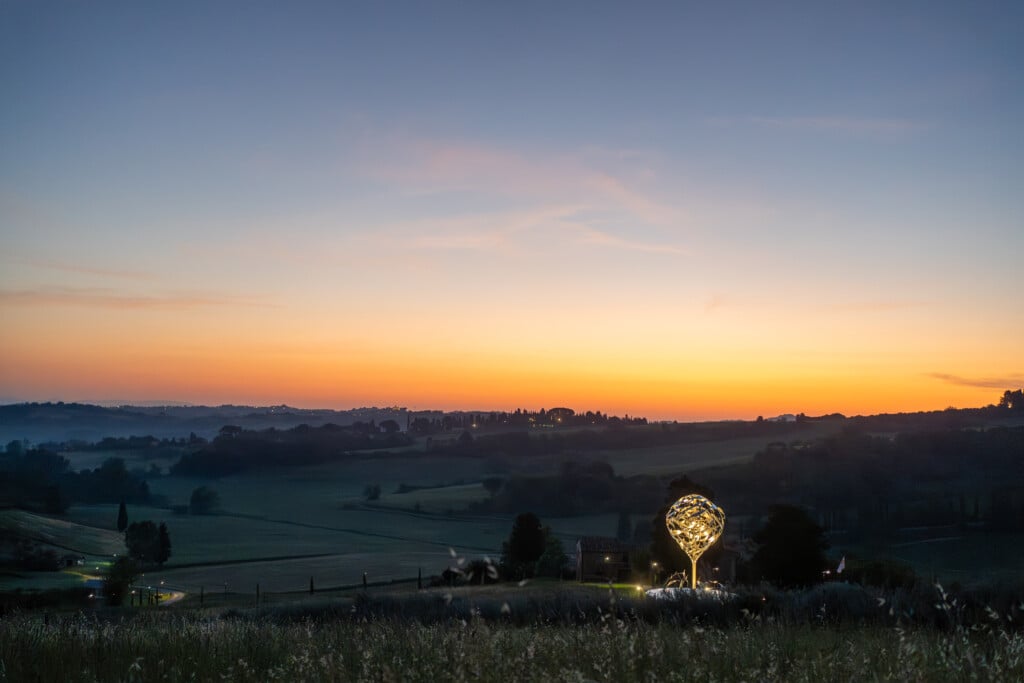
Breath stands on the summit of one of the village’s hills, a position that is no coincidence — designed so that the work is visible from afar as a mark in the landscape, equidistant between the hills and the town. From that distance it appears as a vertical form, somewhere between a monument and something alive. Up close, the structure reveals its complexity: brushed steel, a circular base eight meters in diameter, a constellation of metal elements rotating around a central axis, capturing light and wind.
Bringing it to life alongside Ponzi is Dario Spinelli, an experiential designer whose background moves precisely along the boundary between digital and physical — immersive installations, kinetic systems, and interactive environments. The challenge here was to take a language born on two-dimensional surfaces and transfer it into something that is not only three-dimensional, but must withstand the seasons, the wind, and the weight of time.
“I like to think of it as a small pin connecting two different worlds” — explains Spinelli — “the natural and the human. The idea is to be in between two worlds in a number of different ways, without belonging clearly to either one, but serving as a bridge between them.“
Working with Ponzi meant confronting this tension directly. “The attempt is to translate a stroke that is two-dimensional — even if pictorially very spatialized — into something that is not only three-dimensional, but must have the technical characteristics of durability. The goal is to maintain a certain recognisability of the stroke within a structure that must nonetheless be solid and light at the same time.” One of the greatest challenges, he says, but also the greatest satisfaction. Especially considering that the work moves — there are mechanical parts, a kinetic system that allows for no shortcuts. “We don’t like to make things easy for ourselves, because it’s the only way to push past our own limits.“
The choice of brushed steel responds to this logic precisely. Not the mirror-like metal that reflects and imposes itself, but a surface that absorbs and returns light softly, blending in without disappearing. It is both a technical choice — stainless steel ensures durability and resistance to weather — and an aesthetic one. “It doesn’t want to be invisible, but it does want, in some way, to blend in and integrate within the environment. Especially in terms of light, it works particularly well.“
An unexpected confirmation came almost immediately after installation: on the very first day, a bird began nesting on the work. Seganfreddo recounts this with a satisfaction he can barely hide: “it shows that the piece had already been welcomed, quite naturally, as an element integrated with the territory where it was planted and where it was born.“
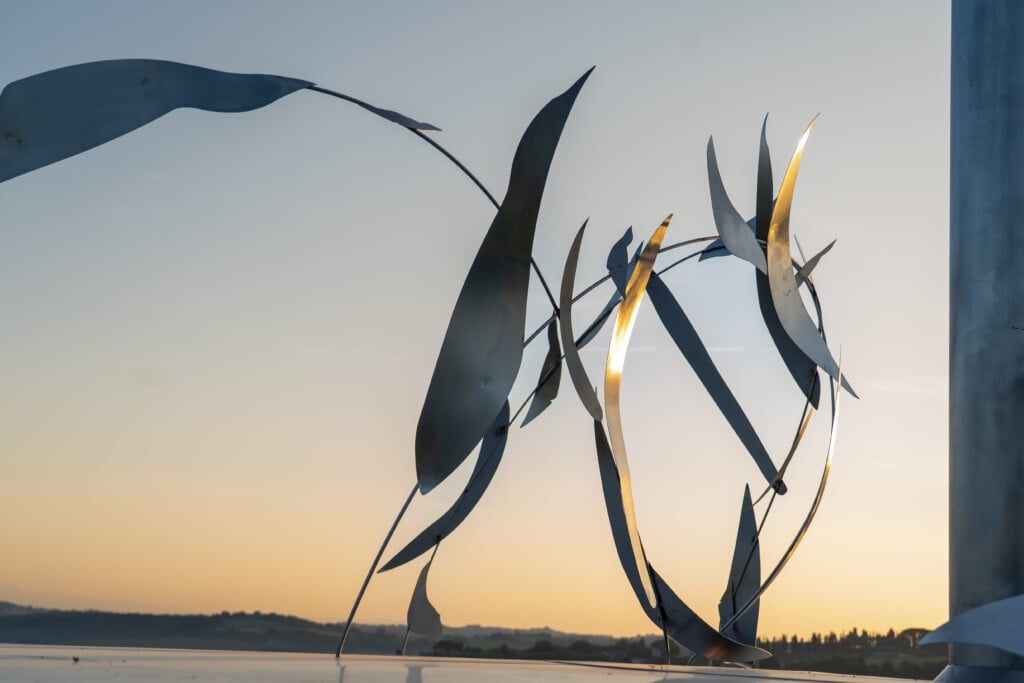
The heart of the work is its most unexpected part
But it is the centre that holds the most unexpected part of Breath. Inside the structure there is a mechanical flower. It opens at dawn, slowly, following the natural cycle of light, and closes again at sunset. Every day, regardless of who is there to watch.
We saw it at different moments of the day — from dawn to sunset and into the evening, when the outer structure continues to turn in the dark and the flower has already been closed for hours. It is an almost discreet gesture, compared to the scale of the work. You could nearly miss it, if you didn’t know it was happening.
Ponzi speaks of this with a line that says more than any technical description: “If we are not seen, if no one applauds us, if no one likes us constantly, we exist all the same. We exist because our reason, like a flower, grows — it doesn’t ask itself whether to grow from a rock, a sewer, or a botanical garden. That is its nature: it grows, it moves forward, it develops following what is written in its DNA. We do the same. So existing even when no one sees you doesn’t mean existing less — it simply means having understood how to manage one’s own narcissism.”
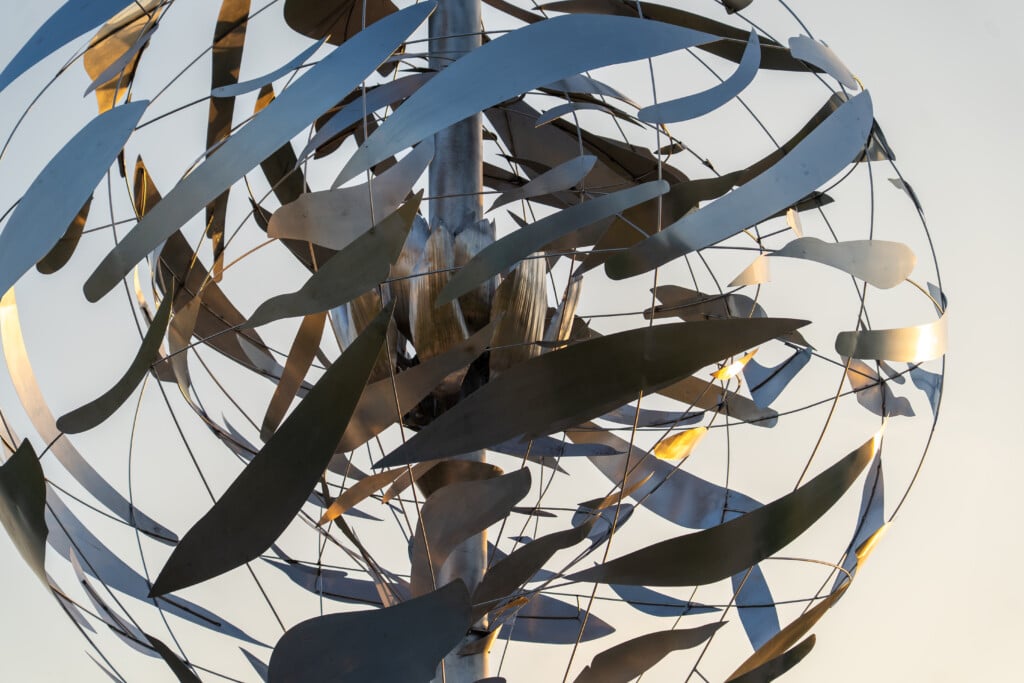
Synchronising with nature
Emiliano Ponzi is a name that needs no introduction in the world of illustration. The New York Times, The New Yorker, Apple, Hermès. But Breath was not born from a commission — it was born, as he himself puts it, from listening. “If you feel that the language you are using is no longer enough to make yourself understood, to express yourself, you need to explore.“
The choice of the hilltop was one he had already made in his mind years ago. A point equidistant between the hills and the village, visible from both directions, capable of telling that particular relationship between humanity and nature in this corner of Tuscany — a balanced coexistence, almost organic.
“Synchronising with nature simply means stepping out of our daily loop of habits — including toxic habits of thought. I choose to come here, perhaps at seven in the morning or seven in the evening, and wait for the flower to open or close. It’s just a few minutes, but they are part of a choice, and they make you take part in a process.“
The strongest design decisions, Ponzi says, are the ones you can’t see: the negative spaces, the voids through which the sky enters, the hills, the light that shifts with the hour and the season.
From a curatorial standpoint, Seganfreddo frames all of this through an important distinction: not environmental art, but art that is placed within an environment. “The theme of landscape, of location, of relationship, is very often overlooked. This is an extraordinary landscape, but also a very fragile one. So great attention and care went into choosing an element that would become a mark of the territory while integrating with the territory itself.” And he adds: “Art is when creativity imposes and proposes something new. Without that quality, it becomes decoration — or cosmetics.“
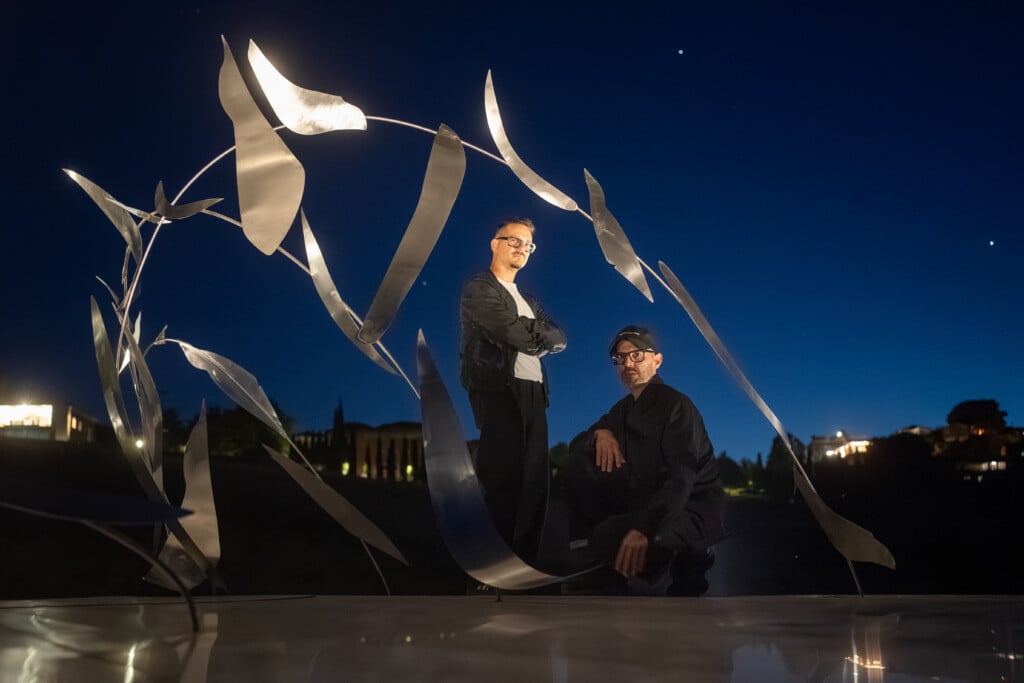
One last question — what remains
To close, I asked all three the same question: what do you hope stays with someone who sees Breath at dawn or at dusk — an image, a feeling, a question? Three different people, three different roles, three answers that together tell the story of the work better than any description could.
Spinelli says something simple: he hopes a feeling of peace remains. Something hypnotic, like watching a fire. “Something that reaches into our reptilian brain and lets us rise above our everyday thoughts.“
Seganfreddo sees it as a necessary counterpoint: “This almost becomes a kind of counterweight — something that draws you in and makes you stop within the context with a different kind of approach. Works placed within an environment allow you to widen your gaze and enter a different state of inner observation.“
Ponzi hopes for something even more accidental: that people arrive knowing nothing about him, without context, without expectations. And that the encounter happens all the same.
The title of the work is accompanied by a line from Emily Dickinson: “The Landscape listens — Shadows — hold their breath.“ A line that, at certain moments on the grass of that hill, feels not like a quotation but like a precise description of what is happening around you.