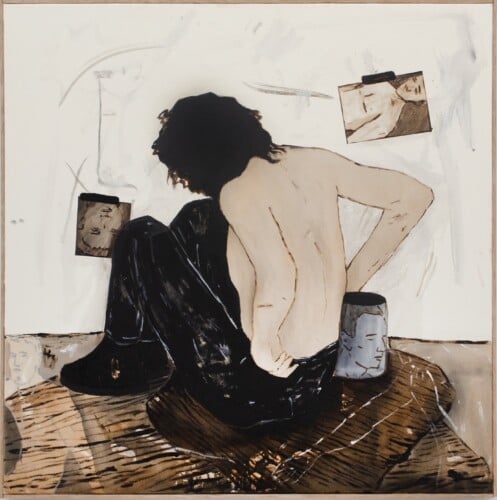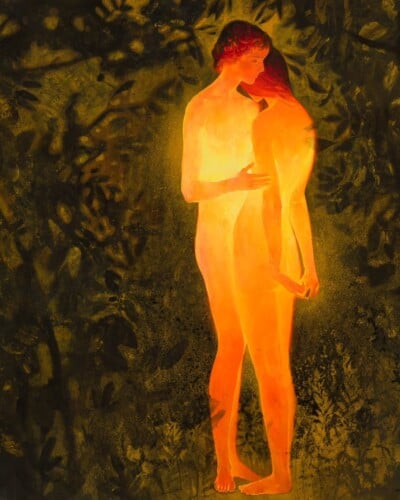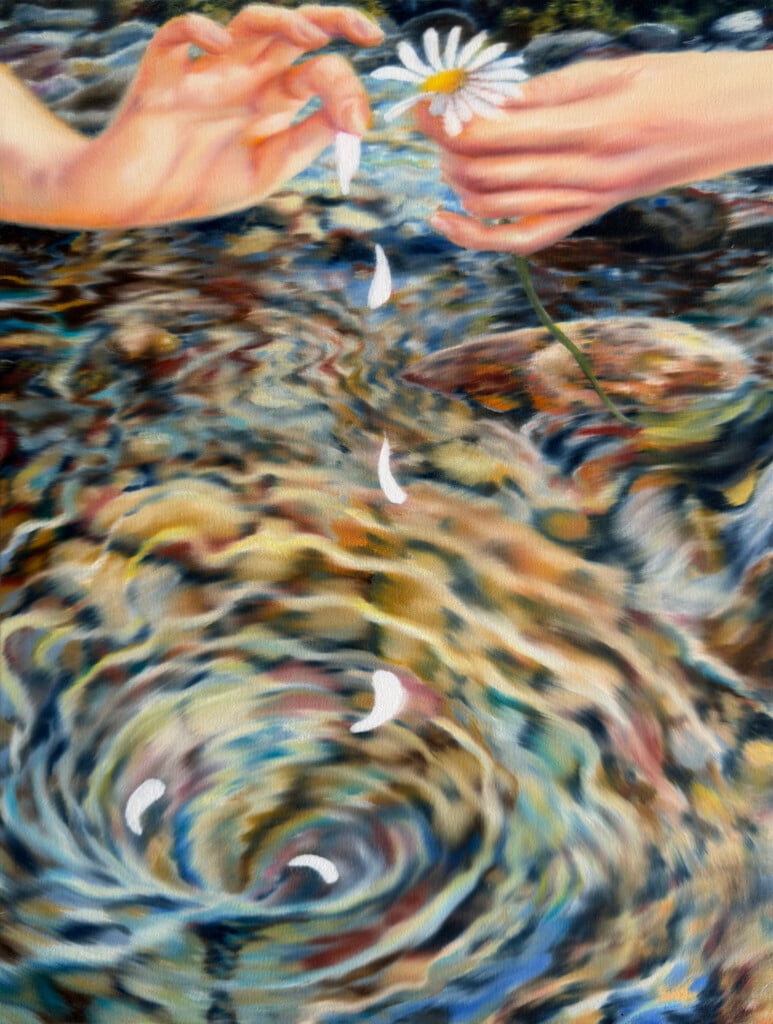
We learn how to be in the world before we even understand what that means: we learn how to sit, how to smile, how to appear, what to show and what to hold back. The body thus becomes the first place where social rules are written, corrected and repeated.
It is precisely from this silent education that Feral Kindness takes shape, the exhibition bringing together the works of Galamb Thorday and Claudia Petraroli, curated by Giorgia Aprosio, opened on September 24, 2026 at Anni Wu Gallery in Milan, where it can be visited until October 31.
The title already contains a contradiction. Feral refers to what is wild, animal, something that has escaped domestication; kindness instead evokes gentleness, care, availability. Put together, the two words bring out a less reassuring question: how much of the wild remains inside a body that has perfectly learned how to behave?
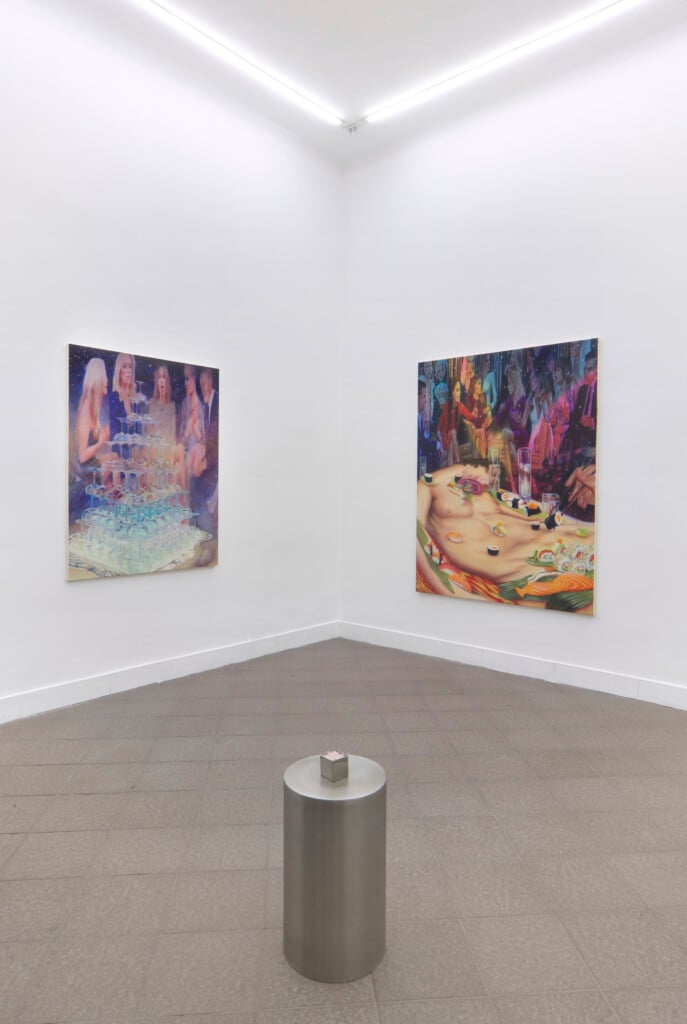
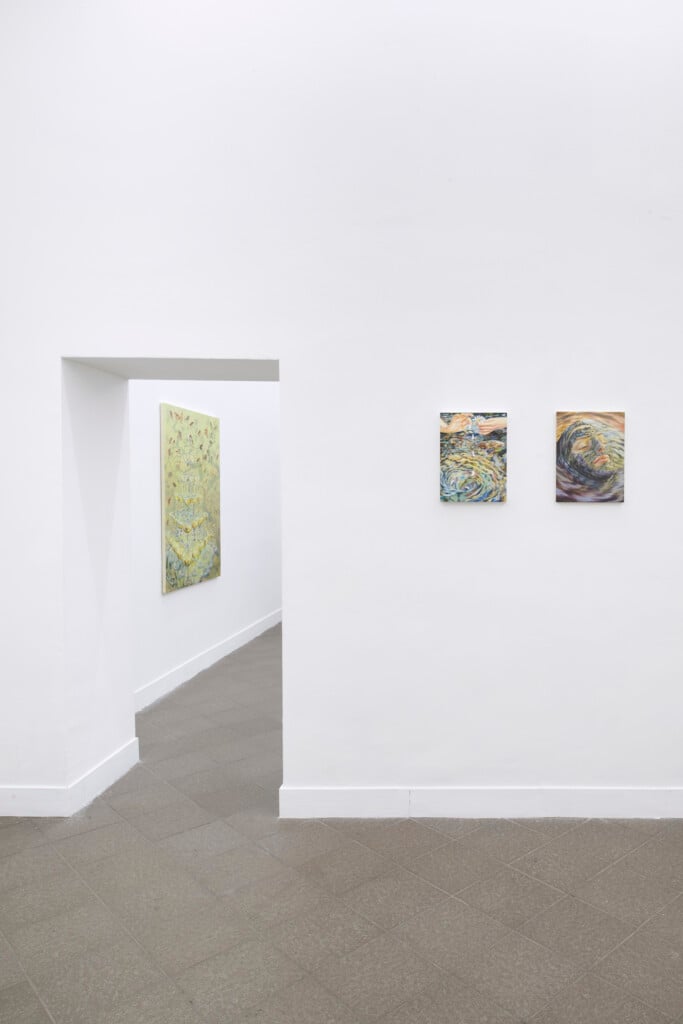
The exhibition doesn’t look for a definitive answer. Rather, it builds a situation in which that question becomes physical. The first encounter is with Host of Guests (2026) by Galamb Thorday. The scene might look like that of an elegant party, if it weren’t for the naked body of a man lying in the center, turned into a surface on which sushi is served. Around him, a group of women in evening dresses forms a circular composition, suspended between conviviality and aggression.
The work takes up and reverses the imagery of nyotaimori, a practice in which food is traditionally served on a woman’s naked body. Here the roles change, but the component of violence contained in being turned into something to be looked at, used, consumed does not disappear.
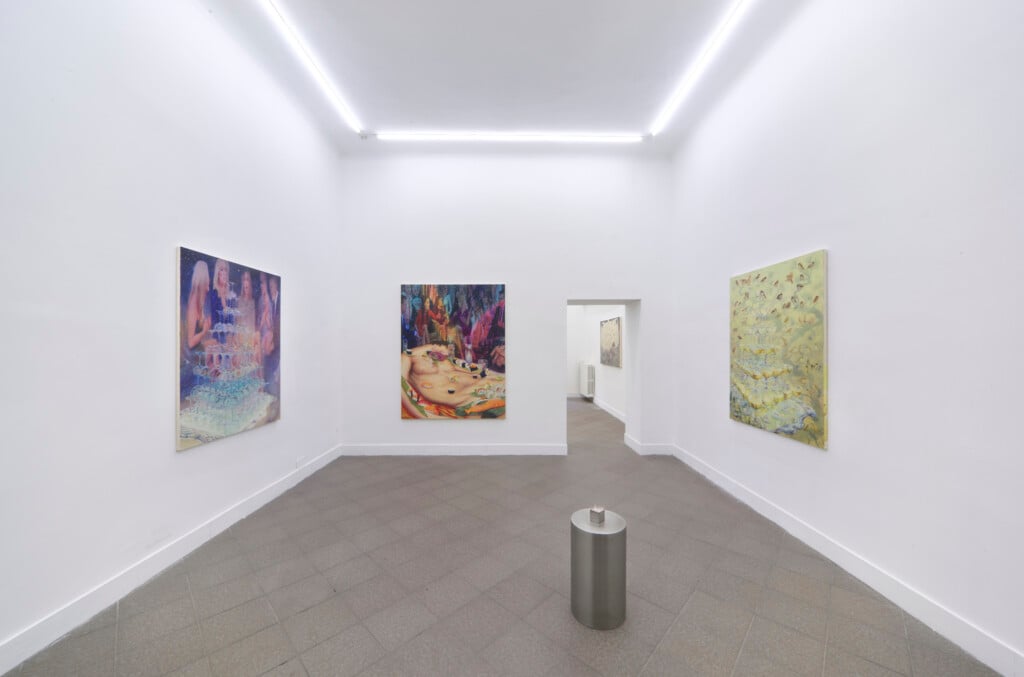
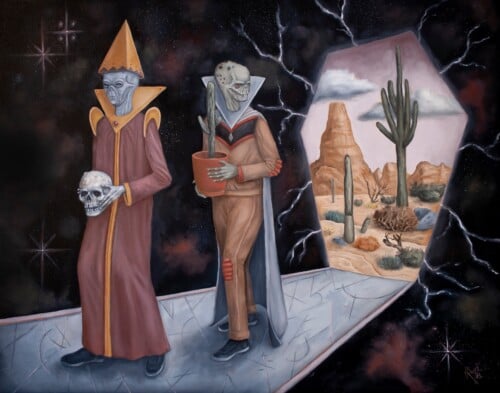
Thorday doesn’t need to build an explicitly monstrous scene. It is enough to slightly alter something we know. The bodies remain recognizable, the objects belong to everyday life, the setting retains a certain elegance. And yet everything seems to have slipped off axis. It is a feature that runs through her painting: realistic fragments are combined through unexpected associations, until they generate images suspended between the familiar and the uncanny.
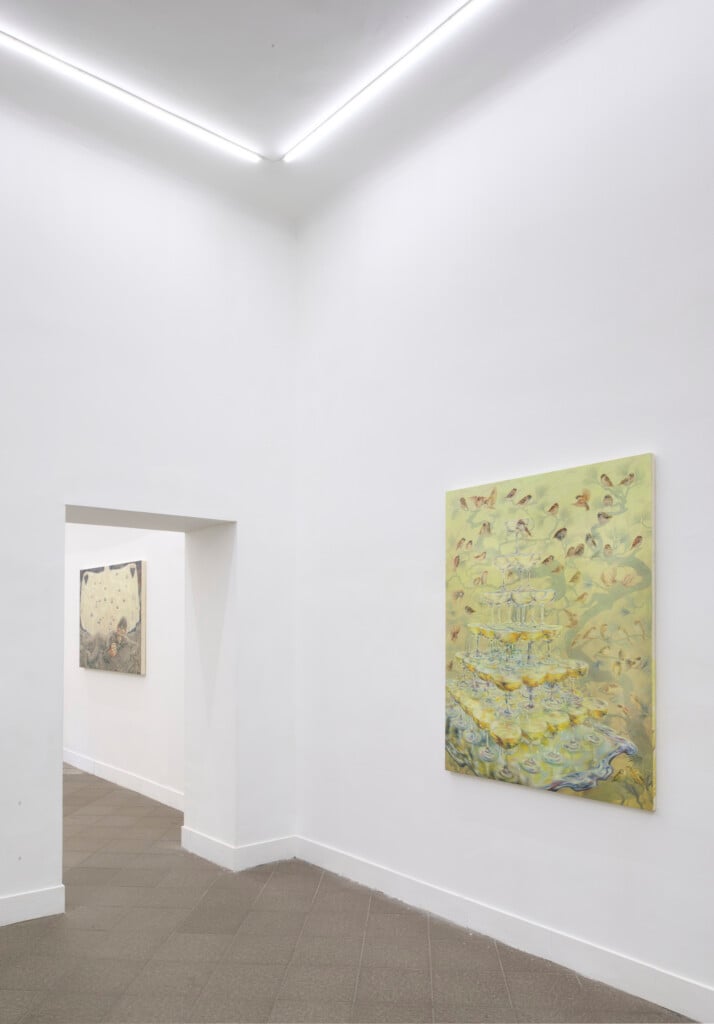
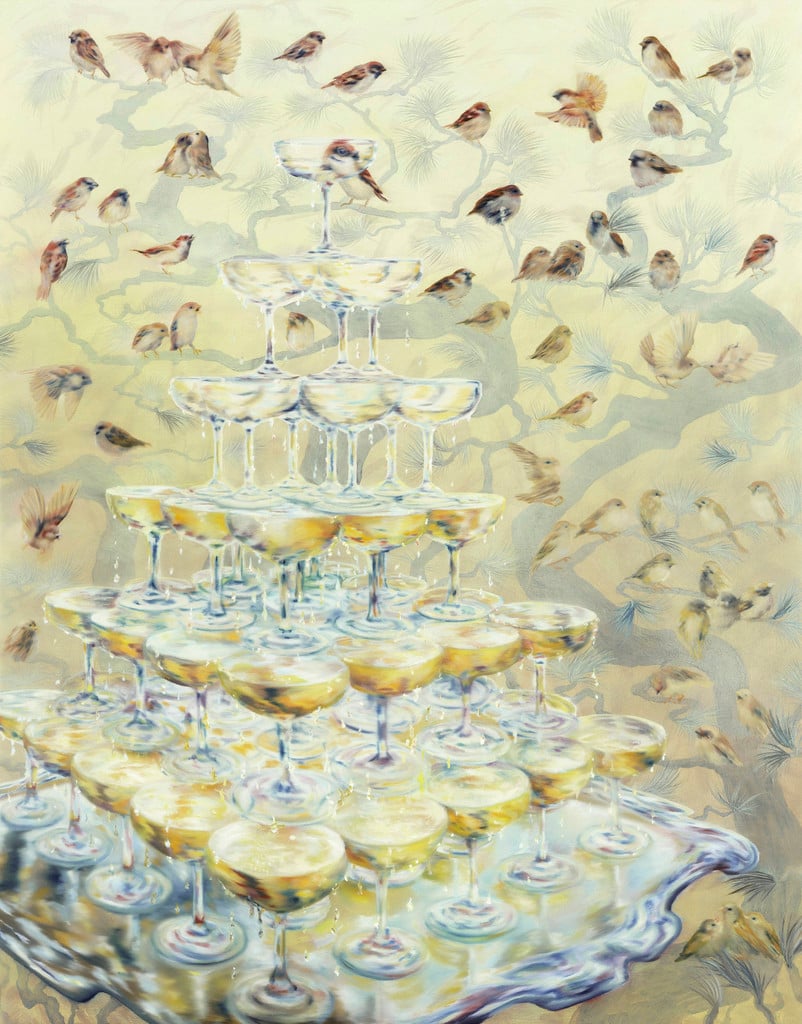
Glasses, too, become protagonists of this ambiguity. In Fizz and Feathers (2025) and The Master of Margaritas (2025), two pyramids of glasses face each other like two opposite moments of the same situation. On one side the glasses are still full and turned upward, on the other they are upside down. Composure gradually gives way to a more instinctive, almost animal energy. The party becomes a place where the rules of sociability begin to lose stability.
In the second room the tone changes, but the theme remains the same, because if the first part of the exhibition portrays the body at the moment it is exposed to others, here we enter the space that precedes representation, that of preparation.
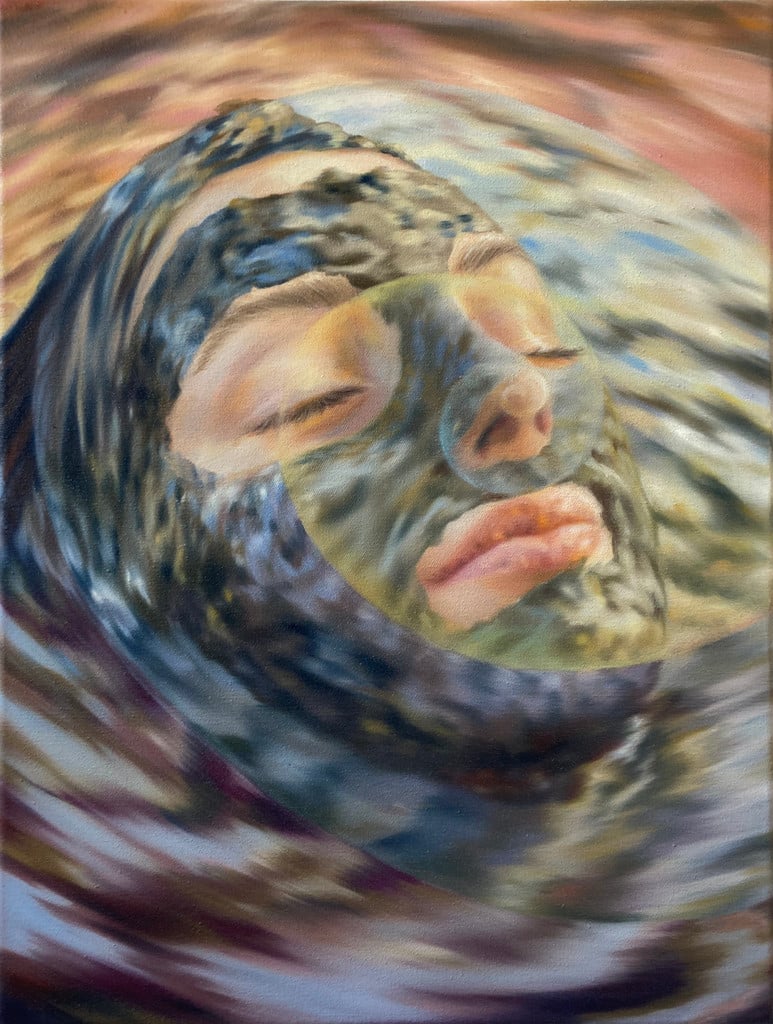
Creams, massages, treatments, beauty rituals: all gestures we are used to considering spontaneous or even pleasant and that, observed up close, reveal instead a component of repetition and discipline.
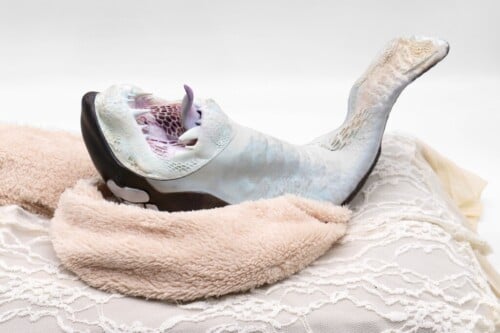
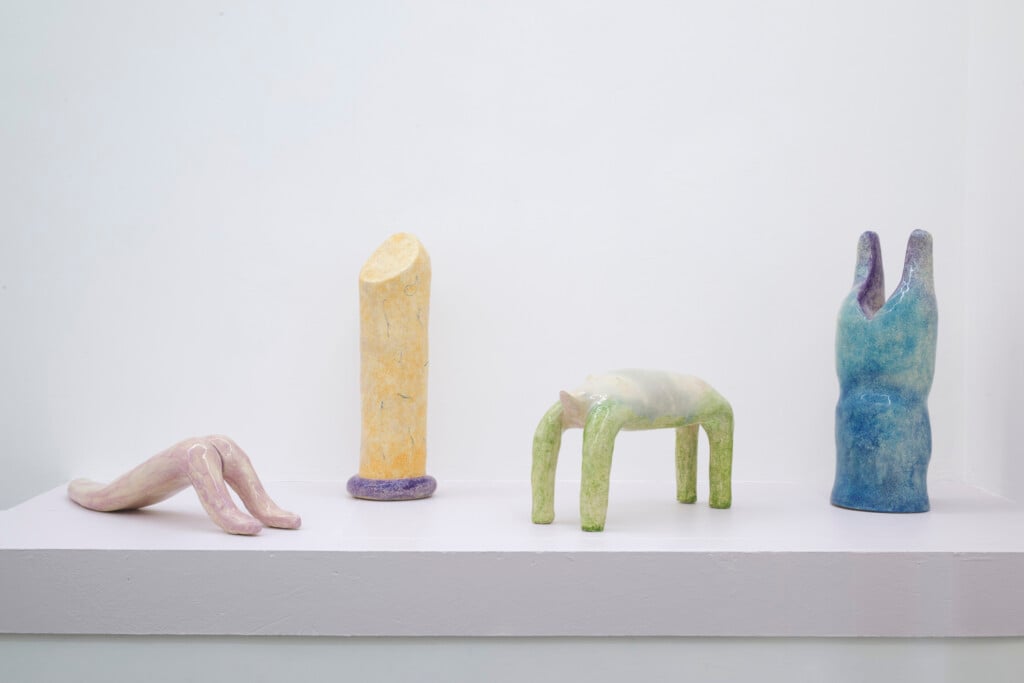
The sculptures of Claudia Petraroli are born precisely from this ambivalence. Tools linked to wellness are enlarged and turned into ceramic; stripped of their practical function, the objects take on almost archaic, anthropomorphic forms, also evoking the so-called Paleolithic “Venuses”.
It is interesting that what changes is not only the scale of the object, but our way of looking at it. What we normally use to take care of ourselves becomes a presence to be observed. A seemingly harmless tool thus turns into a question about why we continually feel the need to intervene on our bodies. Relaxation then becomes something ambiguous: no longer necessarily a liberation, but another practice through which we learn to control the body.
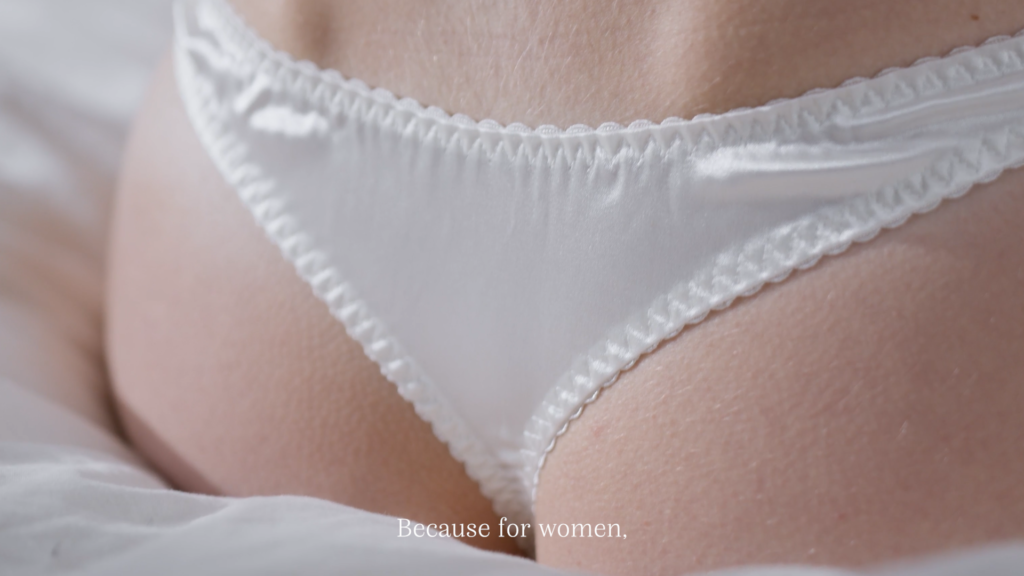
The path reaches its most immersive point with At some point, you will notice a gentle breeze stirring behind your eyes (2026), a video installation by Petraroli that carries the reflection from the surface of the body to the psychic dimension.
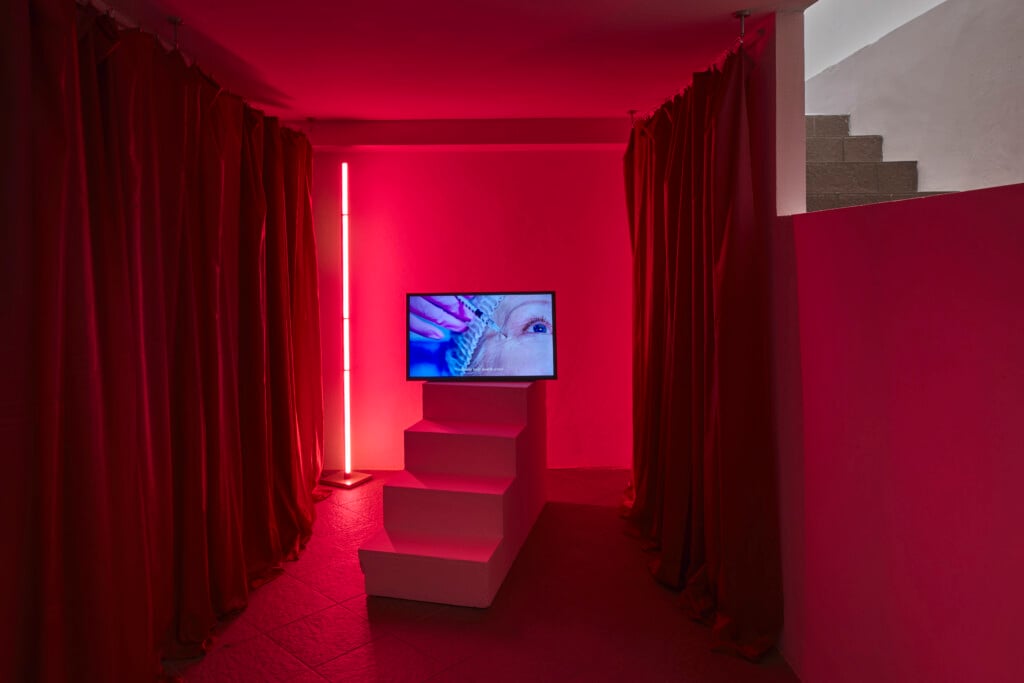
The viewer enters a kind of session guided by the calm tone of a female voice. The images show beauty rituals, female bodies and poses constructed to be observed. But the promise of relaxation slowly cracks: the instructions give way to texts by Valerie Solanas, Virginie Despentes and Sara Ahmed, which deal with aesthetic standards, male domination, work and prostitution. The voice continues to be reassuring while what it says becomes more and more uncomfortable.
In the finale, lipsticks, kajal pencils and rolls of toilet paper invade the screen. The reference is to Nawal El Saadawi, who during her imprisonment in 1981, deprived of paper and pen, secretly wrote her memoirs using a roll of toilet paper and an eyebrow pencil. Care, beauty and the objects of femininity are thus removed from their usual function and turned into instruments of resistance.
The dialogue between Thorday and Petraroli works precisely because their practices are different. Galamb Thorday, born in Keszthely in 1990 and based in Leipzig, works mainly with painting. Her images are born without preparatory drawings, through a kind of mental collage in which recognizable bodies, animals and objects are assembled until they lose their original logic.
Claudia Petraroli, born in Teramo in 1987 and active in Milan, moves instead across photography, ceramics, video and 3D modeling. Her research observes collective behaviors, consumption and the way everyday objects and rituals contribute to building contemporary identities.
One works mainly through the deformation of the image, the other through the transformation of objects and rituals. But both arrive at the same point: that space in which what we call normal begins to look strangely constructed. Feral Kindness is a way of closely observing everything we have internalized, good manners, beauty, care, relaxation, availability: seemingly harmless gestures that can hide a long history of training. In the end, what remains is not the opposition between the wild and the kind. It is the doubt that even kindness, when it becomes a continuous performance, may have something feral about it.