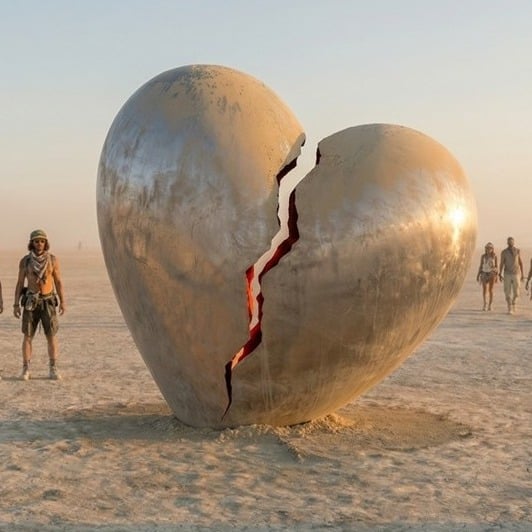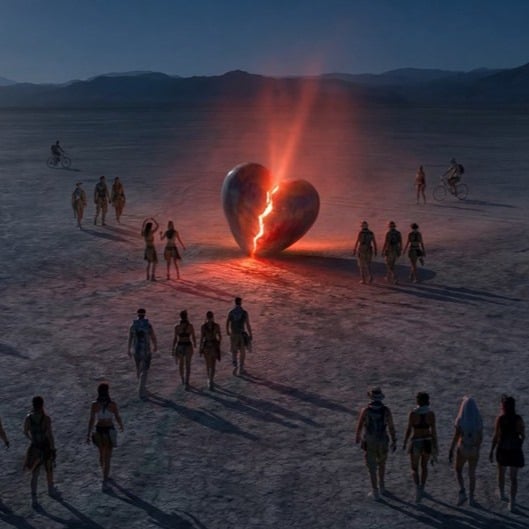
In the Nevada desert art is one of the ways in which Burning Man builds its own city. And in 2026, between cosmic trees, gigantic interactive architectures and surreal visions, the installations once again promise to transform the playa into a giant open-air museum.
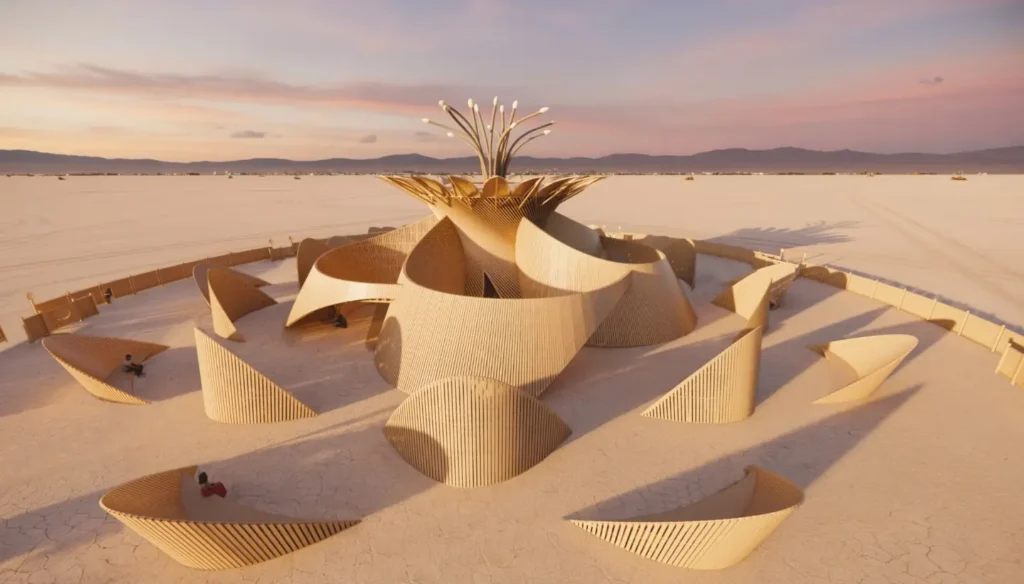
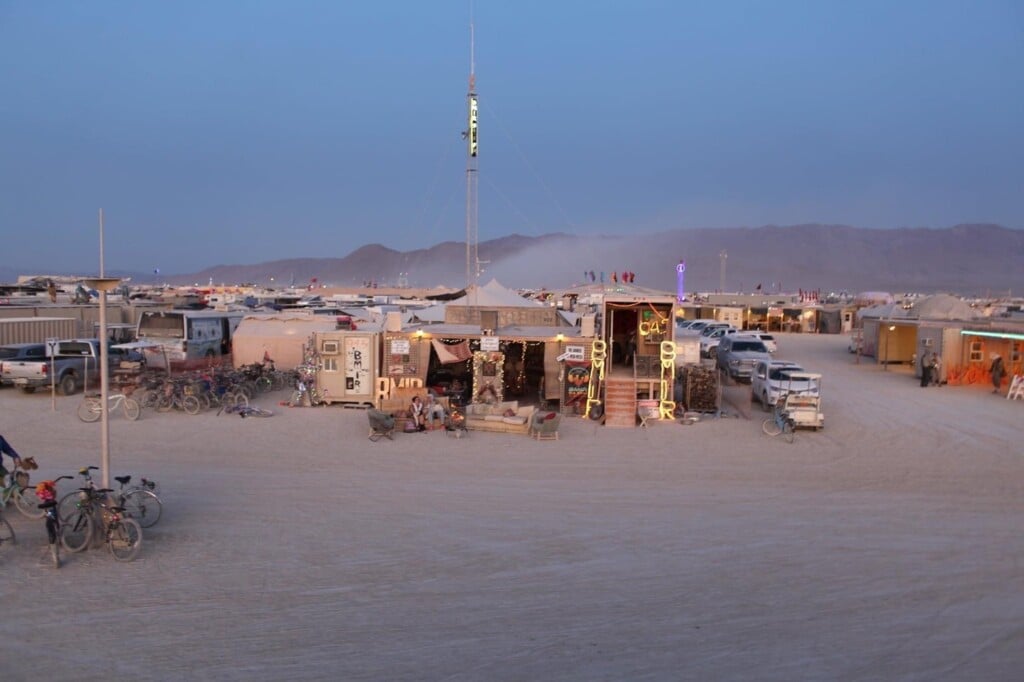
Every year, at the end of August, something appears in the desert that for a week seems almost like a hallucination: Black Rock City, a temporary city built almost entirely by its own inhabitants. Thousands of people arrive with tents, RVs, bicycles and ephemeral structures, but above all with ideas. Among them, some create enormous sculptures, walkable architectures, luminous works, sound installations and environments in which the public is no longer merely a spectator.
This is one of the features that makes Burning Man’s art different from that of a normal exhibition. The work is not simply looked at but is walked through and inhabited. For 2026 the chosen theme is “Axis Mundi”, a concept present in many cultures around the world indicating an axis, real or symbolic, capable of connecting Earth and sky, human and divine, the physical world and the spiritual dimension. Many of the selected works play precisely with this idea of connection, although Burning Man stresses that adherence to the theme is not required for selection.
A museum in the desert
Much of Burning Man’s art does not simply arise from the individual artists’ financial means. The Burning Man Project in fact runs a genuine funding program, the Black Rock City Honoraria, through which projects destined for the open playa are selected every year. In 2026, 75 projects were chosen, to which a total of approximately $1.3 million was awarded directly to the artists. On top of this comes an overall investment by the Burning Man Project of nearly $6 million a year for art, including equipment, logistics and other services.
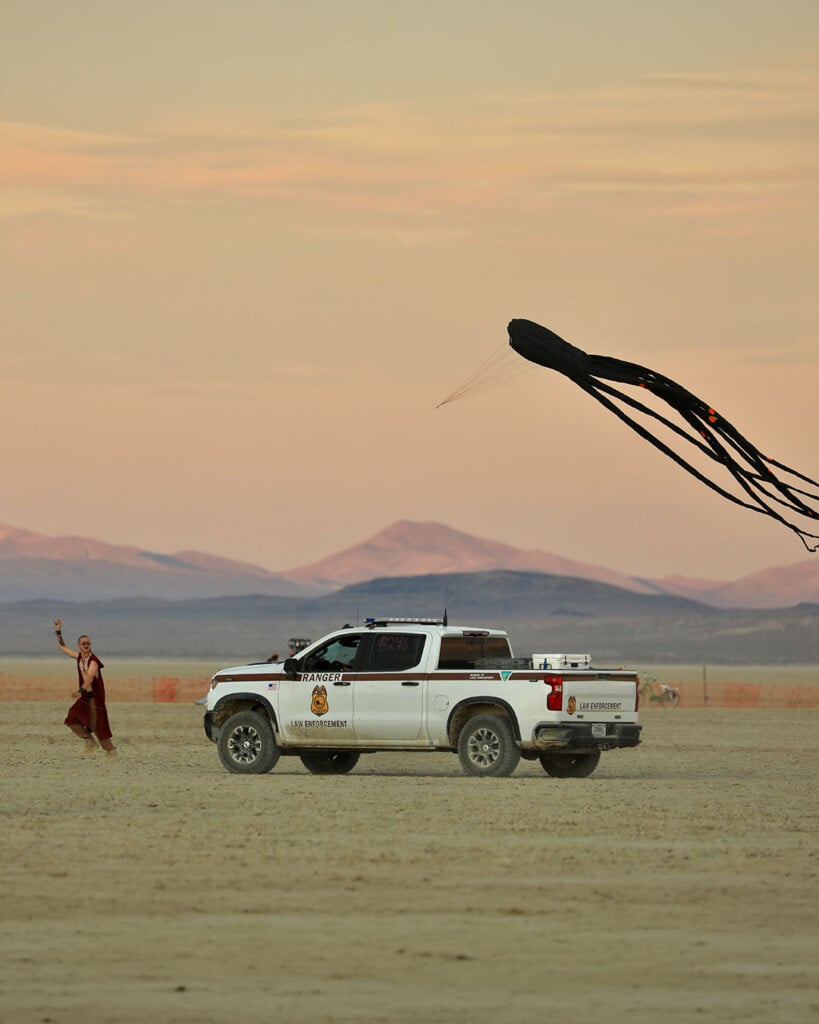
The program looks above all for works that are visually strong, three-dimensional, impactful, interactive and designed to be placed on the playa. Performances, workshops, DJ sets or simple structures are not funded through this specific program. And there’s another important distinction: the funded works are not all the works present at Burning Man. In 2026, more than 400 art installations are planned. The Honoraria thus represent a particular selection within a much larger ecosystem, in which works produced independently by artists and community groups also coexist. The Burning Man Project also offers support to artists who register their works, even when they do not receive Honoraria funding.
Among the many installations selected for the 2026 edition, we have chosen five projects that particularly struck us for their scale, originality and ability to transform the public’s experience.
ZARVAN — Gazelle Dasti
A gigantic human head that becomes an instrument for seeing, hearing and communicating.
Among the 2026 works, ZARVAN is perhaps one of the most successful in turning an abstract concept into a physical experience. The work by Gazelle Dasti is an interactive sculpture about 23 feet tall, inspired by Zarvan, an ancient Persian deity associated with time. The public can look through periscopes positioned inside the eyes of the work, observing the landscape through ZARVAN’s gaze. Tubes are instead integrated into the ears, through which people positioned on opposite sides can speak and listen to each other.
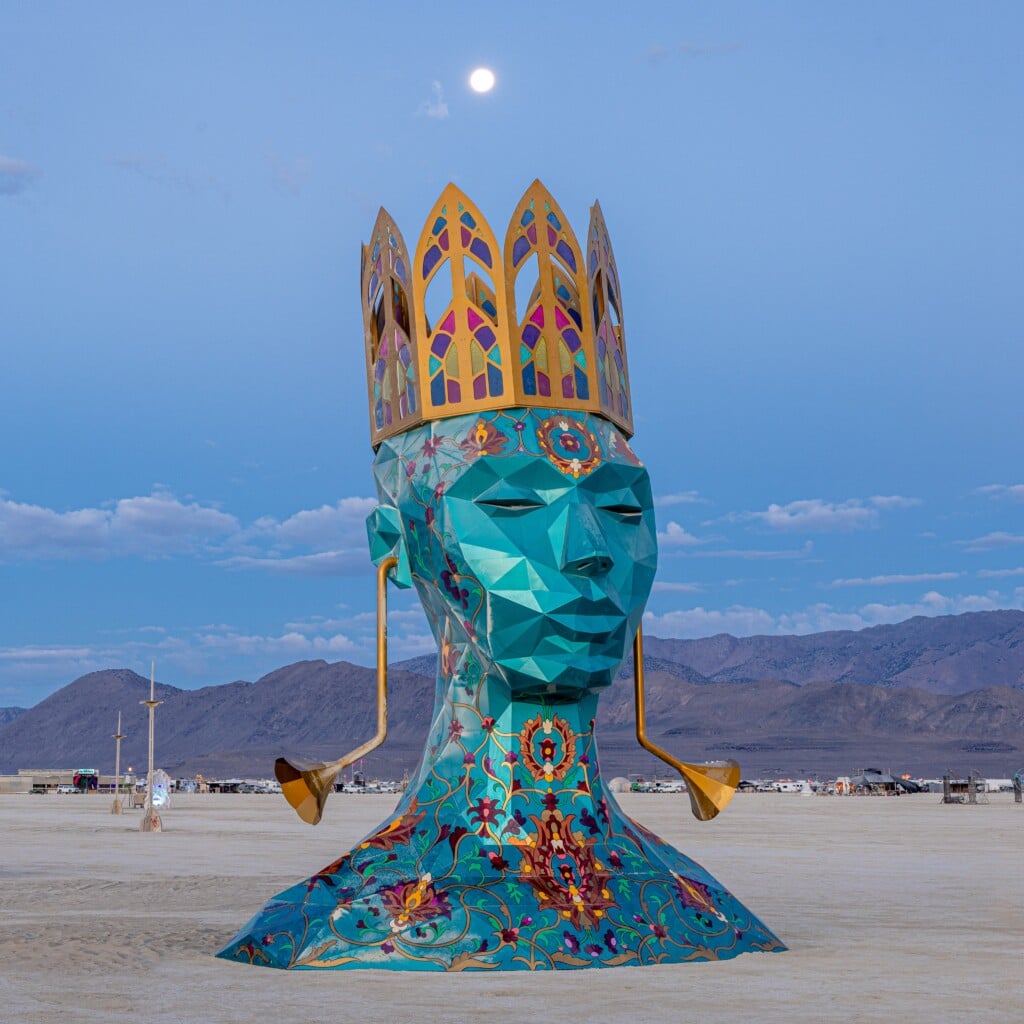
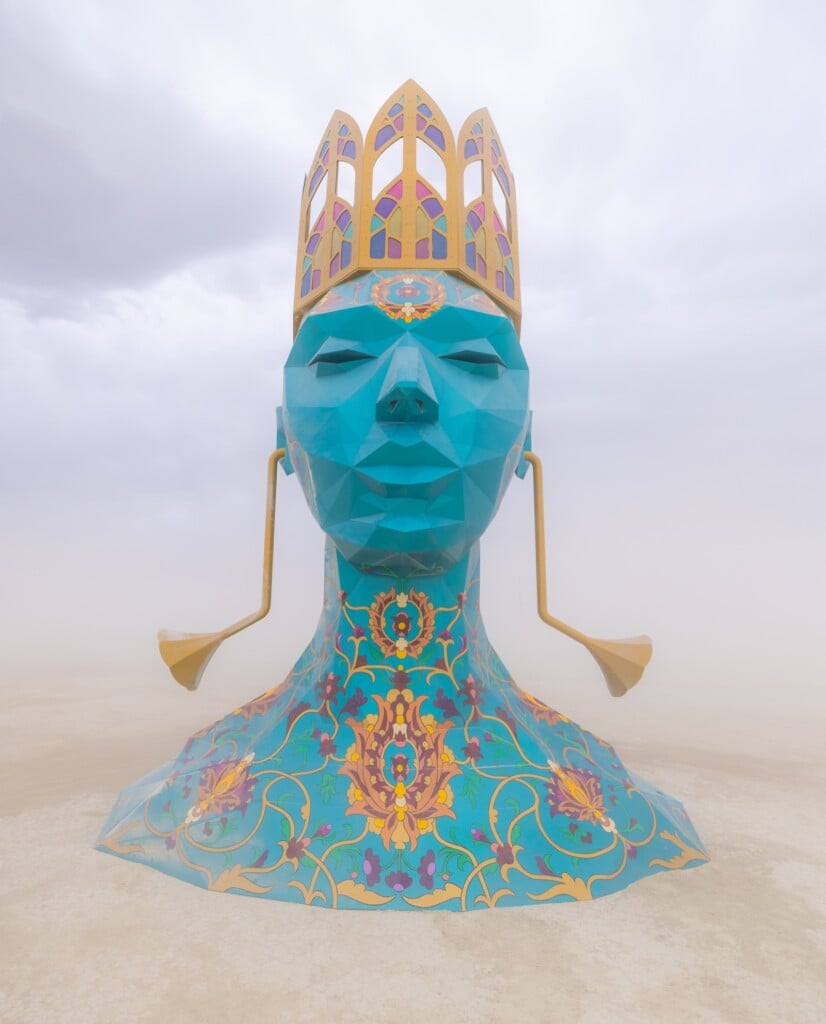
The sculpture thus becomes a kind of machine for human connection. It’s a work that embodies the theme of Axis Mundi very well: it doesn’t simply build a vertical monument, but creates an axis between people who would otherwise have no reason to communicate.
Above and Below — Sean Orlando
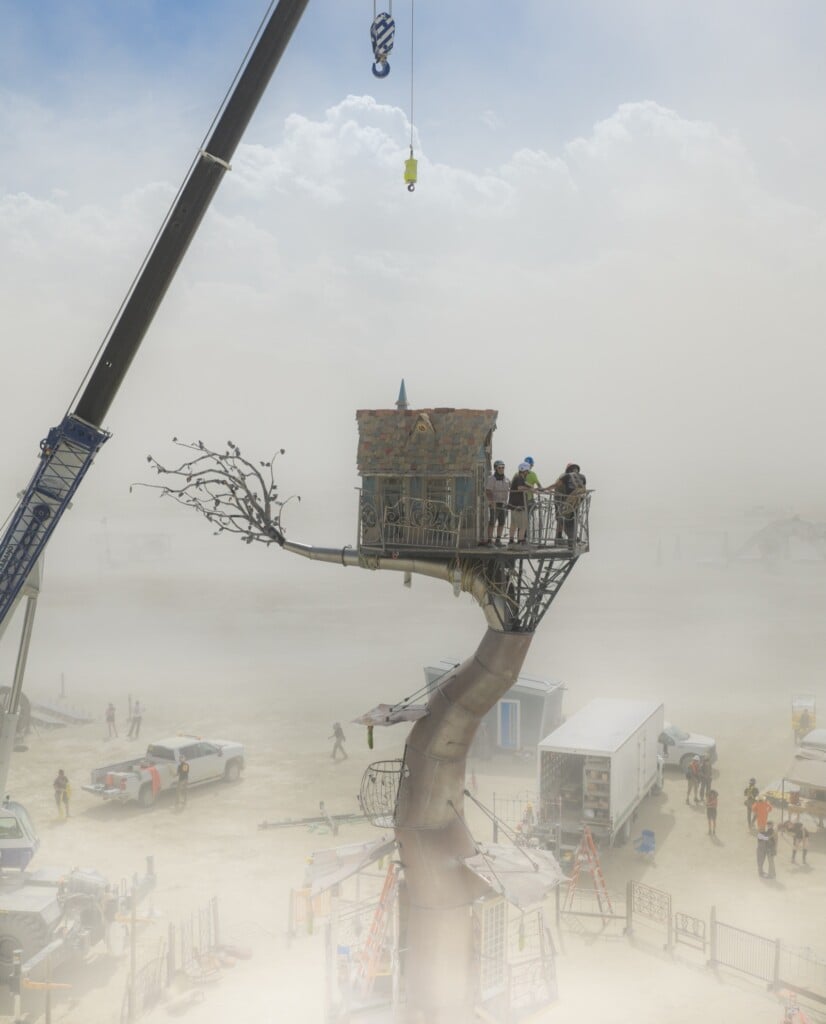
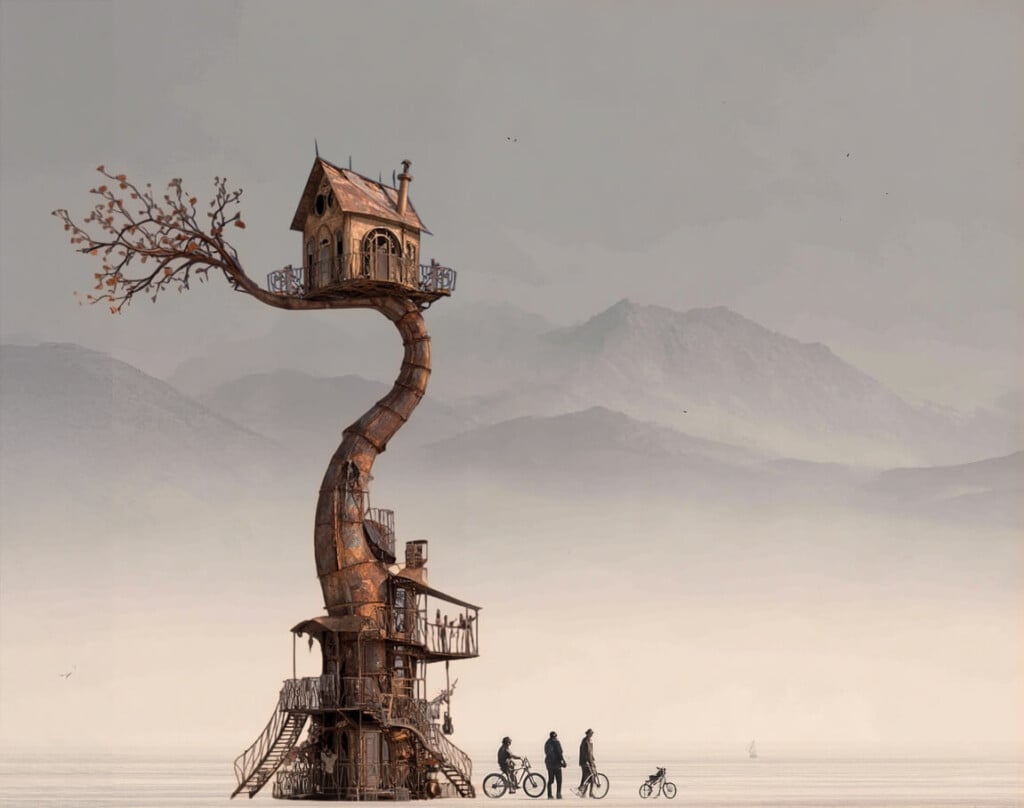
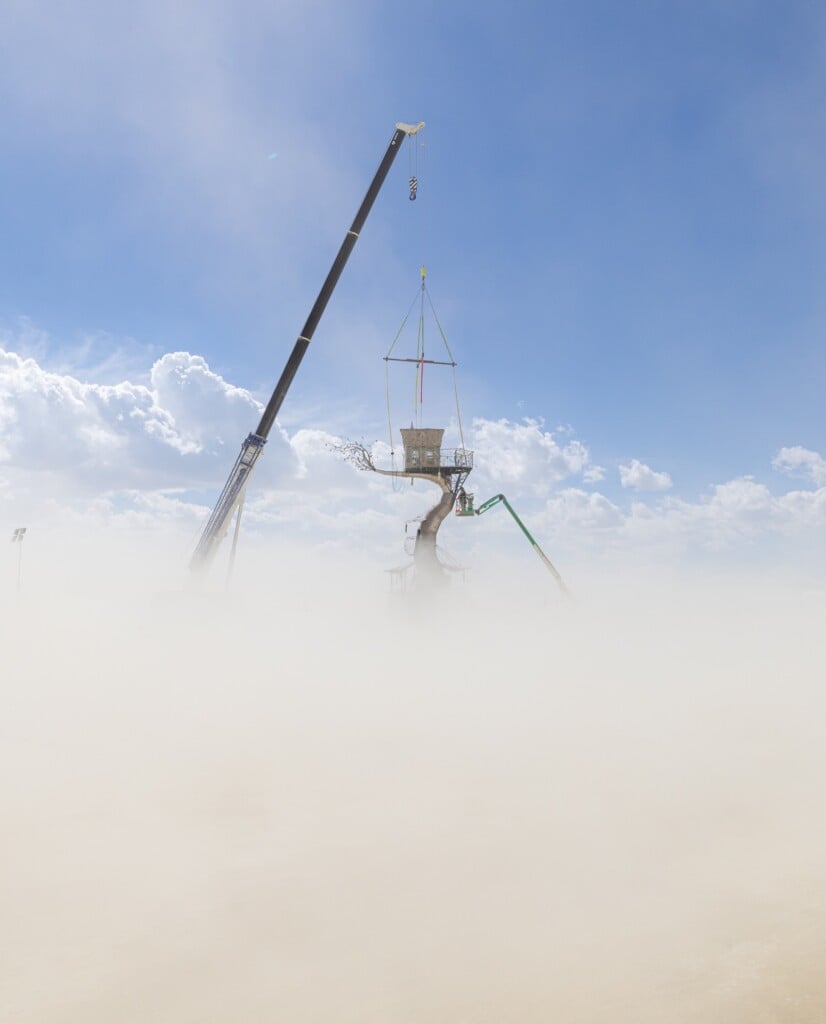
The theme Axis Mundi seems almost made for a work like Above and Below. Created by Sean Orlando, the installation is an immersive structure about 40 feet tall in which a kind of sinuous trunk connects two distinct environments. The project uses the shape of the tree as a metaphor for a connection between two worlds: the familiarity of home and the exploration of the unknown.
It’s one of the most literal interpretations of the theme, but that’s precisely why it works. The tree is simultaneously root and growth, memory and future, earth and sky. And above all it is not presented as an object to be observed from below: it is an immersive structure designed to be experienced.
ALUNA — The Frequency of Being
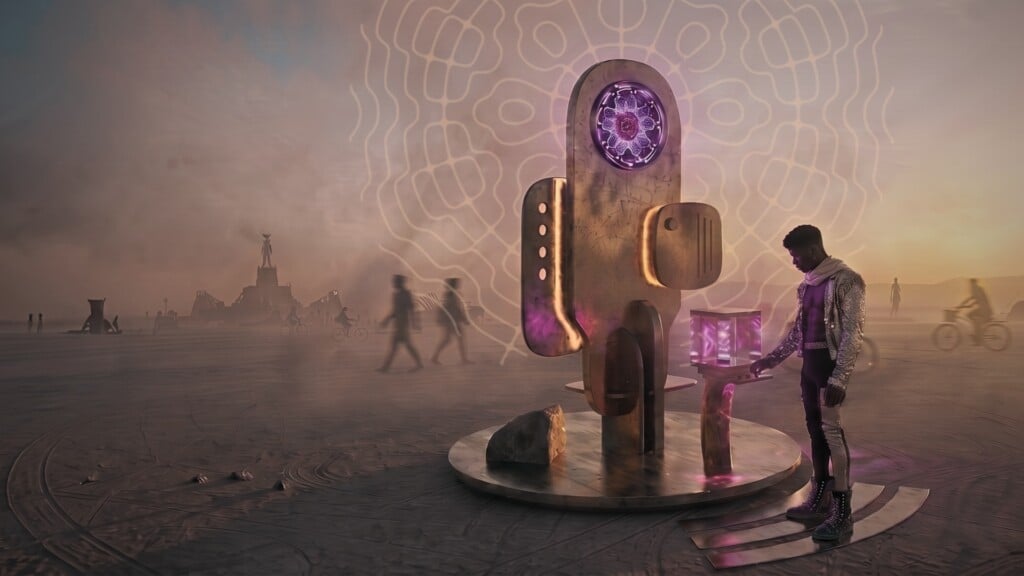
Among the most interesting international works of 2026 is ALUNA — The Frequency of Being, created by Santiago Caro, Tixana Ospina and Outline Creative Lab in Colombia.
The work draws on ancestral Tayrona symbolism and combines it with contemporary technologies. At its center it contains water and uses the vibrations produced by participants to modify the patterns visible inside the structure. It’s a particularly significant choice for a festival in which audience participation is an integral part of the work.
Here there is no clear separation between artist and viewer: the audience’s behavior contributes to producing what the audience sees. The result is a sort of visual translation of vibration, turning something invisible into something perceptible.
Axis Mundi: Resonant Spire — Sergei Konchekov
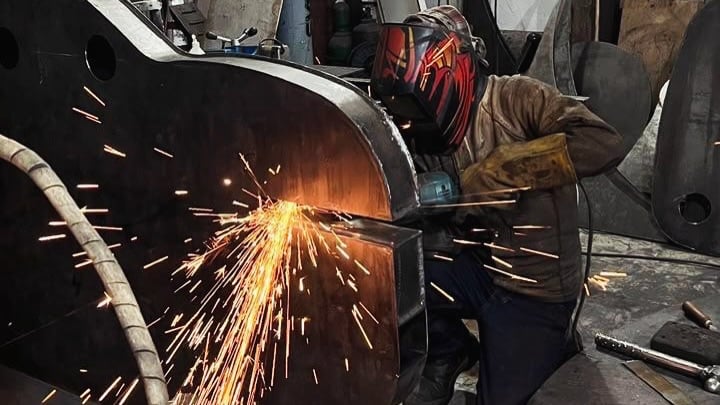
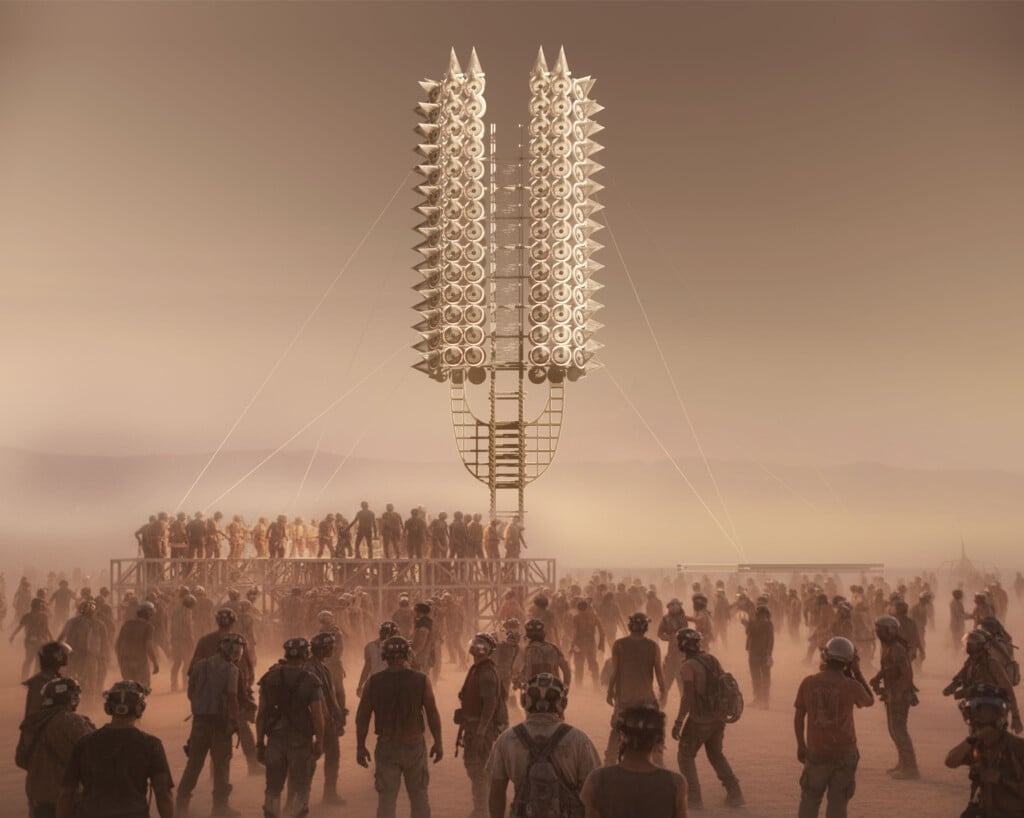
A 33-foot-tall wooden tower that turns participants’ voices into light and sound. If Axis Mundi means a connection between different dimensions, Resonant Spire is probably one of the most direct interpretations of the theme.
The work by Sergei Konchekov is a wooden tower about 33 feet tall. But its distinctive feature is that the structure captures participants’ voices and turns them into a continuously shifting composition of light and sound. The audience thus becomes part of the system.
In this sense the work perfectly encapsulates one of the most interesting features of Burning Man’s art: the sculpture is only the starting point. The complete work emerges from the interaction between structure, environment and participants.
Eiffela Broken Dream — Philippe Maindron
A broken Eiffel Tower in the middle of the Nevada desert, suspended between the collapse of a civilization and the possibility of starting again.
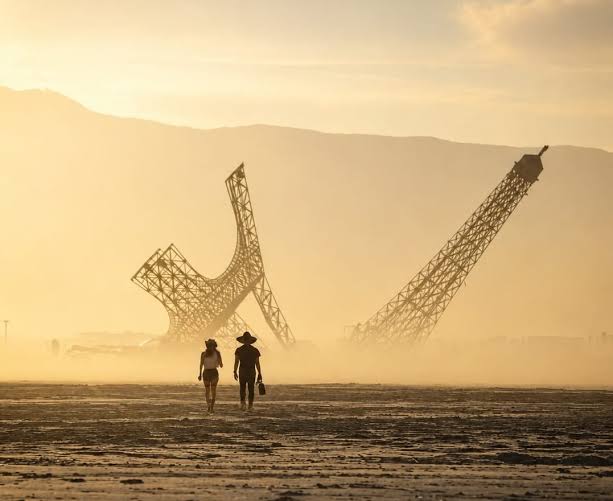
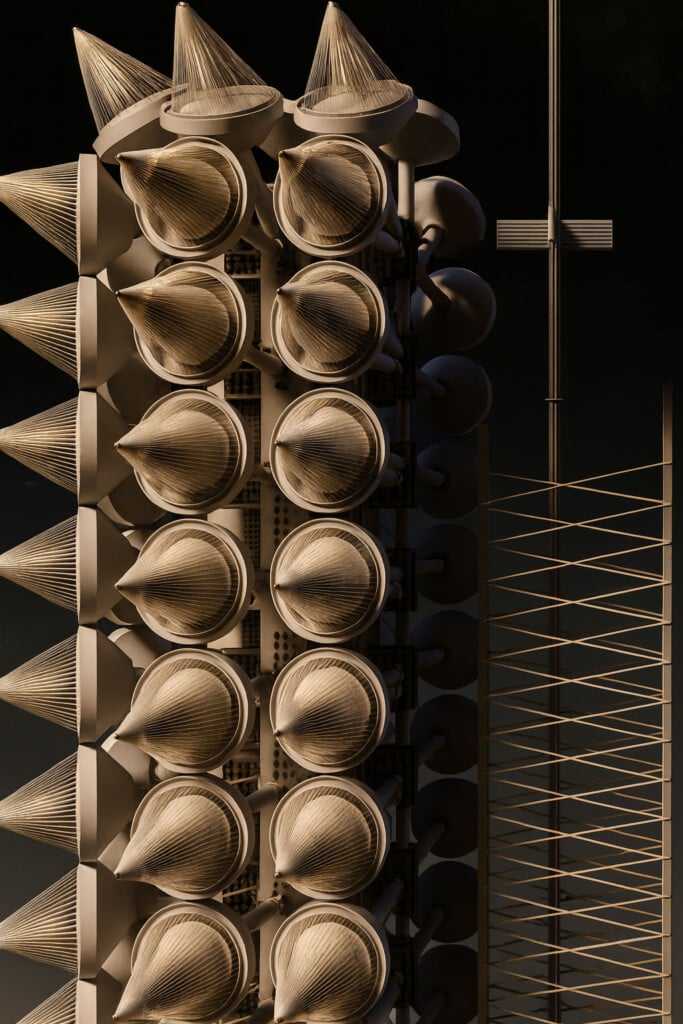
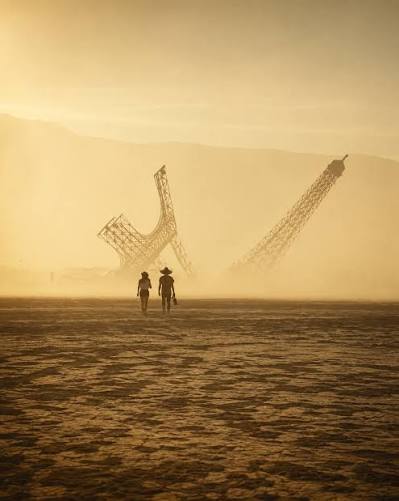
Among the most striking images of Burning Man 2026 is certainly Eiffela Broken Dream, the monumental installation by French artist Philippe Maindron.
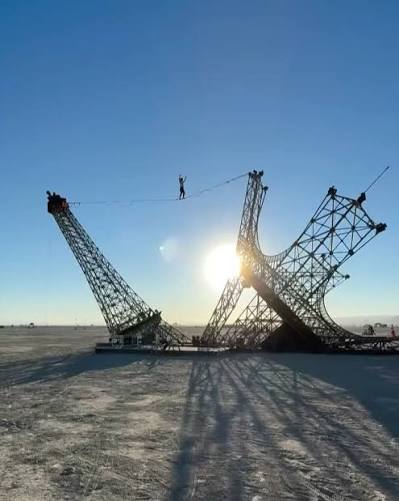
The work recreates the Eiffel Tower, but presents it as if it had fallen and broken apart in the middle of the playa. Made of steel, the structure stands approximately 15 meters tall and is composed of thousands of metal elements. The lower section of the tower, with its four legs resting on the ground, represents the collapse and sinking of a lost civilization. The upper section, however, continues to reach toward the sky, becoming a symbol of hope and the possibility of rebirth.
Connecting the two halves is a long suspended cable, where tightrope-walking performances take place: the void created by the destruction of the tower thus becomes a passage to cross.
The Eiffel Tower, one of the most recognizable symbols of modern architecture and the city of Paris, is completely removed from its original context. In the desert, it becomes a surreal image, almost like a ruin from another era and another world.
TITANIC — Titanic’s End
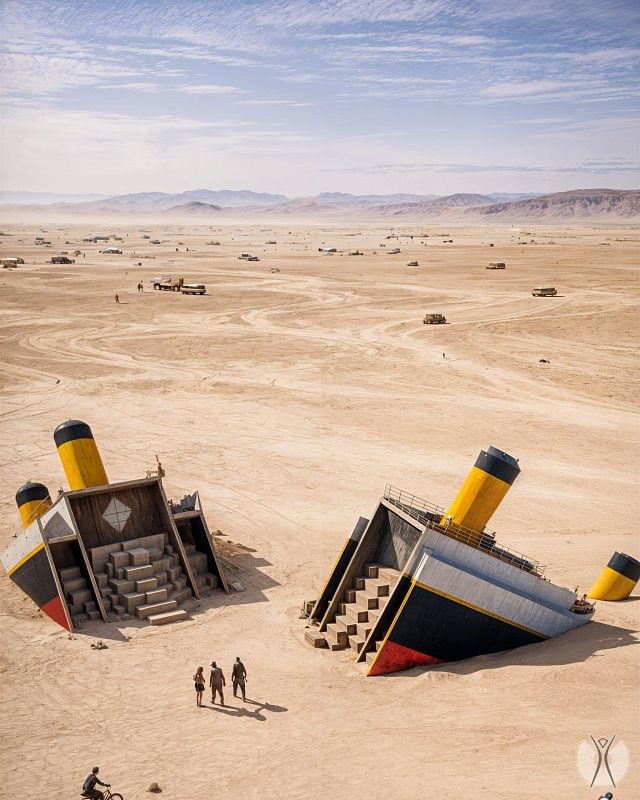
The Titanic in the desert. Broken, gigantic and fully explorable. If there’s one image that perfectly represents Burning Man’s logic, it’s taking one of the most recognizable objects in Western culture and rebuilding it in the middle of nowhere.
TITANIC is a gigantic representation of the passenger ship, but it is not conceived as a simple monumental replica. The structure is broken in two and reaches about 200 feet in diameter, creating spaces that participants can enter and explore. The choice is interesting because the Titanic carries an enormous amount of meaning: technology, ambition, luxury, tragedy, faith in progress and sudden vulnerability. In the context of the playa, however, the object completely changes nature. It’s precisely this shift from representation to experience that makes the work typically “burner.”
PULSE THE EARTHBEAT— Manuela Magni e Mauricio Guerrero
Among the installations at Burning Man 2026, Pulse the Earthbeat takes the idea of connection to a deeply physical level. Conceived by Manuela Magni and Mauricio Guerrero, the project is an immersive sculpture that uses light to translate participants’ heartbeats into a collective visual experience. Sensors detect the rhythm of the heart and synchronize the sculpture’s light frequency with that of the person walking through it. When multiple visitors interact simultaneously, their different heartbeats begin to relate to one another, transforming the installation into a kind of shared biological system where each individual’s body helps shape the artwork.
The project also introduces an element tied to the so-called “Earthbeat”: at the top of the structure, a light pulses every 26 seconds, mirroring a vibration recorded by seismologists off the coast of Guinea. The result is a dialogue between an intimate scale—that of the human heartbeat—and a planetary one.
However, the true defining feature of the art at Burning Man 2026 isn’t deciding which sculpture is the “most beautiful.” These five works reflect five completely different ways of engaging with an installation. And they all share one fundamental characteristic: they aren’t meant to simply be photographed.