No photographer, no movie stars, no exclusive parties. This year, the red carpet that was supposed to host the Montée de Marches has been left closed in the box and from the Promenade de la Croisette you can only hear the waves of the sea. For the fourth time in history, the Cannes Film Festival, which was supposed to start on May 12, has been canceled and while we wait to see what initiatives in the coming months will try to fill this void, let’s take a trip into the past of the festival through some of the most iconic posters.
1939
The very first poster for the Cannes Film Festival was commissioned to Jean-Gabriel Domergue, a French painter born at the end of the 1800s who specialized in portraits of young Parisian girls. The artist was able to finish the work shortly before the inauguration scheduled for September 30, 1939. Unfortunately, due to France’s entry into the war on 3 September, what should have been the first edition of the famous festival was never held.

1946
On September 20, 1946, the first real edition of the Cannes Film Festival began and, with the war behind us but the scars still deeply open, it could not fail to be the year of Rossellini’s “Roma città aperta“. In order to welcome the representatives of international cinema in the best possible way, the organizers hired Leblanc to create a poster that would draw attention to the location offered by the French town, with its crystal clear sea, the famous palm trees of the Promenade de la Croisette and the warm Mediterranean sun.

1974
The poster for the 27th Cannes Film Festival is a true homage to early French cinema. The rather surreal illustration of a man sitting on a sofa with a large winged eye instead of a head is an original work by Georges Lacroix.

1982
The image chosen for this edition of the festival pays tribute to Federico Fellini. It is in fact an image inspired by an original illustration made by the Italian filmmaker himself for “Amarcord”, one of his most famous films and which also earned him an Oscar for Best Foreign Language Film.

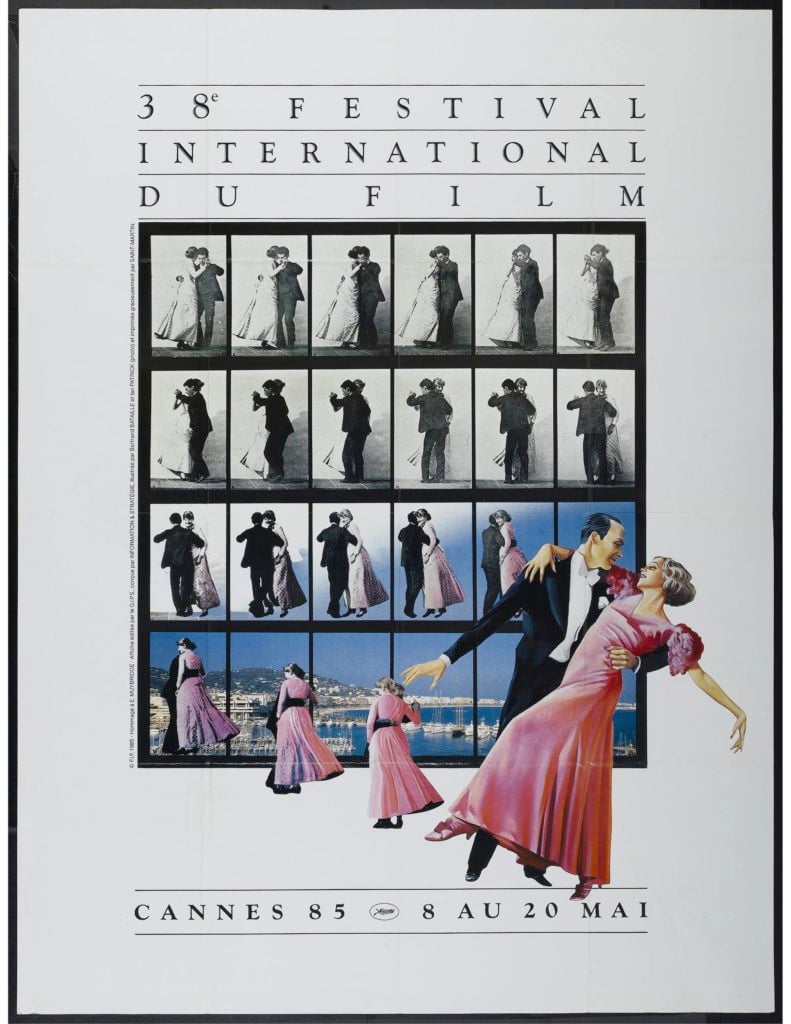
1985
The poster for the 38th edition is a tribute to Eadweard Muybridge, the British photographer and pioneer of movement photography. His is the famous series of 24 photographs showing a galloping horse.
This experiment, which went down in history as “The Horse in Motion” is considered one of the first examples of cinematography.
The image created by the agency Information et Stratégie is divided into 24 frames showing a couple of dancers. As well as focusing on the evolution of the movement, this graphic also emphasizes the evolution of cinema, from black and white to color.
1886
Also curated by the agency Information et Stratégie, the 1986 poster celebrates some of the most emblematic icons of cinema, from King Kong to Charlie Chaplin.

1990
The focus of this poster is all about the Festival and its undisputed symbol, the palm tree. What could look like a photograph, is actually an illustration made by Castella Traquandi.

1992
To pay tribute to the German actress who died a few months earlier, Marlene Dietrich appears in all her beauty on the 1992 festival poster. This time it is a photograph taken by Don English, a photographer with whom the actress worked on the sets of several films including “Shanghai Express“.

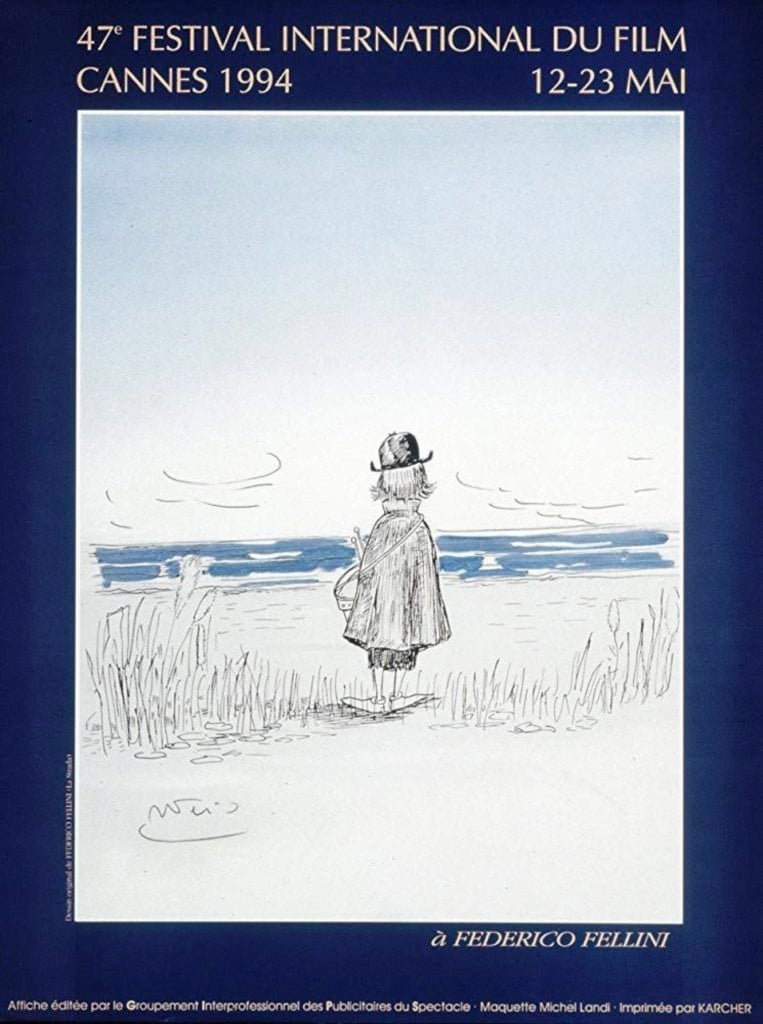
1994
The love for Fellini is back in the manifesto of the 47th edition of the festival. Also this time it is a sketch by the same director made for “La strada“. We can in fact recognize the character of Gelsomina seen from behind, with her drum, the coat that seems to swallow her and the inevitable bowler hat. The calmness and simplicity of Fellini’s illustration seem to balance the rawness and strength of the films in competition, among which “Pulp Fiction” stands out.
2008
The story behind the 2008 poster is different from the others, so much so that the official website of the Cannes Film Festival has the whole story and it is told by the author of the image himself.
The author of the poster of the Festival de Cannes 2008 is Pierre Collier, a cinema poster artist, who worked from a photograph by David Lynch who represents the model of the Crazy Horse Anouk Marguerite. “A few months ago, reading Eric Reinhart’s latest novel, “Cinderella”, rekindled in me a taste for the Palais Royal quarter. Often too hastily traversed, as it adjoins the most excellent “Chez Georges” restaurant, rue du Mail… One afternoon that I granted myself entirely devoted to strolling, I crossed the threshold of the covered passageway Vero Dodat with all its subtle melancholy. There one comes across a gallery, simply named “Galerie du Passage”, which had on display a troubling exhibit of fantastical shoes in situ, laid out at the feet of extravagant, bared creatures. This was David Lynch’s photograph exhibit, “FETISH”, sponsored by the brilliant creator of shoes, Christian Louboutin. I myself was confronted by an order as flattering as it was perilous: the Festival de Cannes had asked me to design the poster for the 2008 edition. Once one has reasonably refrained from employing the usual cast of the Red Steps, film strips, cameras, clapboards and palm trees, the temptation of a homage in the blink of an eye becomes a must. But the Festival wished to look forward. I quickly proposed a typographical principle from the undying font “Avant Garde Demi, Capitals in 100 spacing”, then that of “fade-in”, such as ritually employed by Jean-Luc Godard in his “Hi(stories) of Cinema”. But what should appear in it? What would be the nature of the revelation? My mind was a total blank. It is then that I remembered the photograph by David Lynch, that face of a woman revealed to concealed eyes… Reception / Screening… a moment in suspense… in the grip of sensuality. Platinum blond like a reminiscence of Norma Jean. A sanguine mouth offered like an echo attentive to this anthracite maskscreen… in the expectation of a revelation, magic? The cinema.”

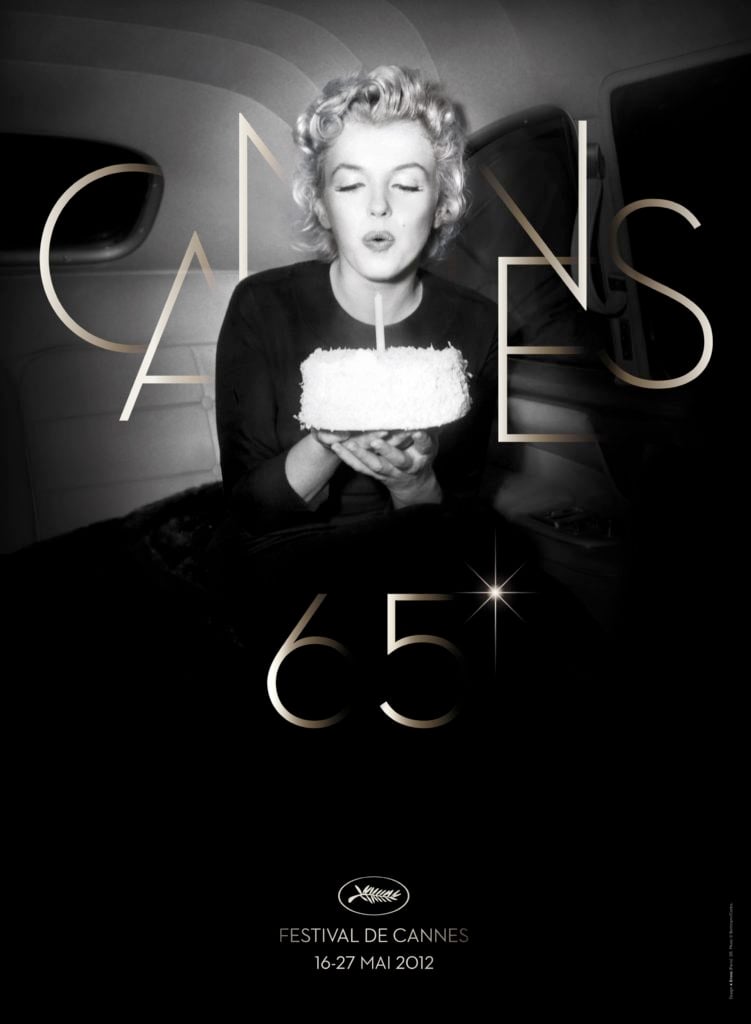
2012
Marilyn Monroe is the face of the 65th edition, captured in a photo by Otto L. Bettmann showing the legend of cinema blowing softly on a candle.
“Fifty years after her death, Marilyn is still a major figure in world cinema, an eternal icon, whose grace, mystery and power of seduction remain resolutely contemporary“. Just like Marilyn, the Cannes Film Festival is a symbol of timeless and unreachable elegance.
2016
Let’s finish with a manifesto that cannot go unnoticed. A man climbs a ladder – symbol of the famous Montée de Marches and therefore of the festival – facing the immensity of the Mediterranean Sea and everything is coloured bright yellow. For this edition, we wanted to pay homage to Jean-Luc Godard and his “Contempt“, inspired above all by the opening sentence in the film “The cinema,’ Bazin said, ‘substitutes for our gaze a world more in harmony with our desires“.
For its 69th edition, the Cannes Film Festival celebrates the magic of cinema, the art of imagination.