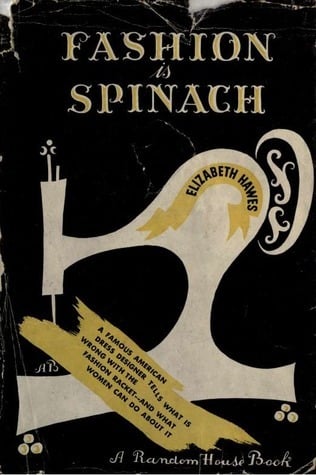
In 1938 Elizabeth Hawes published Fashion Is Spinach, a book whose title sounds like a statement: “fashion is like spinach,” she said, “you may eat it out of habit, but that doesn’t mean you really like it.” It’s the opening of a book that, more than the memoir of an American designer, is a cultural detonation against the fashion system as it existed on the eve of the Second World War. A text we should pick up again today precisely because it anticipates many contemporary discussions about authenticity, production, and the construction of taste.

At the time, Hawes was already an unusual figure: she had worked in Paris, knew couture from the inside, and studied the power of American buyers who, crossing the Atlantic on the Normandie – the ship that was nicknamed the Seventh Avenue Express – brought back to New York designs, patterns and the idea that “real” fashion was born only on the banks of the Seine. In her pages she dismantles exactly this mythology: the French myth as a cage, as a limit that prevents America from developing its own identity. It’s a perspective we revisited a few months ago also in the Financial Times, as historians and curators analyse that decade as the cradle of American fashion.

Hawes, however, had already seen this horizon back then. For her, fashion is a rigid system, an industrial mechanism that creates desire almost automatically: what is produced is what is convenient to produce, not what is truly needed. Her target is not style — on the contrary, she defends it as a personal gesture, as a language — but “fashion” as a collective ritual, seasonal, manipulated by industry. A distinction that may seem obvious today, but in 1938 it was an almost subversive statement.
What strikes you in the book is the clarity with which she describes the contradiction of America at the time: a country that produces 80% of the clothes it wears, concentrated in Manhattan’s Garment District, yet continues to chase European couture as if it had no design capability of its own. And yet, a few years later, during the Nazi occupation, the Parisian maisons are forcibly brought to a halt and that dependence is suddenly broken. Only then does America – from Claire McCardell to Mainbocher – find an autonomous language made of pragmatism, simplification, and that nonchalance which will become synonymous with the American Look.
Fashion Is Spinach anticipates all of this. With irony, but also with an almost documentary precision, Hawes describes the uselessness of certain diktats, the absurdity of forced trends, the frustration of consumers, the gap between what is needed in real life and what the industry decides is desirable. In short, it’s a book that feels like it came out the other day: it criticises mass production when fast fashion did not yet exist, defends tailoring at a time when the word “artisanal” was not a marketing label, and exposes the logic of the trend before it became an algorithm.
Rereading it today means going back to a simple question, which Hawes repeats like a mantra: why do we wear what we wear? Because we need it, or because someone has convinced us that we need it? It is this reversal of perspective that makes Fashion Is Spinach such a contemporary text: every time it feels like we are subjected to fashion rather than choosing it, we can already find the answer in those pages.
It is a book full of wit, dissent and a vision that at the time was perhaps not fully understood. But today, in an era of rapid consumption and instant desire, it resonates with an almost prophetic force. Hawes did not want to destroy fashion; she wanted to free it. And perhaps it is precisely in refusal – in saying that we don’t like spinach – that we can start thinking again about the way we dress.
Read also: Zara turns 50 between nostalgia, creativity and many contradictions