For Hubert Crabières, a French photographer working between fashion and the visual arts, every image stems from a real tension: the one between what he imagines and what can physically hold together. On his sets, often built with limited means and within tight timeframes, everything is genuinely unstable, on the verge of collapsing during or immediately after the shot. It is within this space of instability—physical before even conceptual—that his work takes shape.
Moving between fashion, publishing, and cultural institutions, Hubert Crabières develops a practice that resembles a performance without an audience, where the camera acts more as a threshold than an end. The image is never fully resolved: it reveals its own mechanisms, embraces the unexpected, and retains traces of what escapes control. Rather than constructing perfect illusions, he seems drawn to that moment when balance begins to crack and something, inevitably, slips away.
It is from this tension that our conversation with him begins.

In many of your images—where objects, bodies, and materials seem to pile up to the breaking point—there’s always the feeling that something might give way at any moment. How do you create this unstable balance during the process?
I think this sense of instability in my work stems, first and foremost, from the literal physical instability at the moment of capture: everything is often balanced precariously and collapses during or right after the click. It also comes from a kind of instability in the negotiation between my ideas and their feasibility, of which this literal search for balance is a reflection. I rarely have the time or the means to test an idea or allow myself multiple takes; I was actually going to write that I rarely have the means to ‘rehearse’ because it feels very close to a stage performance.
Leading up to the shoot, I let the project evolve mentally through different forms, even the most catastrophic ones, so that I’m ready to negotiate with whatever resists or fails on the day. Most of my projects involve a performative dimension that is almost at odds with the laws of physics; everything is hanging by a thread, and it’s this tension that the camera captures.
On a more strictly photographic level, this instability is also a play on the entire narrative built around the ‘photographic moment,’ the ceremony of organizing a shoot, and the sense of submission to the camera. I like to overplay this event, to turn it into a spectacle, and play with this moment where the timing is dictated by the staging’s ability to remain balanced. It’s as if I want to dominate the camera, but it always ends up winning.This instability is therefore a reflection of all these questions converging at the moment of the shot.
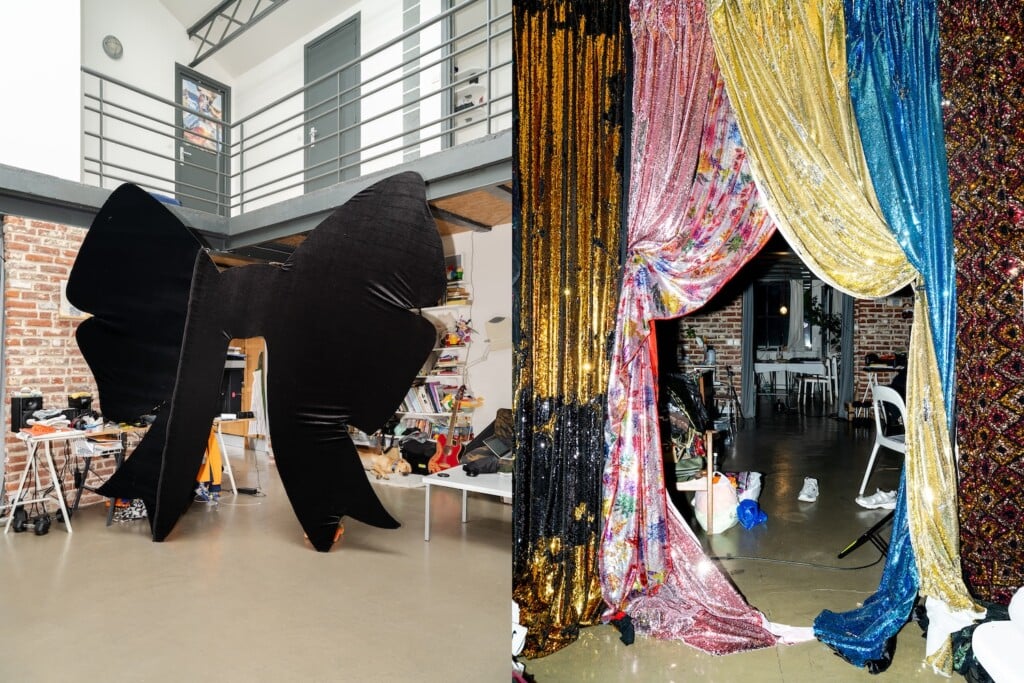

In your sets, we sometimes glimpse props, tricks, and technical elements left visible, as if the image’s device were never completely hidden. What role does this choice play for you, not to “close” the illusion, but rather to declare its artifice?
When this aspect of my work is brought up, I sometimes say that I am like a magician who leaves his tricks visible, or whose tricks are visible despite himself. I recently read an article by Emile Rubino that featured a quote by David Campany: ‘The lens captures what exceeds the eye.’ Leaving the artifice visible is almost like a reminder that this magic trick exists for a camera whose viewpoint exceeds my own intentions. In fact, my intentions occupy only a small space within the photographic frame.
In the beginning, I didn’t intentionally leave these details in; but I was shooting with a wide-angle lens on film, so I would only discover them once the image was developed. I found an interest in this ‘off-camera’ element that ultimately doesn’t speak about what is outside the frame, but definitively about what is happening inside it, focusing our attention even more on what is at stake in the image. Deep down, to avoid being purely sucked in by the image, it’s important to me that it reveals its own mechanics.
To return to the previous question, my shoots are often moments of such high tension that I stop worrying about the framing and focus entirely on what is happening in front of me, ready to react if something collapses. That is often why an arm, a hand, or a cable ends up in the shot.
Finally, I’ve been heavily influenced by early cinema, what is sometimes called the ‘Cinema of Attractions.’ It was an era where spectacle and stage magic met cinematography, gradually inventing a unique vocabulary that blended stage tradition with questions of optics and chemistry. There was always something makeshift about it, a visible deception, and paradoxically, for me, that reinforced the conceptual power of the image.
I’m thinking of those images in which humble materials, everyday objects, or almost improvised solutions coexist with a highly constructed aesthetic. How important is it for you to maintain this DIY dimension even when working on more structured productions?
I’ve never really thought of my work in terms of ‘DIY’, at least not as an aesthetic in itself, where DIY becomes the very purpose of the image. My impatience to realize an idea simply means I work with what’s around me. To put it simply: I try to create an image as it would look if my resources were unlimited and if gravity didn’t exist. But my resources aren’t unlimited and gravity is inescapable, so I make do with what I find.
When I look at the final image, I want to see the spectacle itself, not a spectacle of the ‘aesthetic of its production,’ even if that is obviously present. Perhaps delusion is the engine behind my images. In any case, I’ll never have the means or the patience to realize my ideas exactly as they exist in my head. There’s also a paradox where the more resources I have to realize my ideas, the less ‘achievable’ they become, either for lack of time or due to technical constraints. So, I always end up back in this position where, if I want to make them happen, I have to settle for limited means.
My photographs are, in a way, performances without an audience, but performances nonetheless, in which I seek a sense of wonder, even if it’s built with tools that will, to some extent, make the result ‘disappointing.’ Ultimately, I see all of this as forms of resistance: resistance to photography as a medium, as an icon, or as a screen between us and the world; resistance to the narratives and aesthetics of commercial photography or speculative art, and so on. All these imperfections perhaps betray a kind of enthusiastic self-sabotage in the face of this confusion.

In your works more closely related to fashion, there’s a sense of tension: on the one hand, styling and construction, on the other, elements that seem to escape control or introduce irony. Is this a balance you consciously seek?
I think I’ve already partially answered this, but to be more precise, I would say that the various contexts in which I create images involve different types of relationships with my ideas. Or rather, my ideas negotiate differently with the contexts underlying their realization. First, I would say that I am, or I try never to be, ironic. If I carry out a project, it’s because I’m in alignment with it and because I’ve interrogated the context enough, to the best of my abilities, to stand by it. I am not an ironic person; I doubt too much for that.
However, I do recognize a form of humor in the contrast between the commercial ambition of an image and my own ambitions, which exist on a different plane, a contrast between the scale of my staging and the tools I use to achieve it. The more a context involves economic tensions, implicit rules, symbolic stakes, or power dynamics, the more naturally the need to control the image arises. But I believe that a controlled image is, above all, an image that controls us. By introducing this lack of control, as uncomfortable and stressful as it may be for me during the shoot, I also introduce fragility. I like the idea of a ‘fragile humor,’ and that brings us back to this question of balance.
You’ve often distanced yourself from moodboards and references, yet your images clearly engage with contemporary imagery. How do you construct an image without starting directly from other images? Is that still possible today?
I would say that ‘aesthetic’ and ‘style’ are terms that have never interested me. The moodboard transforms every practice into mere surface, into style, into purely formal decisions. Besides, one is never more intelligent than their moodboard, quite the opposite, in fact. It’s quite surprising to me that people don’t realize this. I think there is a difference between a moodboard and a dialogue, or simply a confrontation or contact, with the references that surround us or precede us.
On the other hand, I try to ensure my projects aren’t built on decontextualized references. It is typical of the commercial commission to depoliticize images, to imagine they are nothing more than references drifting in and out of our imagination, devoid of any dialectic, history, or positioning. The problem, then, isn’t whether or not we look at others’ images, but the pursuit of this culture of ‘floating images.’ The moodboard places all references on the same level: it isn’t a reinterpretation, or a bold act of deliberate plagiarism; it is the abandonment of the idea that images can tell us anything other than themselves.
I would like, perhaps naively, for my research to be driven by a desire for emancipation, specifically an emancipation from images. It seems impossible to emancipate oneself from something that isn’t rooted in some form of relationship with the world. And then, there are sources of inspiration for the image other than images themselves. Reading, music, and many other forms of expression are also ways to nourish a visual practice.

In recent years, you’ve begun working with cultural institutions, beyond the fashion world, also developing collaborative projects with a strong ironic edge. Where do you feel most free today—and where do you feel your work is more easily absorbed or neutralized?
I think experience has shown me that the duality between public institutions and the private sector is becoming increasingly blurred. In fact, those in charge of communication often move back and forth between these two worlds. Besides, the context of a commission is always a complex space where different, sometimes even dissonant, stakes must coexist. An image always serves a specific project, be it commercial, promotional, temporal, and so on.
In my practice, it is up to me to decide how much freedom I want to grant myself. This freedom lies in my ability to make the image exist beyond its production context, without denying or hiding that context. To achieve this, I develop several strategies: photographing my scenography before the models arrive, working with people from my own circles, or using recurring sets.
However, the more the stakes involve a commercial dimension, the more inevitable the ‘adherence’ of the image to the brand’s ambitions becomes, and the faster the question of the ‘politics of images’ and the potential for radicalism disappears. In those cases, it becomes complex to develop survival strategies. That said, I believe that the people who approach me do so because they are interested in my specific practice, which means the dialogue is always very rich. I would say that, until now, I’ve been given the chance to experiment with my ideas in both worlds.

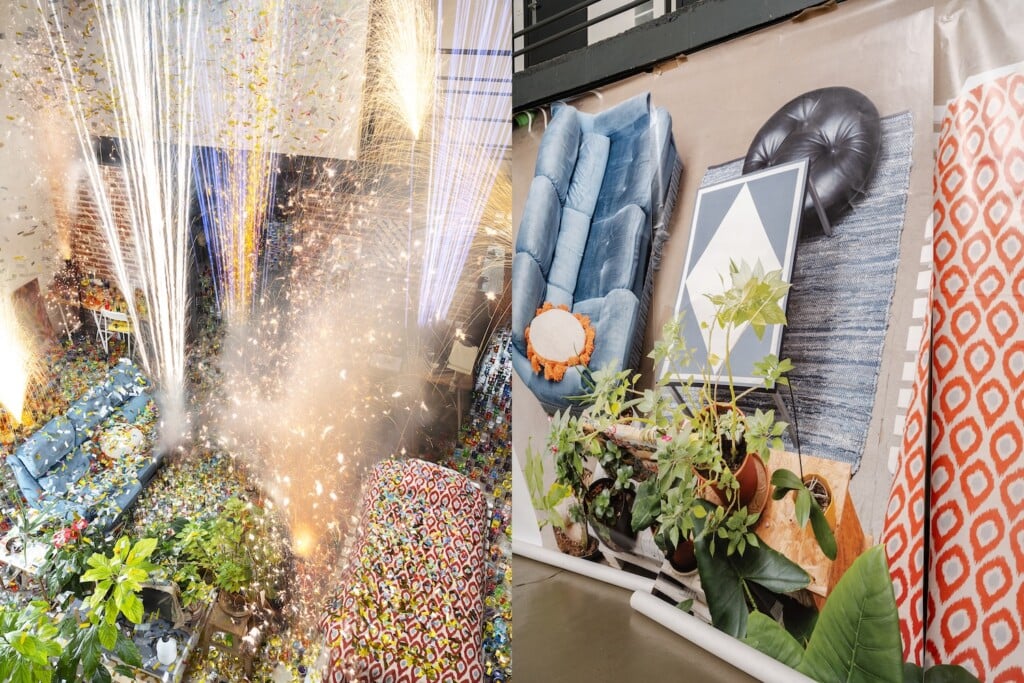
Even starting with projects like On dirait le Sud, your approach seems increasingly closer to an installation dimension, where the set isn’t just a means to produce the image but becomes a space to be traversed (your home studio has literally been dressed in a variety of ways). Are you still interested in achieving the final photograph, or are you increasingly interested in building an experience that exists before and beyond the shot?
To pick up on what I wrote earlier, I imagine my photographs as performances without an audience. But there is an ambiguity, insofar as the photograph is simultaneously the documentation of these performances, performances carried out not only solely for this photographic moment but by taking into account the technical characteristics of the camera.
However, the time spent on the staging is obviously longer than the time of its photographic capture, and this relationship between temporalities interests me greatly. Yet, as time passes, I want to move the camera away and ‘open up’ the spectacle. In February, I left the studio where I had already been working for 12 years. This major shift in my practice also corresponds to this moment where I want to develop the scenic aspect of my research differently.


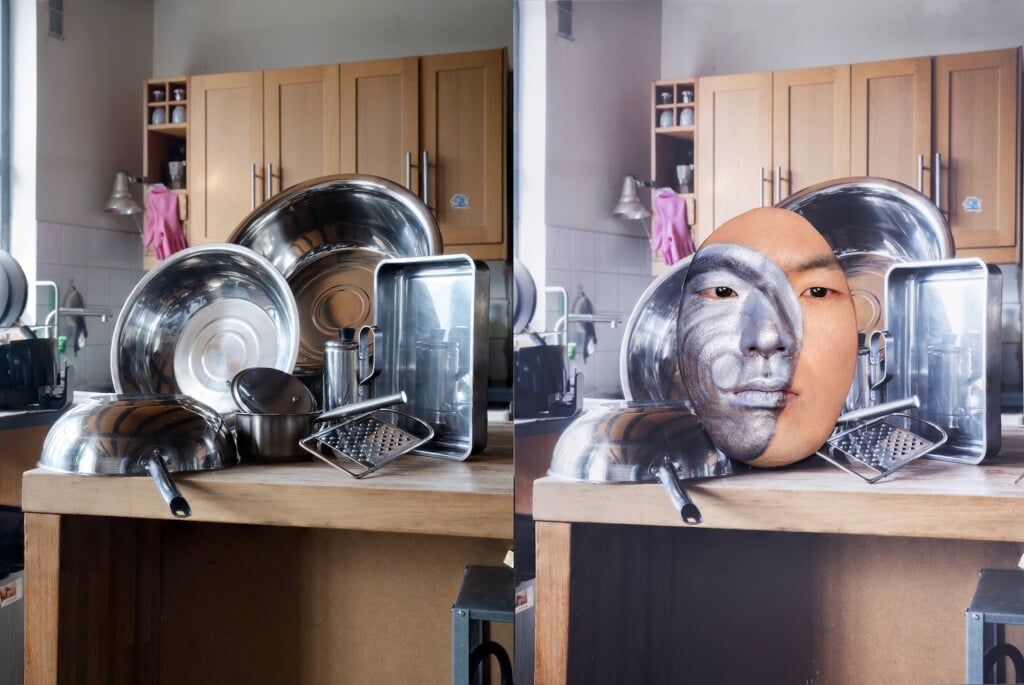
Photo cover: Stainless steel kitchen utensils, Argenteuil kitchen counter, 2024, Argenteuil, France. / Woosung as stainless steel kitchen utensils on the Argenteuil kitchen counter, makeup by Daniela Eschbacher, 2024, Argenteuil, France.