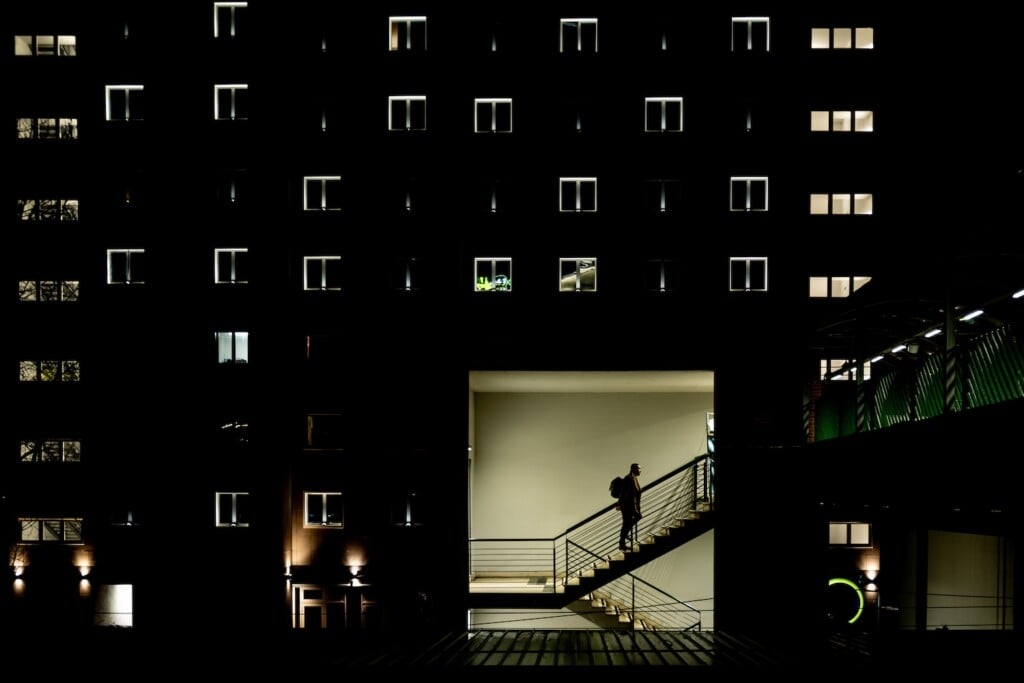
If Marc Augé defined the “non-place” as a space devoid of identity, relations and history, designed solely for transit, consumption or brief waiting, contemporary architecture and visual photography now find themselves having to rework this concept. No longer just anonymous containers or mere highway backdrops, these in-between spaces have become the load-bearing structure of our urban experience. It is precisely within this shift in perspective that the visual research of Francesco Lupò takes shape.
Born in 1983 in Sicily and based in Lecce, Lupò embodies the figure of the photographer-architect. His academic training drives him to explore often forgotten or marginal places, moving indifferently and with methodical curiosity between digital and analogue systems. Under the artistic alias 4trees, his photography steps away from conventional narratives of the metropolis to explore the scale of places, their suspensions and their contradictions.
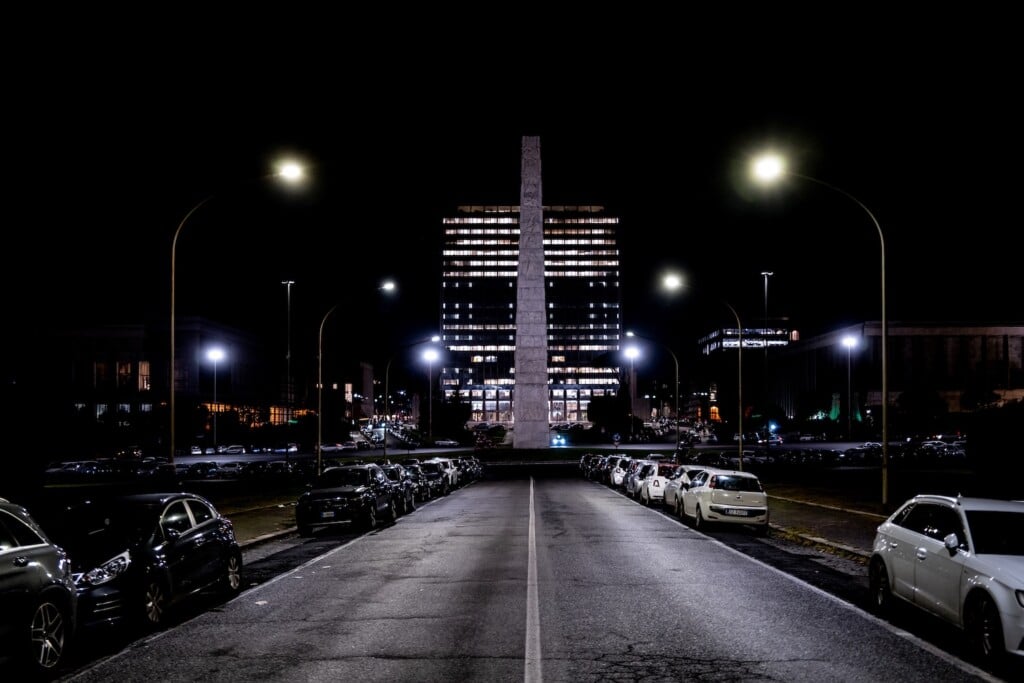
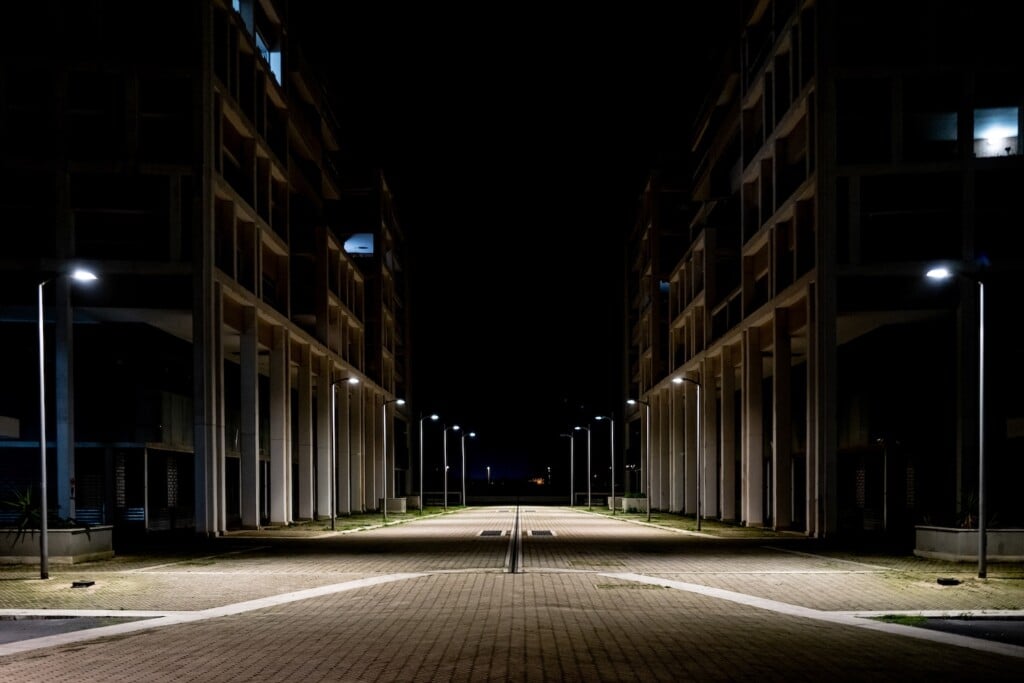
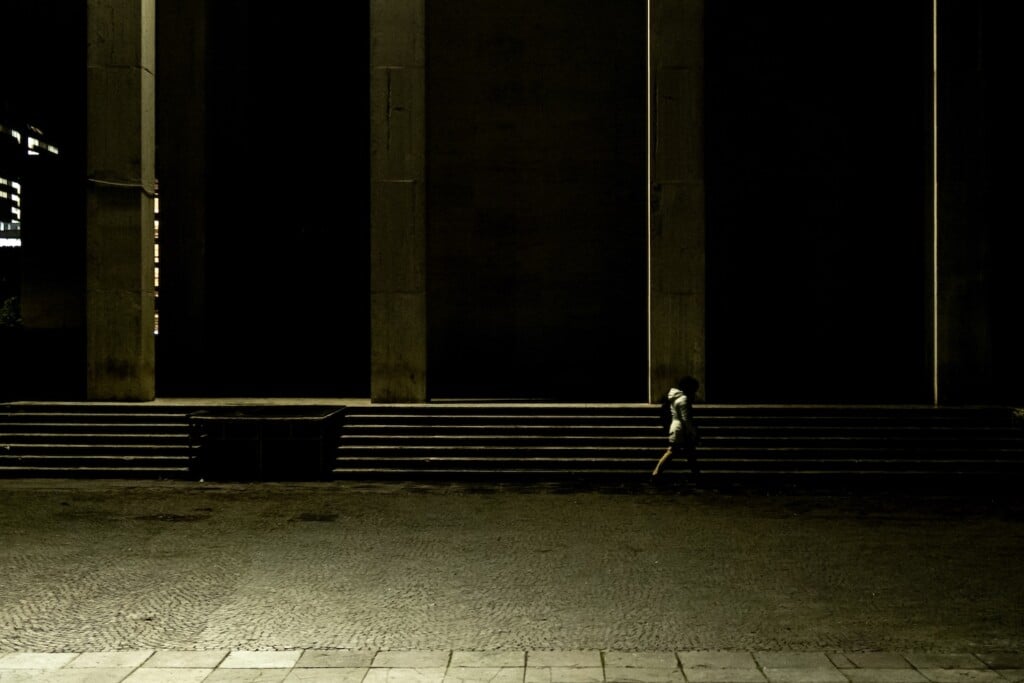
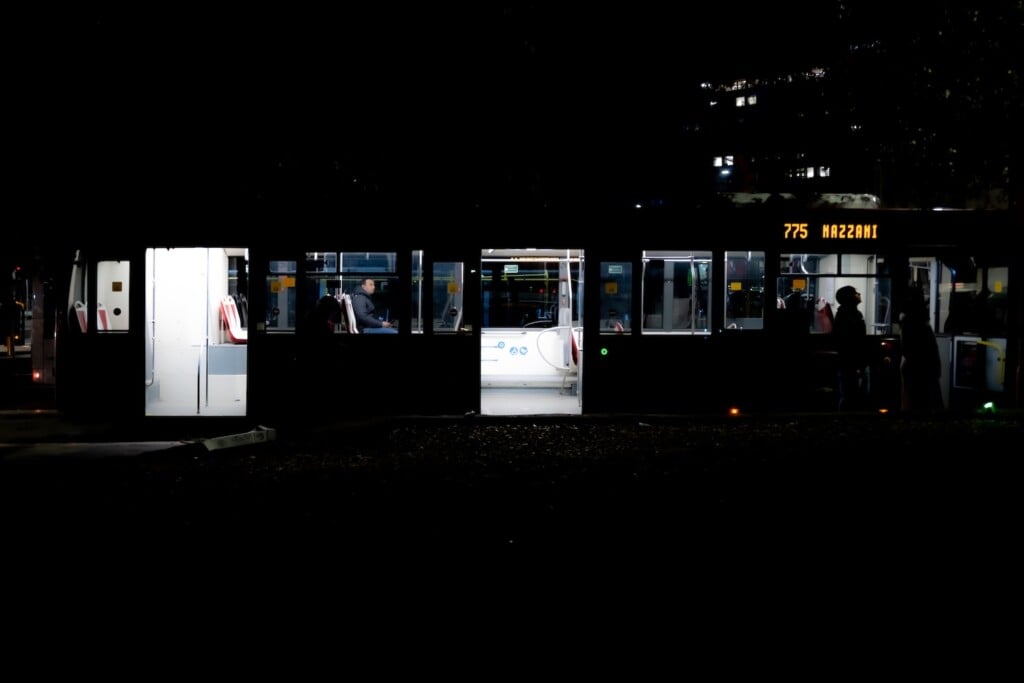
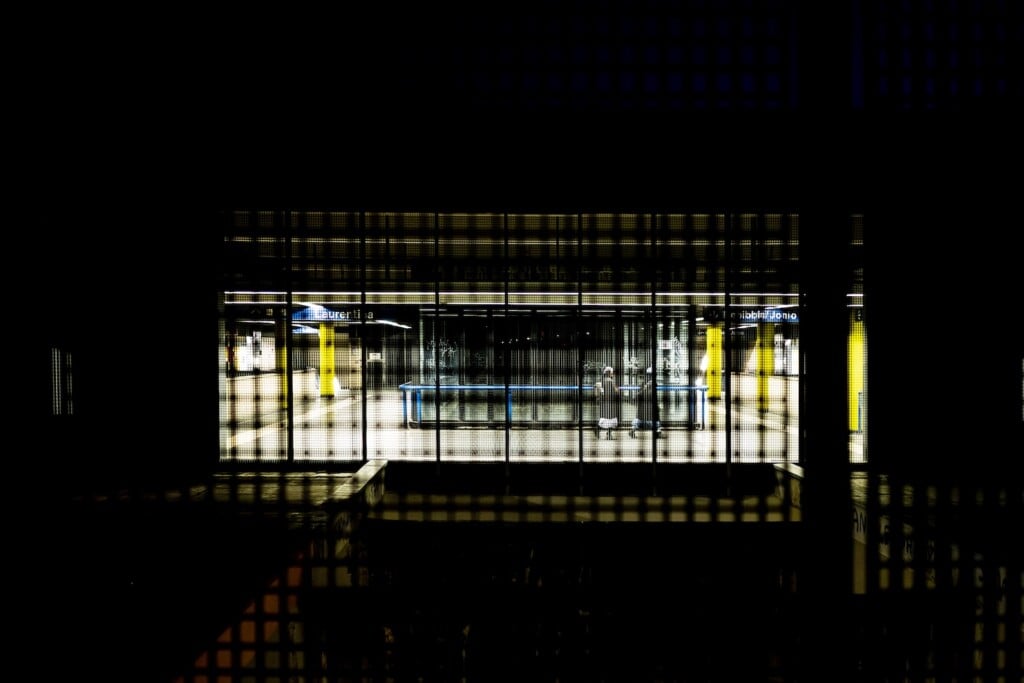
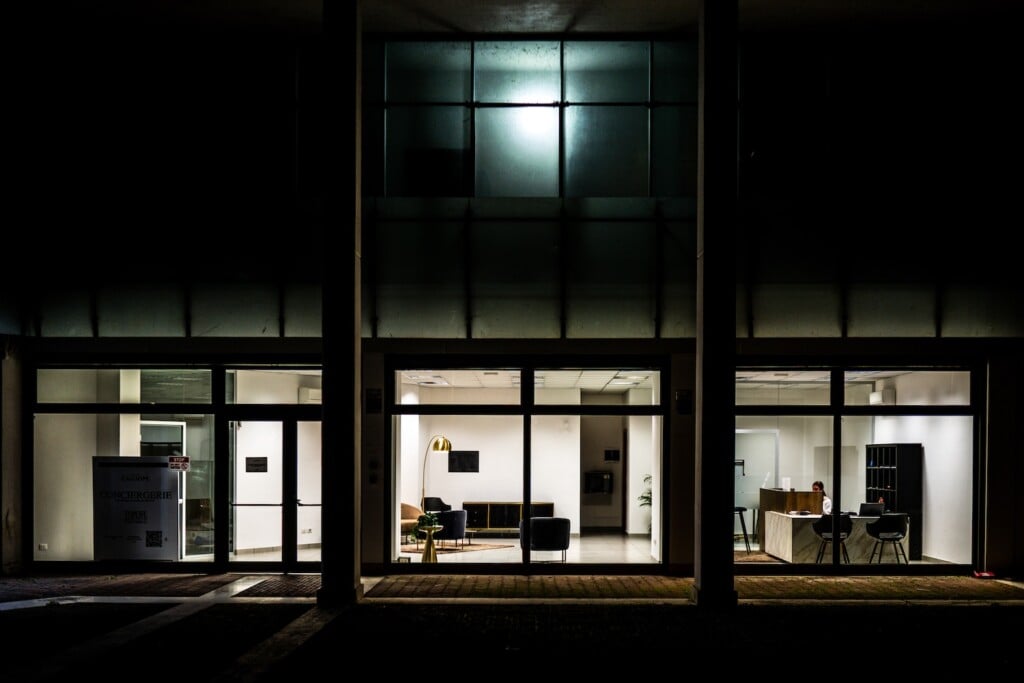
His project 24 R U E is born from a shift in perspective already evident in the title, which mirrors and plays on the acronym EUR 42. Twenty-four images make up a nocturnal itinerary that moves along the axis leading from the Universal Exposition district toward Fiumicino. An exploration that avoids both monumental tones and simplifications about decay, focusing instead on that discontinuous system of junctions, infrastructure, car parks and administrative buildings that define Rome’s western periphery.
The EUR was born as pure representation, as a monumental declaration of identity. And this is exactly the shift that 24 R U E captures: not a non-place by design, but a place that becomes one at a certain hour, when the public it was built for stops looking at it. It’s an observation that broadens Augé’s category rather than simply applying it.
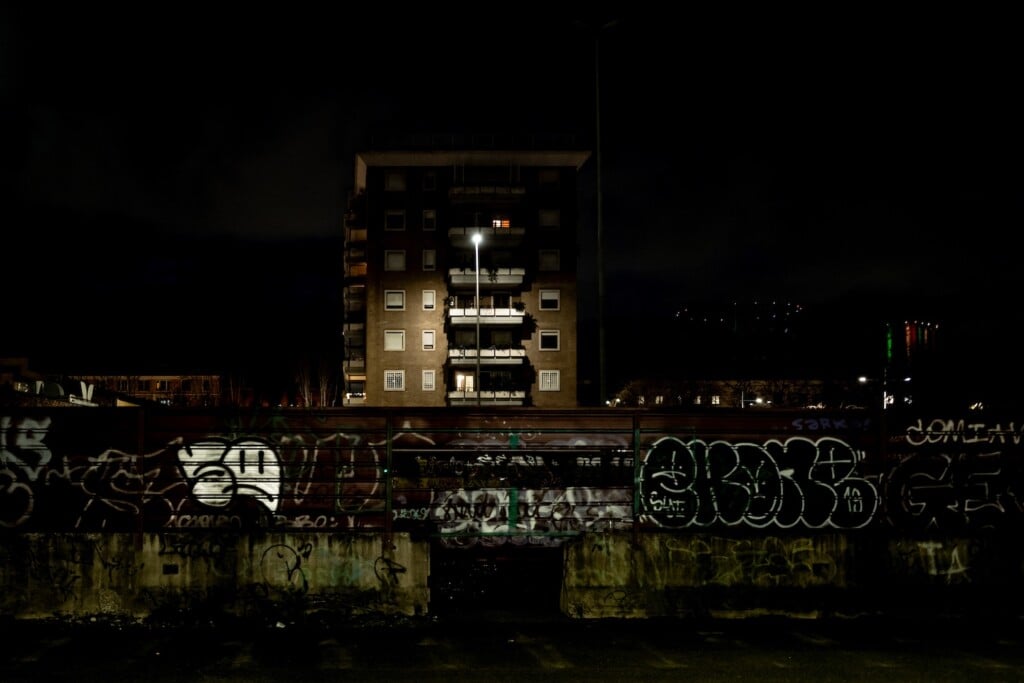
To understand how this visual narrative takes shape and what idea of the city drives it, we put a few questions to Francesco Lupò.
You sign your work as 4trees: “four trees, a fortress”. Can you tell me about that?
There’s little mystery to this alias, it’s a play on words in English between “four trees” and “fortress”. I’ve always liked imagining that four trees arranged a certain way could look like the corner towers of some hypothetical castle. And that castle defends my idea of photography.
And what exactly is this idea of photography of yours?
My idea is that photography has to be, first of all, “reflective”, thought through: it doesn’t just aim to record what’s in front of the lens, but to dwell in the forms, traces and relationships that a place or a situation make visible. To photograph, for me, means creating a space of attention: an image that doesn’t close off meaning, but leaves it open to the gaze and the time of whoever is looking at it.
So you linger on forms instead of chasing the decisive moment. That’s a stance against an idea of photography that dominated for decades. What do you gain by giving up the moment?
I think you gain in photographic quality, but that shouldn’t be taken as gospel. I see so many people shooting hundreds of photos, sometimes even in bursts, only to feed them to social media a few moments later. To me, that’s consumerism applied to photography. I prefer to think the photograph through, to shoot when I’m satisfied with the setup. Then, once I’m home, I put the photographs away safely and start working on them a few weeks later. As far as I’m concerned, the photos need time to mature, and my mind needs to disconnect from the feelings I had during the shoot.
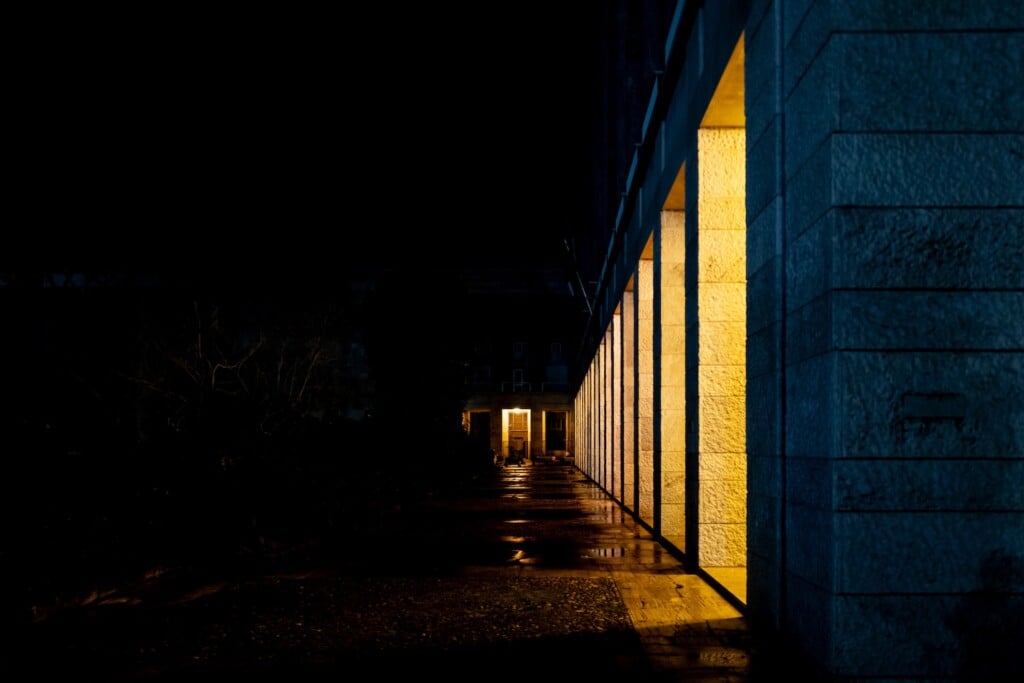
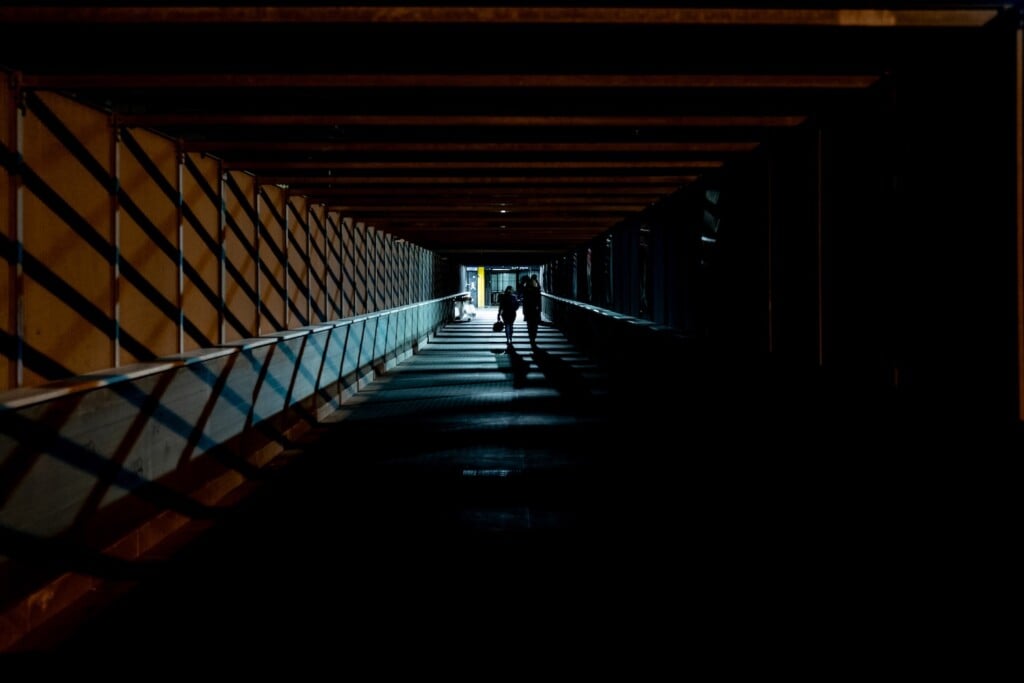
You’re a trained architect and a lifelong photographer. Looking at the 24 images, I notice most are built like an elevation with a frontal facade, with no oblique views, or like a perspective axis with a central vanishing point. Those are the two ways architects usually draw, not the way a city is typically photographed. Is that a conscious choice or does it come instinctively?
It’s obviously a conscious choice. During my studies, and in the profession, we were always trained to present projects in a way we’re not used to seeing with our own eyes: in orthogonal projection. And if you think about it, that makes us see things in a misleading way. Trying to represent that in photography is impossible without excessively manipulating the shots, but on certain occasions I try to get close to that idea.
In the images where someone appears, the figure is almost always small, in the background, and inside the light. How do you decide whether to wait for a person to enter the frame, or on the contrary, for no one to be there?
By trial and error, I wait for someone to walk by and study how the light hits the human figure. It takes a lot of patience, especially when you’re shooting alone. With 24 RUE, there were times I had to go back the next day to look for, or create, the right conditions. Shooting in the periphery, at night, there weren’t exactly crowds of people around.
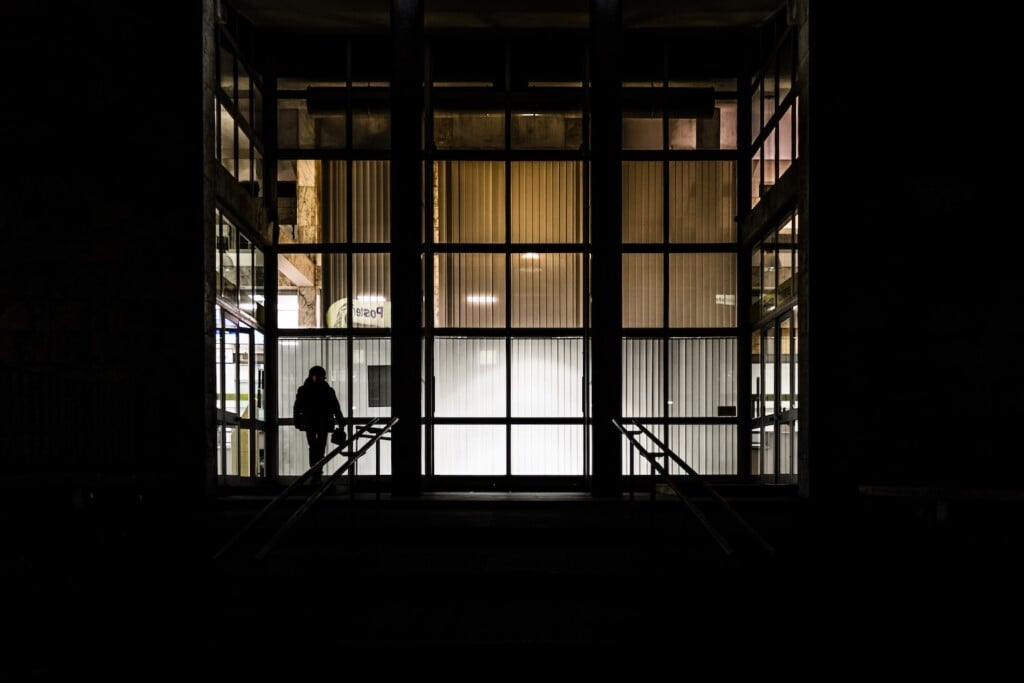
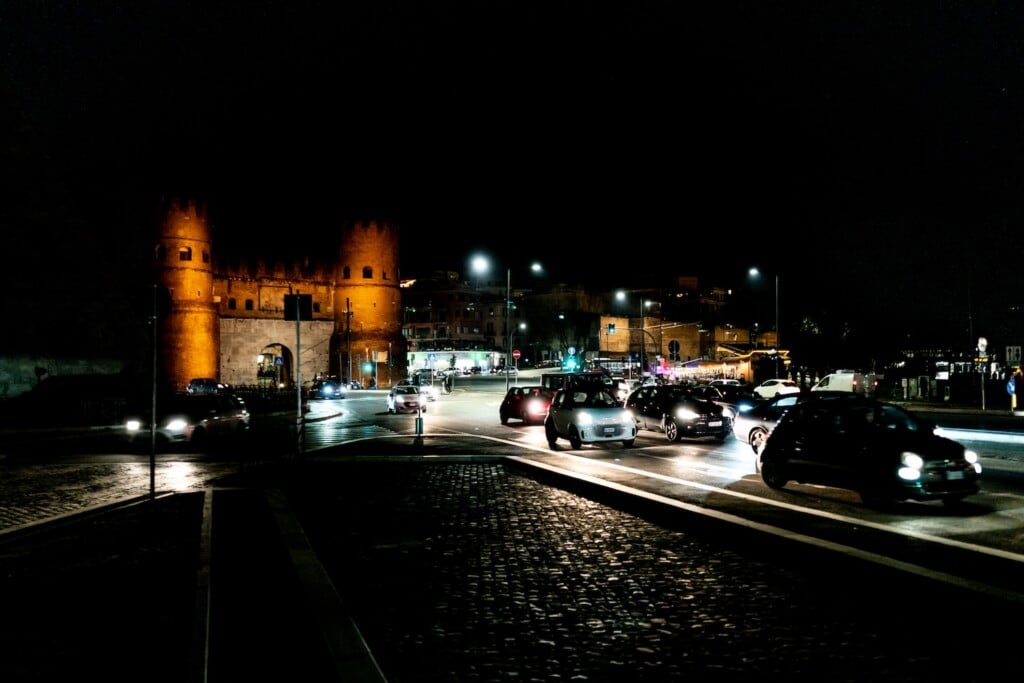
The project claims to steer away from monumental rhetoric, and yet the EUR obelisk and Porta San Paolo appear in the sequence. What role do recognizable landmarks play in a work that goes looking for the margins?
I have to confess that in the shot where you see Porta San Paolo, there’s a beam of light illuminating a portion of the Pyramid of Cestius. The main idea was not to make architectural landmarks the subject of the photograph, in these two cases they act as context rather than protagonists.
The monumental EUR district gets a huge number of visitors, but you photograph what surrounds it: junctions, car parks, administrative buildings. And you photograph it at night, when that representative vocation switches off. After this project, does it feel to you like a place people can actually be in, or only pass through?
Paraphrasing our dear Augé, I can only say that we find ourselves right inside the definition of a non-place. The exact opposite of a dormitory district. By 8:30pm, the EUR shrinks down to a backdrop for what is essentially an urban highway, Via Cristoforo Colombo. Every building turns into an empty, partially lit container. Unfortunately, in the contemporary city there are plenty of areas that only get lived in during certain hours of the day.
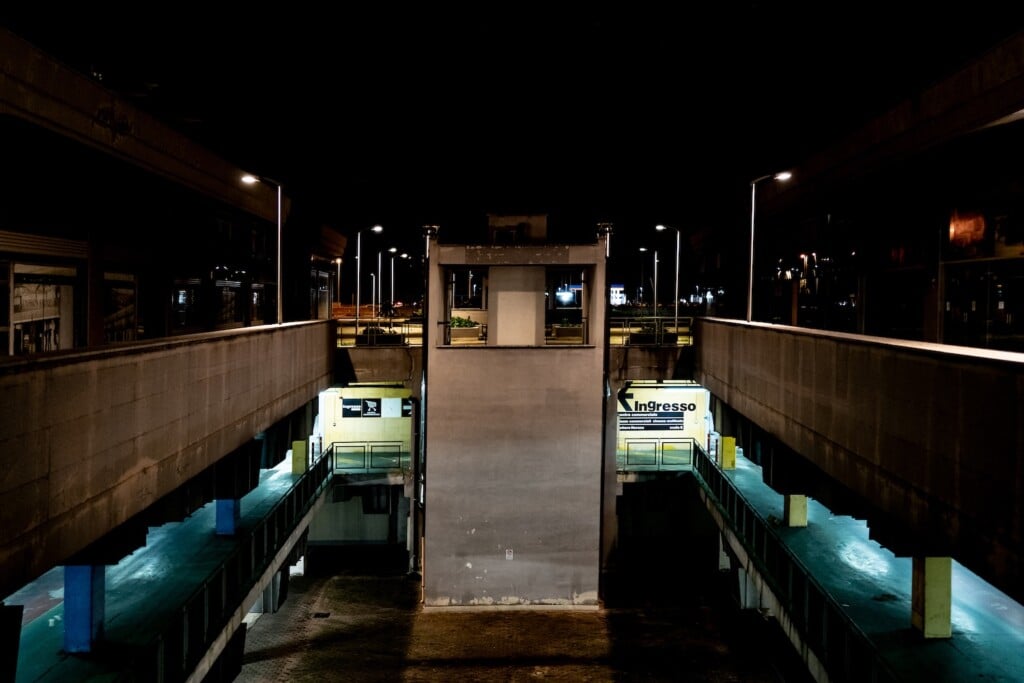
It is precisely within this suspension, and in the ability to show what remains of an architecture once it loses its daytime function, that Lupò turns the “non-place” into material for visual reflection.
His photographs are now among the leading works of “oltre – ESISTENZE AL LIMITE“, the Festival hosted inside Palazzo Romano in Gioia del Colle (BA), open to visitors until October 11. An ideal exhibition setting that investigates border territories, the periphery as a place of metamorphosis, and the extreme stories that inhabit the margins of visibility.
Article by Roberta Ruggieri