Kenzo Takada, known by all simply as Kenzo, died on Sunday, October 4th due to complications at the Covid-19 at the American Hospital in Neuilly-sur-Seine, Paris.
Born on February 27th, 1939 in Himeniji, a small town in the prefecture of Hyōgo, within the Kansai region and the fifth of seven children, Kenzo developed an enormous passion for the fashion world from an early age by reading the fashion magazines that his sisters brought home.

At the age of 18, forced by his parents, he enrolled in the Faculty of Literature at Kobe City University of Foreign Studies but after only a year he abandoned his studies against his family’s wishes, also because of his father’s death, and in 1958 he enrolled at Bunka Fashion College in Tokyo. Kenzo was the first male student at the school, which until then had been open only to female students. During his time at Bunka, Kenzo won a design competition, the Son Award in 1961 and gained experience working in the Sanai department store, where he designed up to 40 dresses a month as a designer of women’s collections. After completing his studies and graduating and then moving to Paris in 1964, he was the first Japanese designer to settle in Paris.

The French capital was a point of reference for Kenzo, Yves Saint-Laurent was his stylist of reference and one of his teachers at the Bunka, Chie Koike, studied at the École de la Chambre Syndicale de la Couture Parisienne transmitting to him the desire to know and settle in Paris.
His move to the French capital was marked by a peculiar fact: in preparation for the 1964 Tokyo Olympics, the Japanese government demolished Kenzo’s apartment behind a large cash refund, thanks to which he was able to leave.
The boat trip lasted a month during which he visited many different cities such as Hong Kong, Saigon, Mumbai and Marseille, until arriving at Gare de Lyon station on January 1, 1965. Kenzo’s first impression when he arrived in Paris was terrible, he called it “sad and gloomy” but immediately changed his mind when the taxi driver took him to Notre Dame which he described as “magnificent”.
In the beginning Kenzo survived by selling his sketches to fashion houses for 25 francs each and working as a designer for a textile company called Pisanti.

In 1970, while he was at a flea market, Kenzo met a woman who wanted to rent him a small space in the Galerie Vivienne. Kenzo accepted to make his “little” dream come true, opening a boutique where he could display and sell his creations, thus his first store “Jungle Jap” was born.
For his first collection, presented of course at the Galerie Vivienne, he spent $200 in fabrics at the Saint Pierre market in Montmartre.
His efforts paid off very quickly: in June ’70 ELLE magazine put one of his designs on the cover; he moved his store to Passage Choiseul; his collection was also presented in New York and Tokyo in 1971; the following year he won the award of the Fashion Editor Club of Japan.
In October 1976, the first Kenzo store arrived in Place des Victoires.

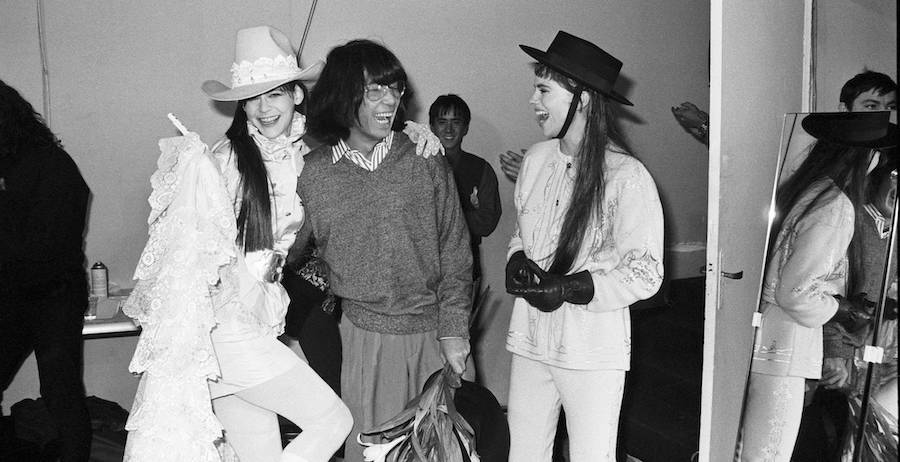
His shows were incredible, in 1978 and 1979 they took place inside a circus tent where, to close the parade, a group of women on horseback wearing transparent uniforms were brought in and he paraded on the saddle of a big elephant.
His first men’s collection was launched in 1983, in August 1984, The Limited Store announced that it had signed a contract with the Japanese designer to create a less expensive clothing line called Album by Kenzo and in 1986 launched the Kenzo Jungle line.
The originality of his design, his ability to bring together different cultures and styles such as Japanese tradition and European style, oversized items and unique silhouettes have made Kenzo Takada one of the most important and esteemed designers of our time.

After the sale of the brand to LVMH in 1993, Kenzo will remain at its helm for another 6 years before leaving it for good in 1999. He was succeeded by Antonio Marras (2003-2011), Humberto Leon and Carol Lim (2011-2019) and, from this year, Felipe Oliveira Baptista.
The maison has issued an official note in which it reads: “It is with immense sadness that the LVMH group and KENZO have learned of the passing of their founder, Kenzo Takada”, while the artistic director Felipe Oliveira Baptista added: “His amazing energy, kindness, talent and smile were contagious.
His kindred spirit will live forever”.