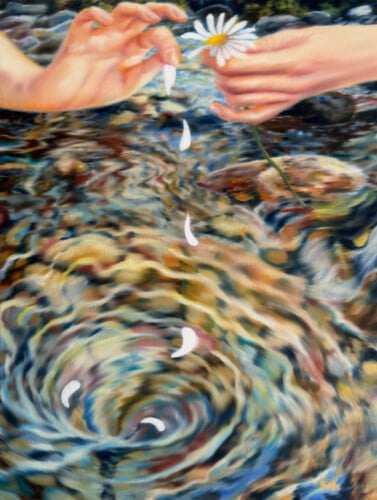
Two hands holding each other to never let go, joining in a chain that tears down the walls, both physical and mental. This is the image that in June 2019 appeared, in all its majesty, under the Eiffel Tower and it is the same image that now can be admired in Turin.
It is the work by Saype, a French-Swiss land artist who a year and a half ago started Beyond Walls, a project that has brought and will continue to bring the artist around the world.

Paris, Andorra, Geneva, Berlin, Ouagadougou, Yamoussoukro and now Turin.
Thanks to Gruppo Lavazza, the Comune di Torino and the Musei Reali di Torino, Saype arrives for the first time in Italy for the seventh stage of Beyond Walls.
In the beautiful atmosphere offered by the Archaeological Park of Porta Palatina in Turin, the land artist has continued “the largest human chain in history“.
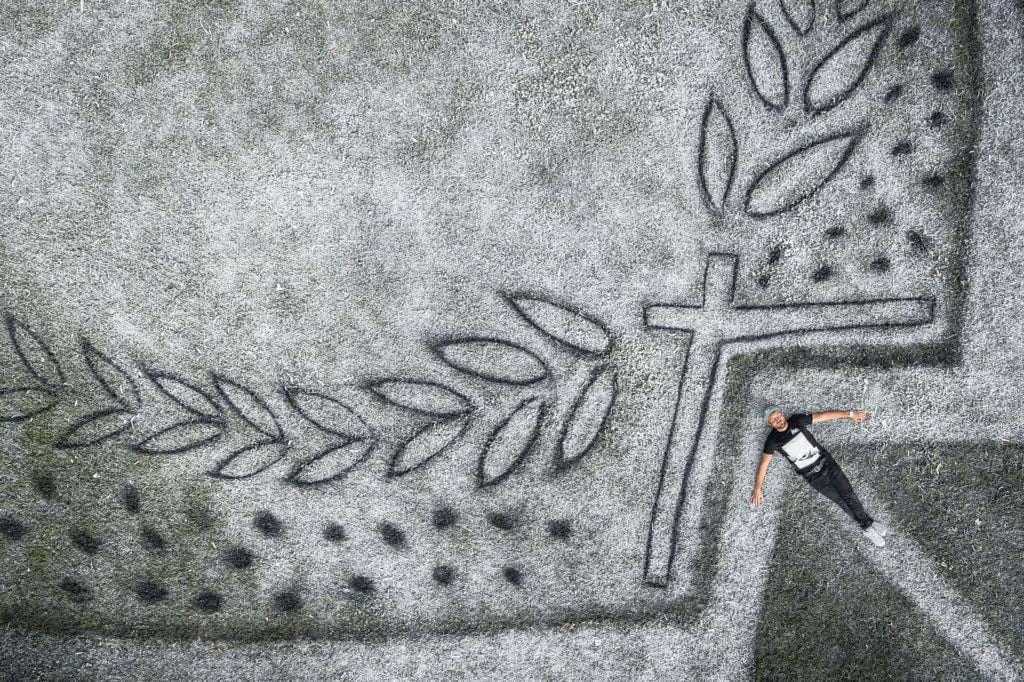
Like all of Saype’s works, the one in Turin has been created with total respect for nature, thanks to a technique and painting developed by the artist himself that make his works ephemeral, as they last from 15 to 90 days. Although his works are ephemerals, the hope is that the human chain, made up of common values such as tolerance and inclusion, will be able to resist the passage of time.
On the occasion of the presentation of the work we went to Turin where, in addition to visiting the artist’s solo show in the central rooms of the Galleria Sabauda of Musei Reali in Turin until January 21, 2021, we had the opportunity to talk with Saype about art, but not only. Read our interview below!

Tell us a bit about yourself. How did you approach art and what was your path?
I was born in the East of France, in a small town and I started my adventure with graffiti when I was about 14 years old. I immediately asked myself what was the meaning of my action and, more generally, that of art and I immediately answered that, for me, the primary function of art is to capture people’s attention. In cities, where we are so polluted, even from a visual point of view, I had the impression that I could no longer capture their attention.
Then, about in 2012, I was reading a lot of Buddhist literature, I approached the subject of ecology and, at the same time, drones arrived in Europe. So, I tried to make a mix between my experience as a writer, what I was learning from reading and the potential of drones. This choice gave me a lot of possibilities, I could have offered an easy access to culture and art.
I would like to add that I was a nurse for 7 years and I believe that this experience has influenced my art, which never lacks a social and human character.
What kind of painting do you use for your works and how did you develop this technique?
One of the first things I realized that I had to do was to develop a type of painting that was as eco-friendly as possible: it took almost a year to do this, a year spent experimenting in the backyard, painting small areas, trying to create a paint that had the least possible impact on the environment. Once I had finished, I started to make my first works, it was 2015.

How did the idea of Beyond Walls start and, in your opinion, which are the walls that our society should break down?
I must admit that I always try to have a very modest approach. Certainly, with my art I try to inspire people, talking about justice and fairness, but I don’t want to make moral speeches because I’m not a historian, a sociologist, or a political scientist. What I try to do is to give impulses, to put a focus on what seems right to me.
I believe that art, being a universal language, can really change things and make a difference.
You know, I am part of an apolitical association called SOS Méditerranée and it deals with the rescue of migrants at sea. It is an association formed by people who really put their lives at risk, sometimes staying on the ship for months to save people.

Well, what I said before, that art can actually chenagee something, was demonstrated in 2018, when I realized in Geneva a work for the association and the resonance was so wide that the Swiss confederation, the state, wanted to donate a pavilion to the association.
In practice SOS Méditerranée had the aegis of the State.
And so, Beyond The Walls is also something that must move people’s souls and this project in particular brings a message of optimism: in a world like today’s, in which history and the past are often forgotten, only by remaining united will humanity be able to overcome the challenges it faces.
Only by creating this human chain can we face the challenges of the future.
How was working in Turin and collaborating with Lavazza?
I knew Lavazza very well because I started working with them in 2018, for the Calendar 2019. What I liked was seeing how Francesca Lavazza is absolutely in love with art. Also, the way the collaboration developed was incredible and I had almost total freedom, both for the Calendar 2019 and for this project. When I presented the idea, Francesca accepted immediately, without changing anything.
What more could an artist ask for?!

In which other places, in Italy or in the world, would you like to create a work?
There are many places, for example, I would like New York. Now we will go to Istanbul and then we should also go to Cairo. But what interests me the most is the history of the places and to be able to create links.