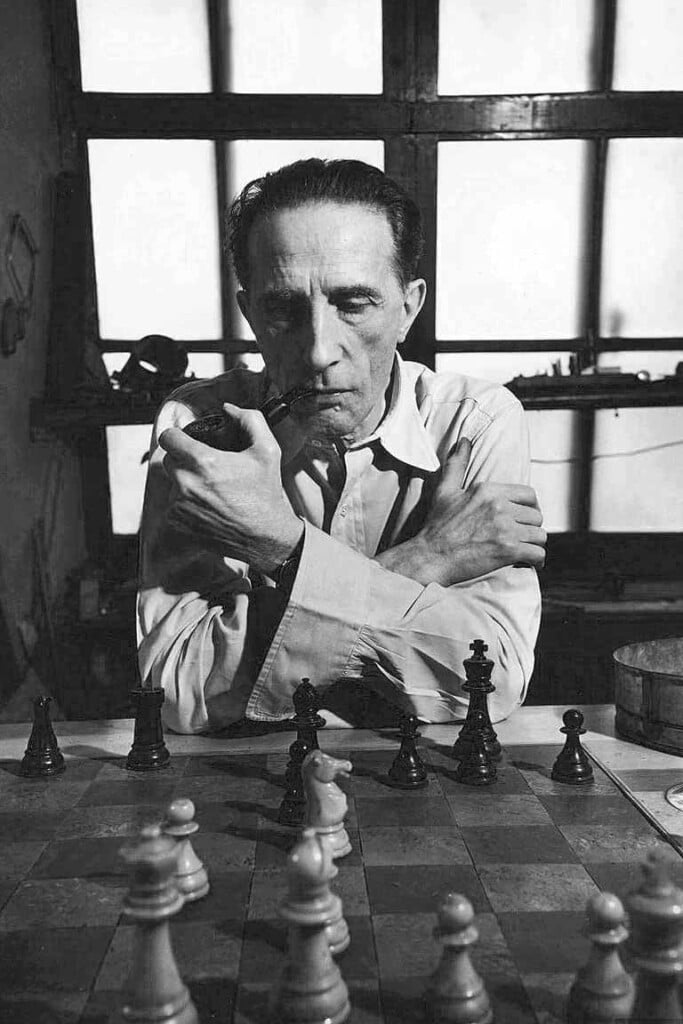
“I am still a victim of chess. It has all the beauty of art, and much more. It cannot be commercialized. Chess is much purer than art in its social position.” – Marcel Duchamp
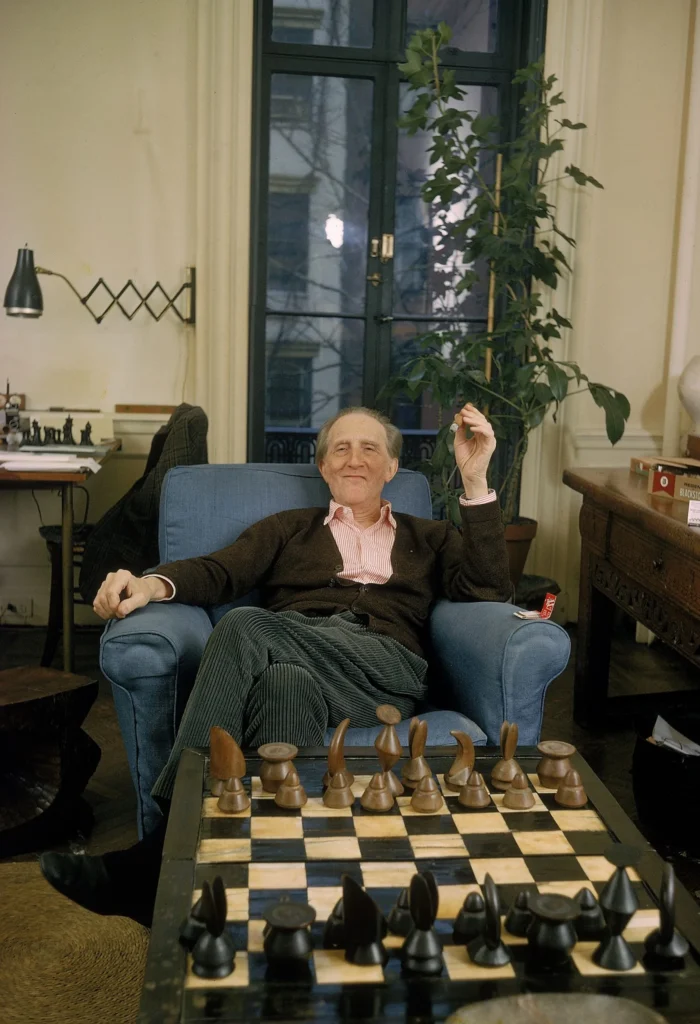
The silence is broken only by the faint sound of pieces on the move, and the air is tense. The polished wooden board is smooth under the fingers, while the contrast between the black and white squares creates a hypnotic visual pattern. The pieces, miniature sculptures ready to spring to life, are set strategically in place to begin the game’s intricate choreography. Marcel Duchamp could easily have been one of the players, absorbed in his passion for chess, which shaped his life and artistic path in a singular, profound way.
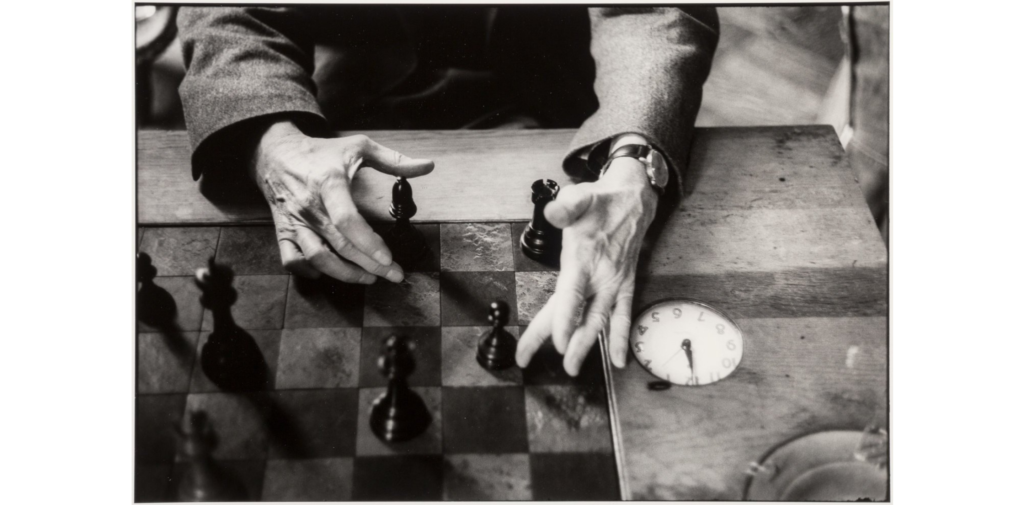
The chessboard as arena: friends, tournaments, art objects
Duchamp, a revolutionary figure in 20th century art, was both an artistic genius and a devoted chess player. A passion that was never just a hobby, but a crucial part of his conceptual arsenal, fueled by an intellectual, enigmatic, and provocative approach that left an indelible mark.
Marcel Duchamp’s life is intertwined with the chessboard in a fascinating way. The game captured his imagination from childhood. Growing up in a family of artists, Duchamp developed a curious mind and a taste for intellectual challenge, which led him to an overwhelming love for chess, a game that embodied the fusion of art, logic, and creativity.
Chess matches are a choreography of mind and movement, in which every piece and every move reflects a deep understanding of the game’s dynamics. The chessboard is an arena where logic and art intertwine, becoming a tangible representation of Duchamp’s visionary thinking. His influence extended beyond the board, drawing in equally passionate artists like Man Ray, turning these matches into fertile ground for sharing ideas and hatching new artistic projects. During the period when this passion was at its peak, several of his contemporaries, including Salvador Dalí, Pablo Picasso, Alexander Calder, and Joan Miró, shared the same affinity for chess.
Descharnes: a view from below, on the set with Dalí
All of this comes together in a photograph taken by Robert Descharnes, who met Dalí in the 1950s and portrayed him right up until his death, literally, since the photo of Dalí in his coffin is his work too. But to find the image I’m talking about, we need to go back twenty years, to the set of the film A Soft Self-Portrait (1966), where artists Marcel Duchamp and Salvador Dalí are playing chess. Descharnes, who here seems to break from his ongoing documentation of the Dalí icon, chooses to frame them both from below, stepping away for once from the perpetual subject of his inquiry. The two are playing on a slab that vaguely recalls Duchamp’s “The Large Glass”, also known as “The Bride Stripped Bare by Her Bachelors, Even”; Duchamp wears a panama hat and the board is held down by four stones of different sizes. What is Descharnes looking at?
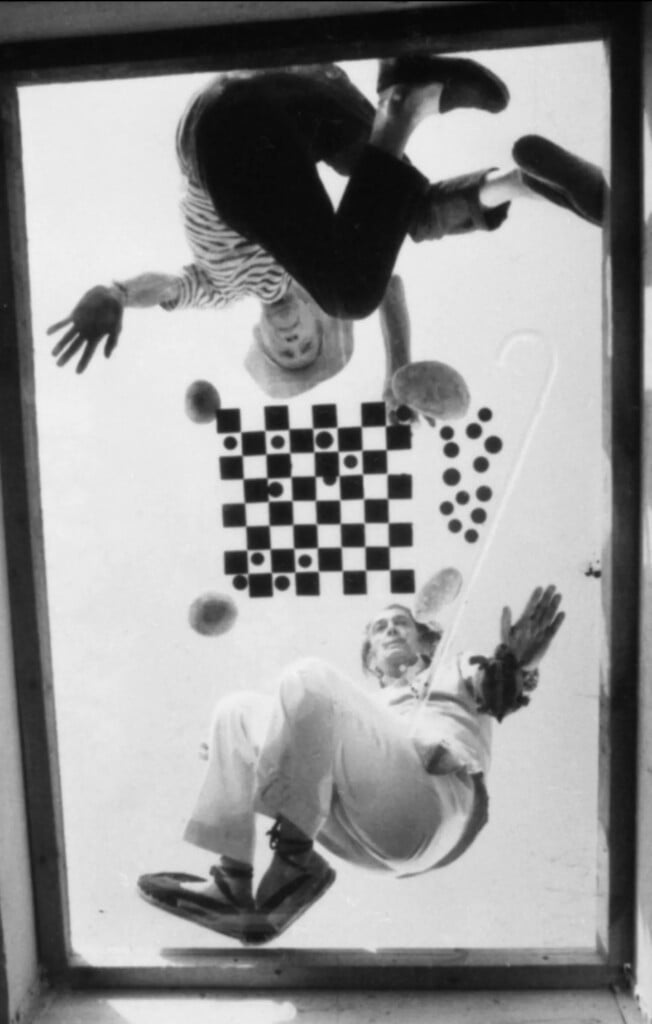
In this image, the two players are completely absorbed in a form of concentration distinct from the one involved in creating a work of art, it’s an entirely new dimension. Neither of them is even looking at the camera. Is it because in that moment they’re focused entirely on the board, or because by then they were used to the camera after yet another shot? Two years after this photo, Duchamp was in Toronto, on the stage of the Ryerson Theatre, playing a match against John Cage using a modified chessboard: each photocell, linked to each square, was connected to a sound-generating system that filled the theater with compositions by Gordon Mumma, David Behrman, David Tudor, and Lowell Cross, the latter also responsible for the prepared board. Reunion was the title of the performance staged on the night of March 5-6, 1968. They played a game; it was Duchamp’s last public appearance before his death a few months later. Duchamp won, even after giving his opponent the advantage of an extra piece by playing with one knight short.
As Garry Kasparov put it: “Chess is one of the few arts where the composition and the performance happen at the same time.”
Wasser: the short circuit between nude and chess
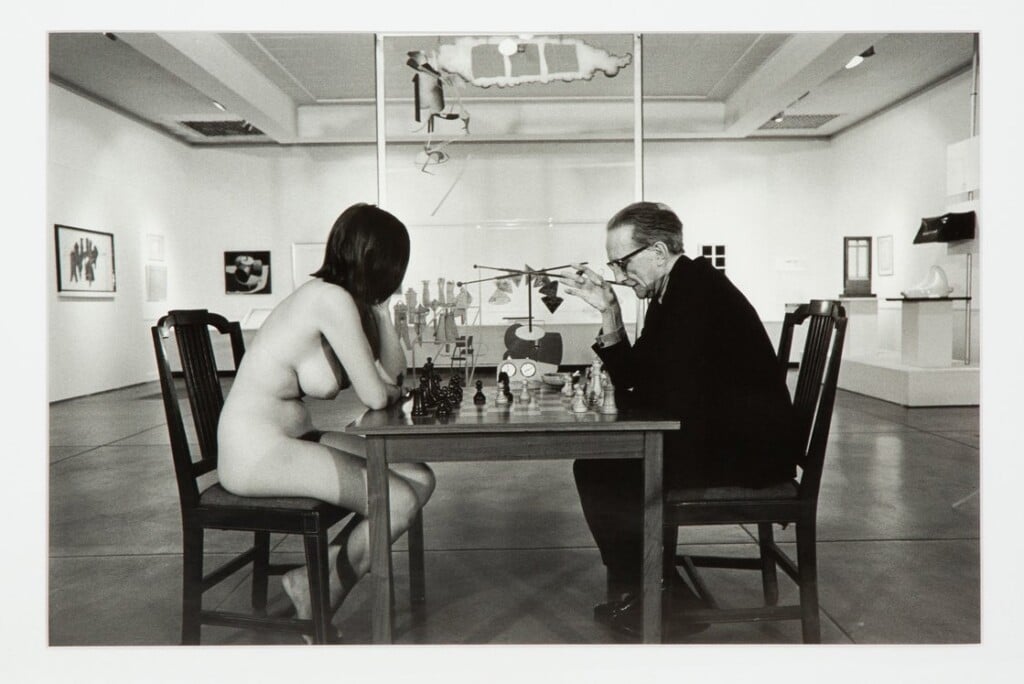
This, however, isn’t the most famous photo of Duchamp paired with a chessboard. That title belongs firmly to “Duchamp Playing Chess with a Nude (Eve Babitz)”, by Julian Wasser. The body of Babitz, a writer in her twenties at the time, so striking and de-sexualized, is framed with serious, scrupulous attention to the game, losing all its mischief and becoming instead a face-off between the artist, absorbed in thought inside an art gallery, and his muse. Paradoxically, this doesn’t come across as a distraction but as a form of focus, neither of the two withdraws from the game, and at the same time, both seem to forget that the woman is nude. Still, it’s fair to say that Descharnes’ image is more centered on chess itself, while this photo, a logical short circuit between the nude and the chess game, turns the attention onto the short circuit itself and onto the dynamics between artist and writer. It later came out that the game was actually played, and that Duchamp, far from distracted, won it easily.
Descharnes, precisely because of his underground, almost underwater point of view, manages the impossible feat of drawing attention to what’s happening below rather than above. And what’s happening above is anything but ordinary: Duchamp next to Dalí, the founder of conceptual art alongside the most famous of the surrealist painters. Placing them side by side is no simple matter. And seeing them at a chessboard revives the notion of deep conflict, to defeat your enemy you can’t just oppose him head-on, you also have to take on the traits you lack, or risk being pulled down by them. Here, then, chess becomes a conflict where surrealism and conceptual art symbolically meet, but they meet below, in the ground where everything blends and values lose their outlines.
Going back to the photo, there’s an odd detail: the pawn on e4 looks out of place, as if it had slipped from its square onto e3. It’s surprising that two minds as influential in 20th-century art as Duchamp and Dalí wouldn’t have said “j’adoube,” the common gesture among chess players for adjusting the pieces. In a match, to “adjust” means touching the pieces to set them correctly without necessarily moving them. But while dwelling on this detail, you realize that what’s truly out of place in the photo is the two of them, Duchamp and Dalí. The real game is being played down there, where Descharnes stands; that’s where every confrontation is actually taking place. Is life where the bride is, or where her bachelors are?
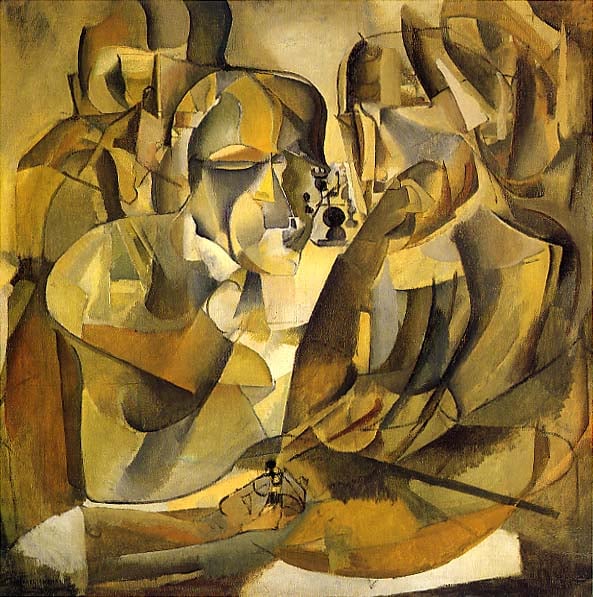
Between the two World Wars, Marcel Duchamp temporarily set artistic practice aside to immerse himself in the game of chess. His participation in tournaments, his involvement in the French chess scene, and his dedication to it were fundamental to his personal and professional growth. In 1920, he came up with the idea of turning the game into an aesthetic experience, creating the wooden chess set “L’Échiquier du Narcisse.” His matches became legendary for their complexity and originality, as shown during the 1925 Nice Tournament against International Master David Janowski, playing Black and catching his opponents off guard with bold, innovative moves.
The last move: from chess to art, all the way to checkmate
Duchamp’s approach reflected a fusion of intellect and creativity, treating chess as a form of art through which to explore the idea of chance and challenge convention. This fusion became intrinsic to his work, shaping pieces like “L.H.O.O.Q.” and “Fountain.” His artistic career and his chess playing were woven together like the squares of a board, culminating in his final work, “Étant donnés,” an enigma completed in 1966, shortly before his death in 1968. Duchamp worked on this piece for roughly twenty years without ever telling anyone, during a period when even his closest friends thought he had given up art altogether. Only his wife Teeny knew about it, since it took up an entire room in his studio. This work can be seen as the last move on the artistic chessboard, a creation that still challenges and intrigues today. Despite his immersion in chess, Duchamp never fully abandoned art, and this final work underlines that return, showing just how much his passion for art had never truly gone out.