Article by Floriana Savino
During the months of the Biennale, the Marea by Melissa McGill (Rhode Island, 1969) is set to embrace a historic artery of shared life in the Lagoon. For this installation, a sea of paintings rendered in fabric, floating in the sky, recalls the remarkable poetry narrated by Rebecca Solnit in her evocation of the supreme image of the so-called spider grandmother.
Solnit writes, within the pages of her essay Men Explain Things to Me (2014):
It is the most ordinary and extraordinary of actions, hanging out the laundry […] and painting. The act of painting does what can be done without words, evoke everything and say nothing, introduce meanings without adhering particularly to any of them, provide an open question rather than answers. […] Many stories can be told about a woman hanging laundry out to dry – sometimes hanging clothes on the line is a pleasant task, a brief excursion into the light. […] Until the invention of the dryer, hanging laundry was the common way of drying washed clothes, I still do it myself. So do Latin and Asian immigrants in San Francisco, with clothes hung outside the windows of Chinatown and in the courtyards of the Mission District fluttering like so many Tibetan prayer flags. What stories do worn jeans, children’s little dresses, a bra of a certain size, a striped pillowcase tell us?
The poetics of the line, held close to the loose dynamism and the horizon of clothes drying in the sun, conveys the trajectory of a project conceived by Melissa McGill as the most steadfast and generous territory of encounter — one that speaks of citizenship and community union. Venice represents a point of arrival for the artist; she came to know its beauty as a tourist before settling for a time within its spaces as a grateful citizen of a horizon of mutual exchange and possible coexistence.
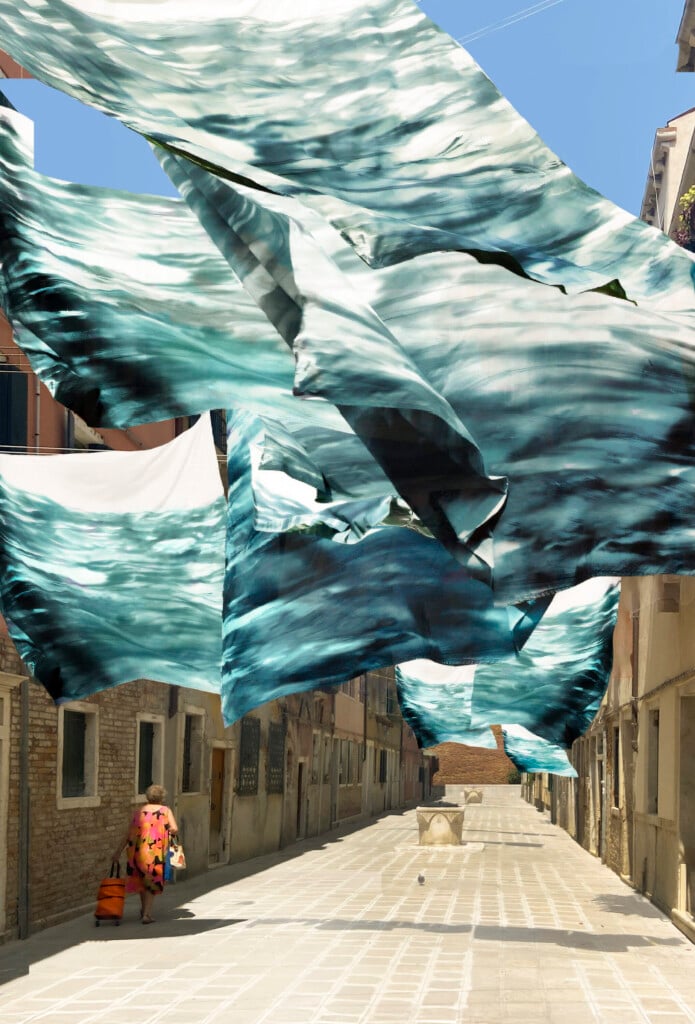

The intervention conceived for the calle of Corte Nova, in the Sestiere di Castello, embraces an itinerary that, while firmly maintaining the territory of Melissa McGill’s own artistic research — environmental activism and an anthropological inquiry characteristically feminine in nature — has intellectually opened itself to the most fervent and varied possibility of a true and living encounter with the concerns of the residents and students who actually inhabit those spaces and took part in the project.
If the sharing of operative effort in the name of art can often carry a project beyond its original point of departure — frequently shifting routes and imaginaries — this new artistic intervention deserves credit for having preserved the essence of a project precisely as envisioned, through the preciousness and peculiarities of many hands that together, in unison, were able to weave a story of sails and waves shaped along the trajectory of the everyday.
Enchanting with powerful and graceful beauty, the sheets hung out to dry in the sun of a calle animated by the force of tradition and the most active neighbourhood community intone the ode of a time and a territory rendered fragile by the disproportionate actions of humankind, as well as by the damaging impact of the most invasive mass tourism. A cloth entrusted to the wind, in the beautiful colour of sea waves, thus evokes the beauty of an eternal flutter and, at the same time, conjures the destructive spectre of a rough sea or storm intent on sweeping away the beauties and architectural treasures of a city we wish to see eternal and protected.
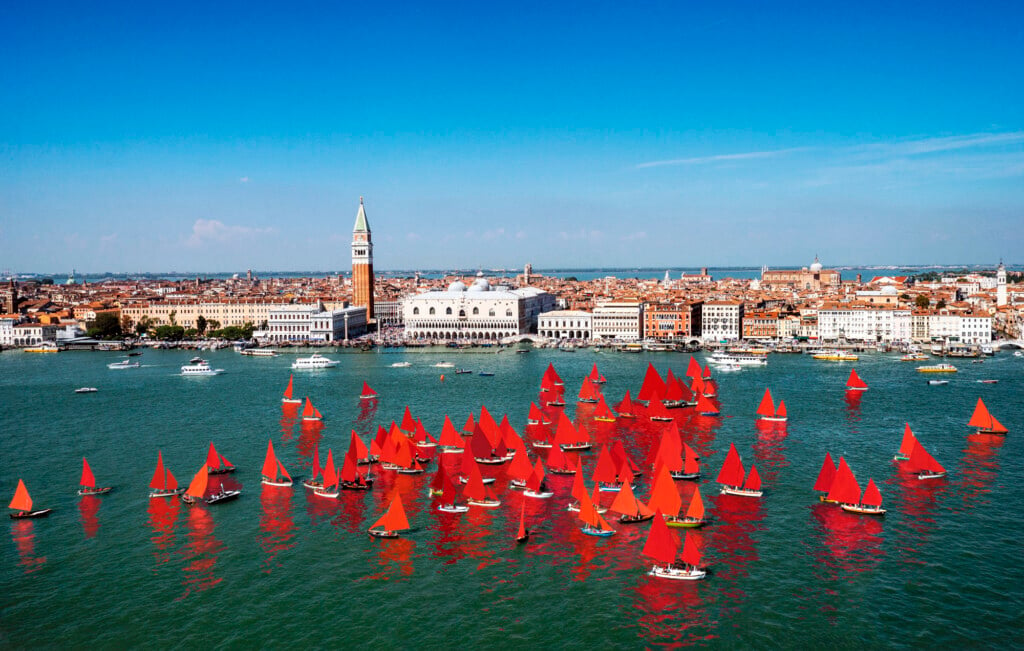

The waters of the Venetian Lagoon had already inspired the artist’s work with the Red Regatta of 2019, continuing a year ago with the project of a living and visually shared archive, once again in agreement and collaboration with the residents of Corte Nova (Quei de la Corte Nova, 2025). On that occasion, it was the tenacity of the washing line that vividly suggested and anticipated the strength of an engaged weave — one that speaks of closeness and civic activism. The photograph, as an archival record of a past season (specifically the 1930s), was thus able to rekindle the living memory of all those who were born along those streets, who lived there, then left, returned, went away once more, or chose to stay.
Along the trajectory of the line, participatory art came to know a small yet remarkable woman named Maria Lai, who in Legarsi alla montagna (1981) was able to evoke, collectively, the essentialness of a small and precious world protected solely by the strength of those who fight for it against the current — beyond the needs and expansionist ambitions of the most audacious capitalist spirit. In Melissa McGill returns the authentic sensibility of an art activist who has chosen water and the motion of the sea to read and hear the heartbeat of the world.
Within a small wooden box (Box of Waves, 2022), Melissa’s sensitive, wave-like universe scents the eyes with a sea breeze that far surpasses the estimated value of the most luxurious precious object in History. Restoring the song of the wind and the vital force of waves kissing the shore, the slice of the world explored through art by Melissa McGill aims to be the most earnest invitation not to lower our guard against the damage perpetrated and inflicted upon the environment — so that the song of the sea may continue to live, and the boundless embrace of the stars remain brilliantly alight.