Paul Insect is one of those artists who have turned subtraction into a weapon. Born in 1971 and adopted by London, he has built a recognizable imagery that lives in the shadows of hidden faces and concealed identities. His figures, often fragmented, cut by masks, or dissolved into chromatic dots, are mirrors of contemporary society, suspended between the need to be seen and the need to protect oneself.
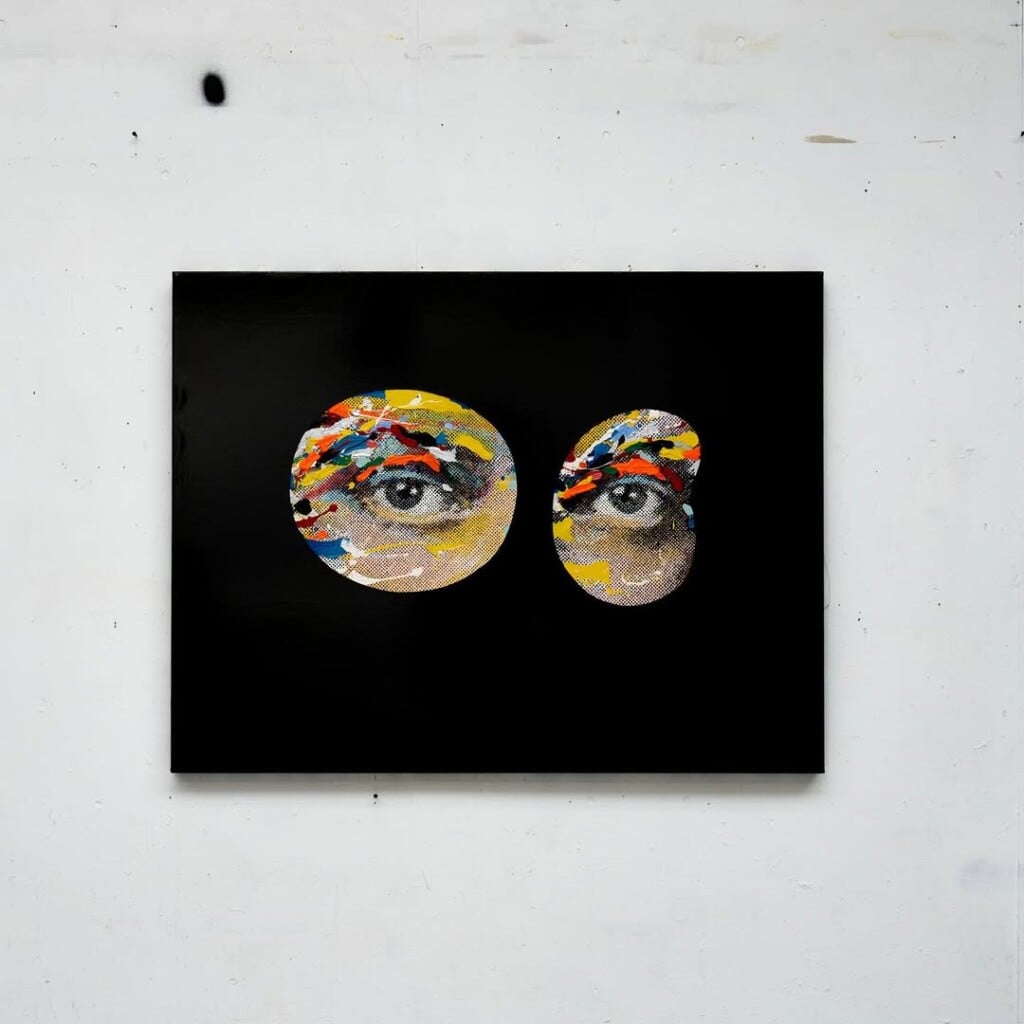
Since the 1990s, when he was part of the insect collective, Insect began contaminating rave graphics and DIY aesthetics with a language that already looked toward pop culture and the digital future. His breakthrough came in 2007 with the exhibition Bullion at Lazarides Gallery in London, entirely purchased by Damien Hirst even before it opened. From that point on, Paul Insect became an essential voice on the international scene, collaborating with Banksy on projects such as Santa’s Ghetto in Bethlehem and on the walls of Palestine.

His work moves between collage, screen printing, painting, and installations. Mixing materials like glitter and diamond dust is part of his practice, turning kitsch into a noble language, while his pixelated or masked faces become icons of the filtered image era. It’s an aesthetic that seems to oscillate between Dada and Pop Art, but always with an ironic and critical edge, capable of reflecting on the fragility of contemporary identity.

In recent years, Insect has refined his research, moving beyond two-dimensionality and embracing sculptures, installations, and even puppets. His solo exhibitions have reached cities like New York, London, and Hong Kong, while his participation in events such as Beyond the Streets has cemented him as one of the most influential artists of his generation.

Following Paul Insect on Instagram means entering a world where color is never decoration but a detonator, a trigger that explodes in the patterns of incomplete faces and in the masks that, paradoxically, tell more than their absence. It is there that the heart of his research emerges: not so much the face itself, but what each of us chooses to hide.