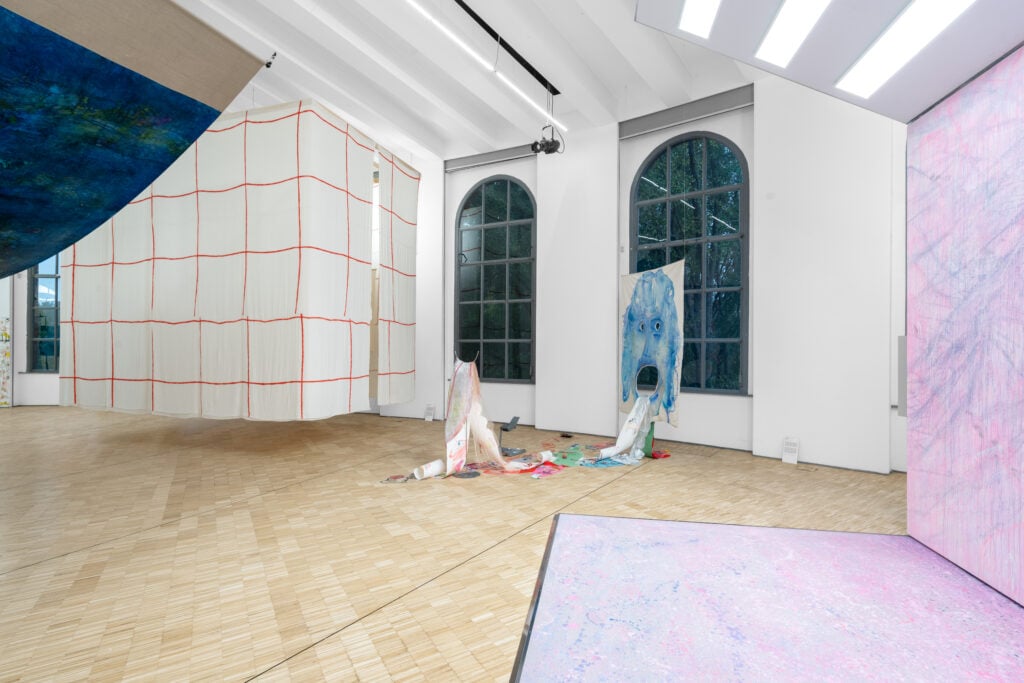
Pittura Italiana Oggi (Italian Painting Today) is the title of the collective painting exhibition at the Triennale Milano, which will conclude in a few days, to be precise, on February 11th. While on one hand, the exhibition aimed to provide the public with a general overview of the direction that painting is taking in Italy today, on the other hand, ideas seem to be somewhat confused. Speaking with artists and curators and reading some articles, particularly Valentina Bartalesi’s article full of questions on FlashArt and Federico Giannini’s more critical piece on Finestre sull’arte, the only common thread in the exhibition curated by Damiano Gullì seems to be the present, emphasized in the title (oggi – today). But how can the one hundred and twenty artists present map the current situation, which is instead constituted by thousands of painters? The artists involved, selected by Gullì based on studio visits conducted by him, belong to different generations, from the so-called Boomers to Gen Z, finding in Triennale an institutional space to dialogue, unknowingly or, at least, only in retrospect. The exhibition, with its free or disorienting path, depending on the points of view, is equally controversial and attempts the feat of summarizing in a single large corridor the complexity that defines Italian painting today, following the model of the 19th-century salon. In this perspective, it is inevitable to think about the exclusion, if we talk about mapping, that the exhibition indirectly communicates. The selection, undoubtedly challenging, generates quite a few discussions. Perhaps, in this regard, it would have been more decisive and impactful to take a clear position and limit the selection to only young artists, under 35 for example, to give significant (often lacking) space to emerging talents, although this choice could also create controversies. From a content perspective, the courageous intention to outline the more or less exhaustive situation of various branches of contemporary Italian painting is clear, from three-dimensional works – or sculptural painting – to the desolation present in the canvases which, to quote Marco Bassan on Artribune, “is the most invasive sensation” of the exhibition. Given the complexity of the exhibition, we don’t want to delve too much into detail, but at least report two aspects we find interesting: the three-dimensional works and the delicate and intimate works of the younger artists, focusing on the ones we liked the most.
Three-dimensional works
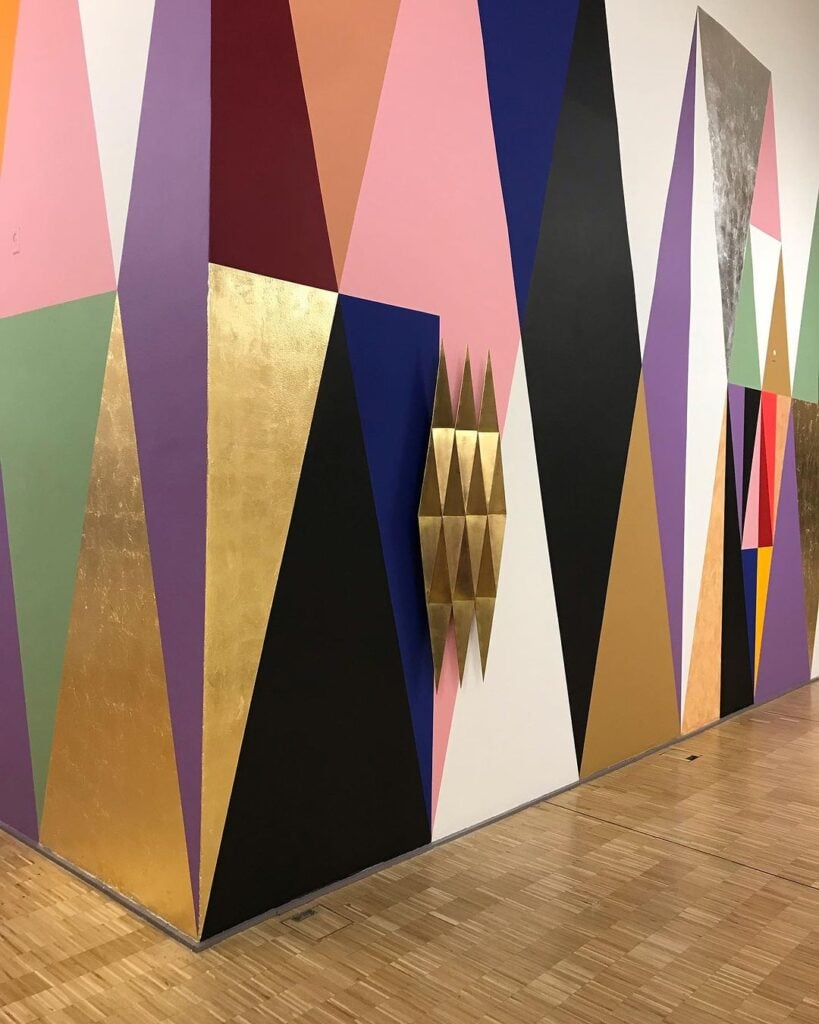
From the outset, the presence of works that aim to break free from the confines of the canvas, expanding into space, is evident. Two examples that we find noteworthy are the works of Paolo Gonzato and Giuliana Rosso. The former with “OUT OF STOCK,” an entire site-specific wall covered in diamond-shaped patterns; the latter with “Tree House,” one of her “scenography” works that we have already seen at The Address in Brescia and at Artissima in Turin. In particular, Rosso’s work delicately narrates contemporary adolescence. A treehouse becomes the stage for dangerous challenges undertaken by two teenagers who are the protagonists of the scene. Alongside the physically present smartphone in front of the artwork, visitors can only observe the scene, excluded from the action and the three-dimensional space created by the artist using the corner of two walls. Three-dimensional works, to borrow from the title of Episode 7 of Tiziano Scarpa’s podcast for Triennale Milano, can either be participatory in a bodily experience or choose to exclude the spectator. In any case, here the perspective is sought in space rather than in technique, necessitating a physical observation rather than just a digital one, bringing the audience back to the center and requiring their presence.
The language of young artists is intimate and sincere
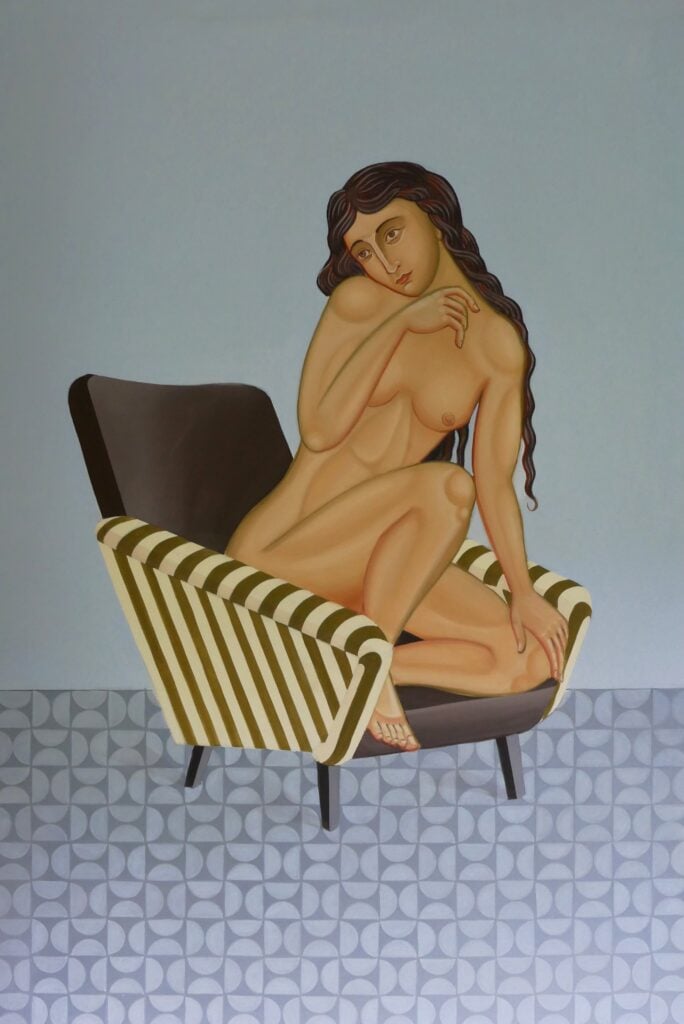
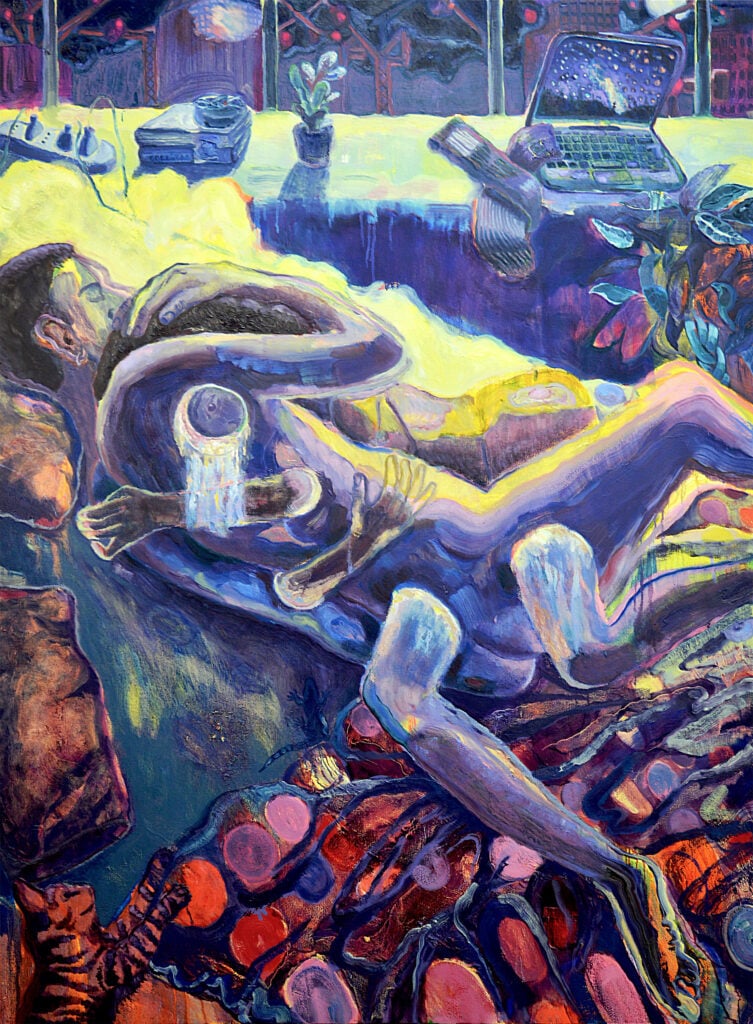
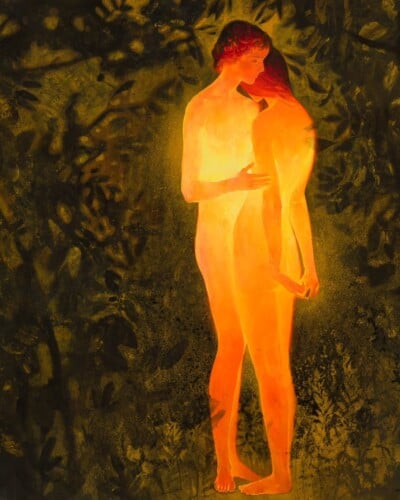
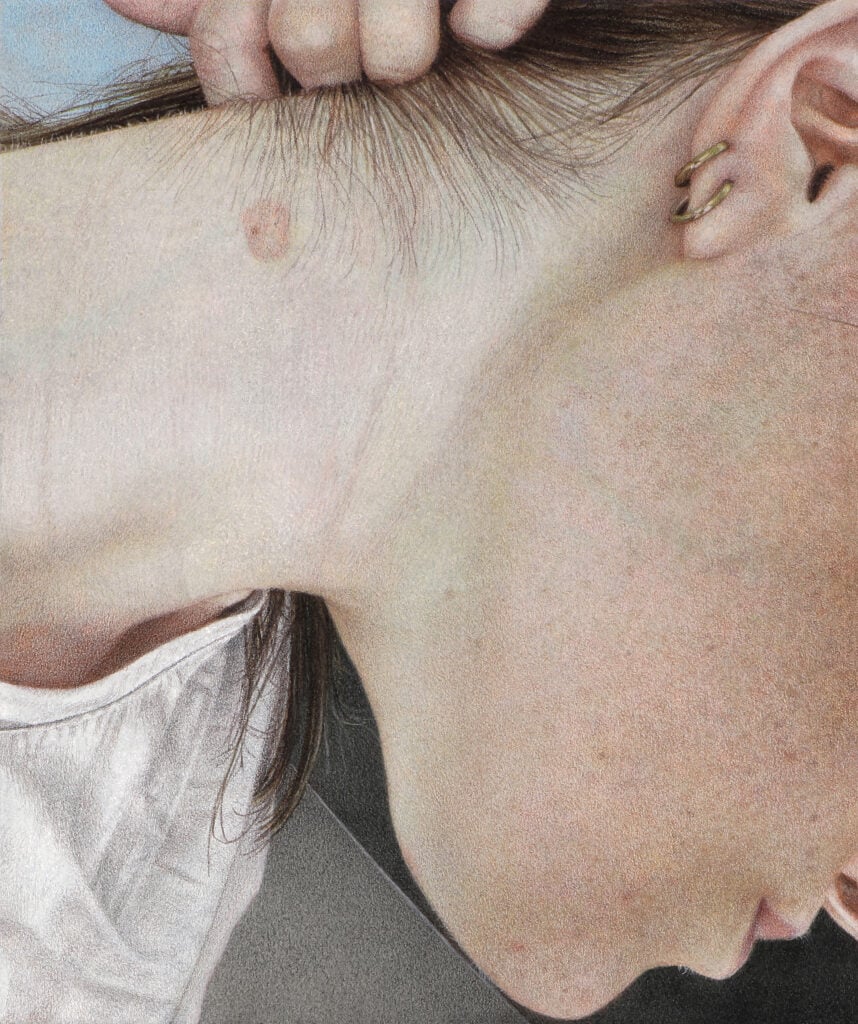
Continuing to emphasize what we liked, we focus on a specific language – the genuine, sincere, and intimate language of some of the painters chosen by Gullì for this collective exhibition. From Emilio Gola (1994) to Aronne Pleuteri (2001), some of the youngest participants, and passing through Chiara Enzo (1989), Ismaele Nones (1992), and Flaminia Veronesi (1986), these artists have the ability to truly listen to the world and translate it into images that strike different chords. In the case of Chiara Enzo, we find with pleasure one of her small canvases, depicting the vulnerability of the individual through an extremely realistic technique. Pleuteri’s work, on the other hand, delves into a more or less explicit catastrophic, belligerent imaginary, inevitably connecting to the current geopolitical situation. Veronesi’s language is more fairy-tale-like, cheerful, and carefree, akin to Gola’s painting, capable of reflecting the other side of contemporary society, longing for freedom, lightness, and equality. Nones, on the same path, through a language that looks to the iconography of the past, honestly addresses present themes such as sexuality and alienation.
Visualizza questo post su Instagram
What’s left?
As Giannini rightly expresses in the mentioned article, a visit to “Italian Painting Today” can’t help but leave us with that post-art fair feeling. Many works, all together but disconnected, an overall enjoyable experience but one that leaves us with few memories, undoubtedly subjective and influenced by our personal perception of what we liked and what we didn’t. Giannini also likens the experience to a football match, «with the audience commenting on the performances of those on the field and complaining about those left on the bench.»