Packaging has always exerted enormous power over consumers, and the sector where aesthetic care is probably the most meticulous is beauty.
A product designed to make us feel more beautiful, or simply better, cannot be ugly.
If we narrow the focus to the world of perfumes, the beauty of the bottles must match that of the fragrance they contain and preserve. It is therefore no surprise that maisons around the world have entrusted famous architects with the design of some of the most important bottles in their collections.
From Kenzo to Dior, from Frank Gehry to James Turrell, we have selected 10 perfumes designed by great architects and turned into collectible works of art.
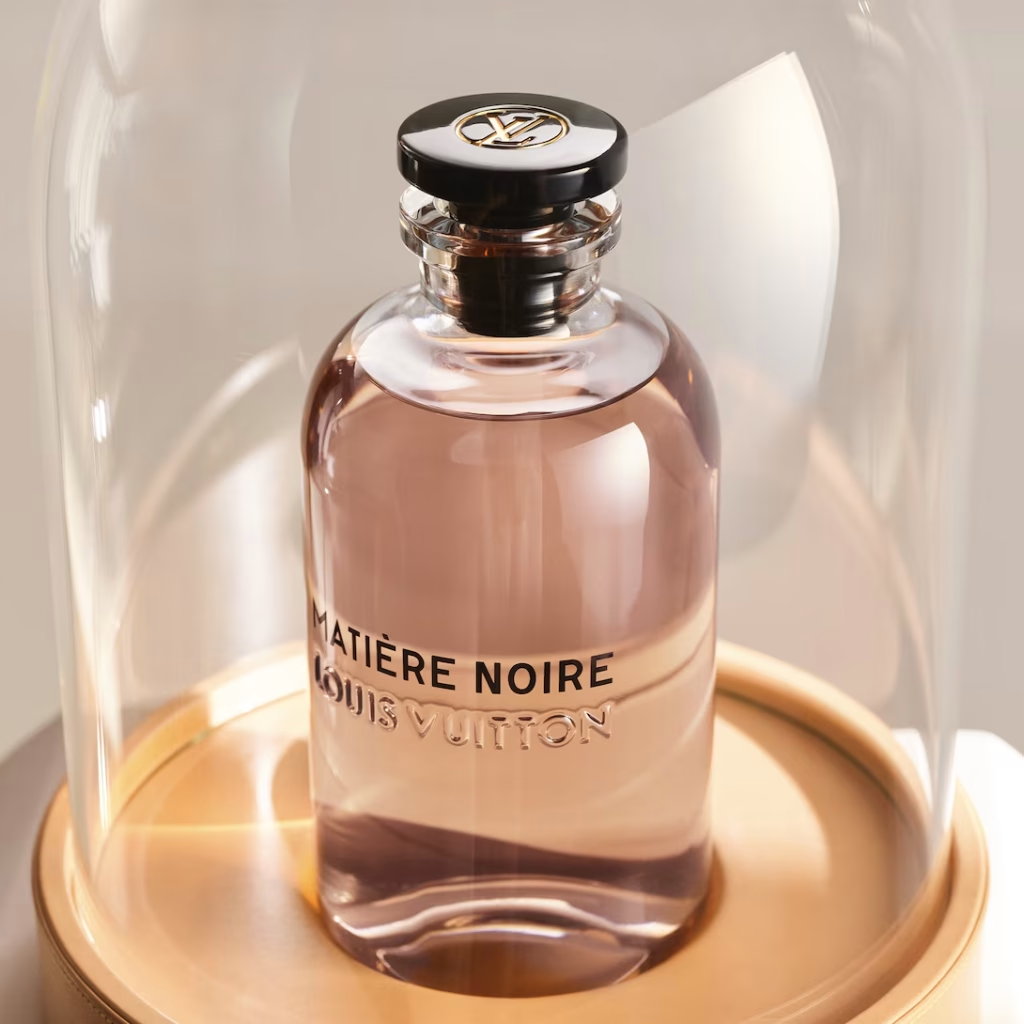
Marc Newson — Flacon d’Exception for Les Parfums Louis Vuitton
Marc Newson, one of the most influential industrial designers of his generation, is known for his fluid and futuristic language, often characterized by continuous surfaces and organic forms. He has long worked with Louis Vuitton on objects that reinterpret travel and contemporary luxury, blending design, function, and sculpture.
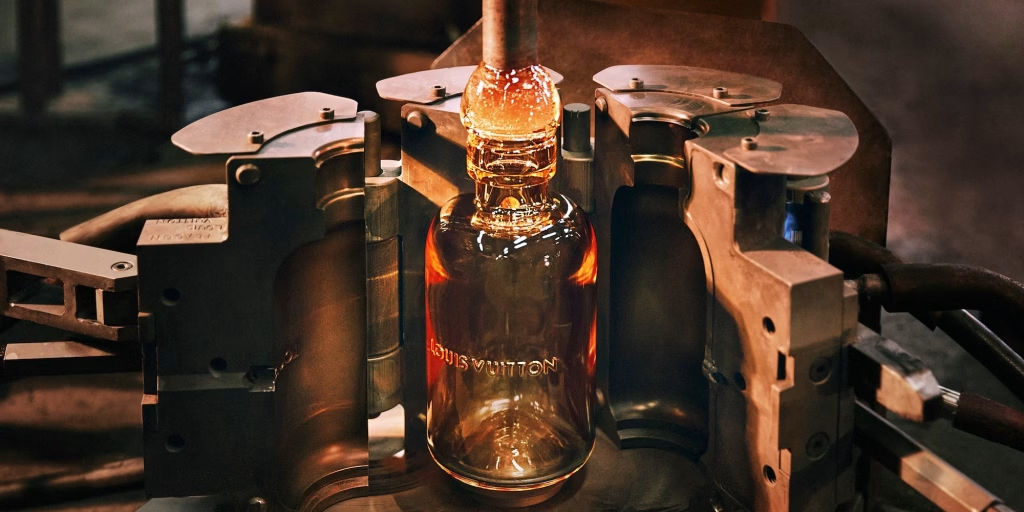
In the Flacon d’Exception project for Les Parfums Louis Vuitton, Newson brings this approach to a monumental scale. The bottle is enlarged to become an exhibition object: a one-liter crystal bottle crafted by the master glassmakers of Baccarat, conceived not only as a container but as a true collectible artwork.
The bottle is designed to be displayed under a glass dome, resting on a natural leather base featuring the Louis Vuitton logo.
Frank Gehry — Les Extraits Collection of Louis Vuitton
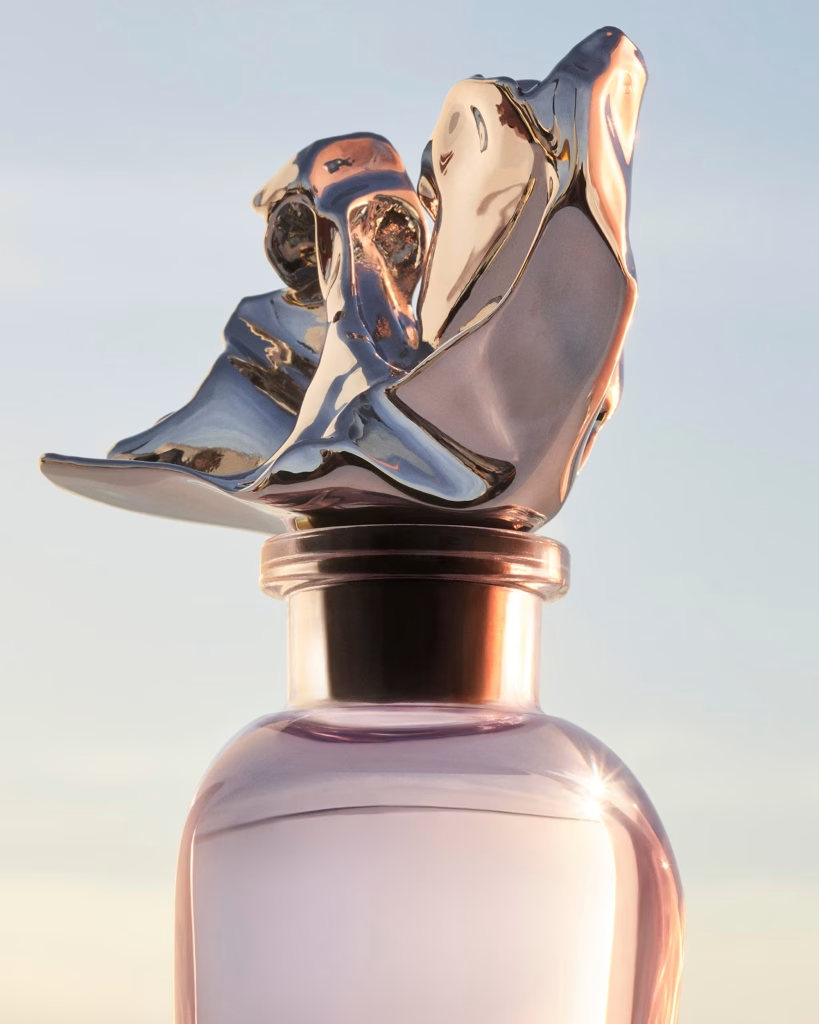
Frank Gehry is known for a sculptural language made of tensioned surfaces, fragmented forms, and an idea of continuous movement that runs through all his work.
In the Les Extraits project for Louis Vuitton, he works directly on the bottle designed by Marc Newson, pushing it toward a more sculptural and dynamic dimension. His intervention focuses on the cap, transforming it into a metallic form that is no longer just a functional element but a true architectural extension of the bottle.
Gehry’s gesture stems from the desire to capture absolute movement. The surfaces seem to fold and open like a transparent sail crossed by wind, or like an imaginary flower in full transformation. The metal reflects light irregularly, creating a sense of living matter, almost unstable.
Zaha Hadid — Donna Karan Woman
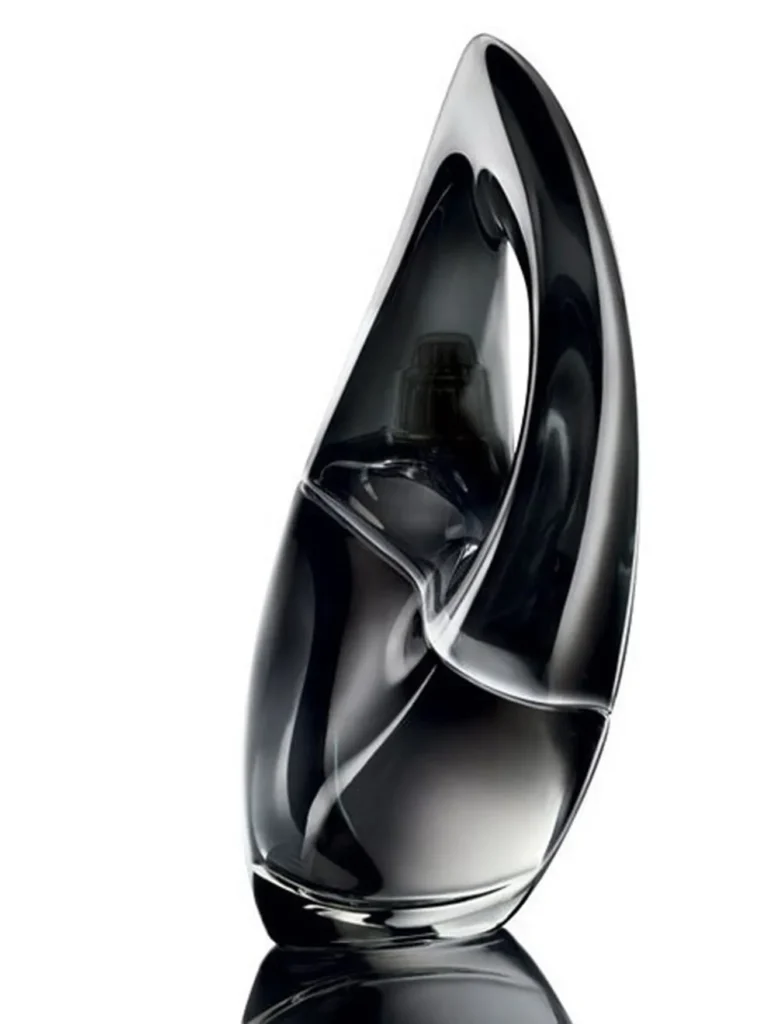
The first woman to win the Pritzker Prize, Zaha Hadid revolutionized contemporary architecture with fluid, dynamic forms that are almost impossible to read through traditional geometry.
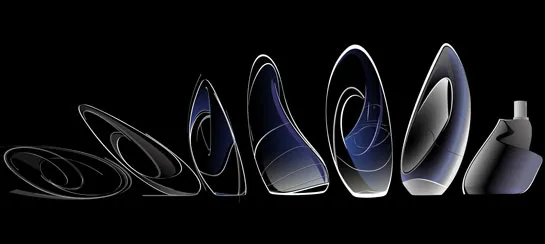
When Donna Karan asked her to design the bottle for Donna Karan Woman, Hadid translated that exact language into glass: a dark, sinuous form, almost liquid, in translucent carbon-colored glass.
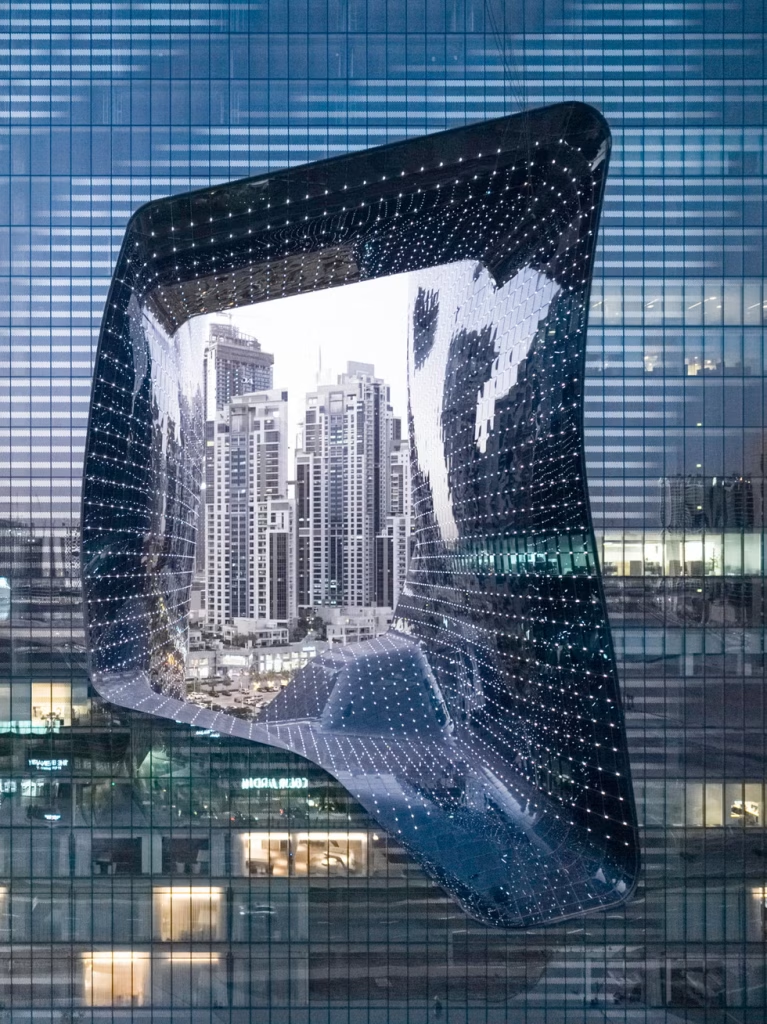
The bottle appears in continuous torsion, as if shaped by an invisible force, and inevitably recalls her famous building The Opus.
Thomas Heatherwick — Christian Louboutin Beauté
Thomas Heatherwick, a British architect and designer among the most influential of his generation, is known for a design language based on material transformations, hybrid structures, and forms often born from a simple gesture pushed to its extreme. We all remember one of his most famous works, the Vessel in New York.
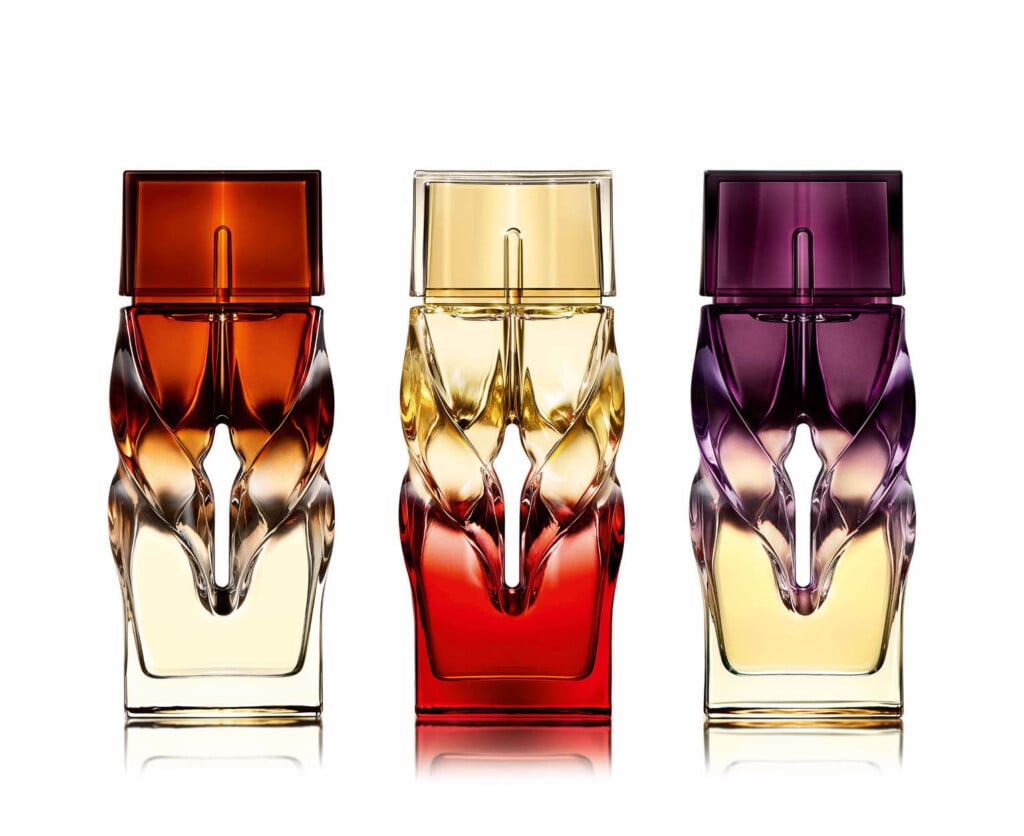
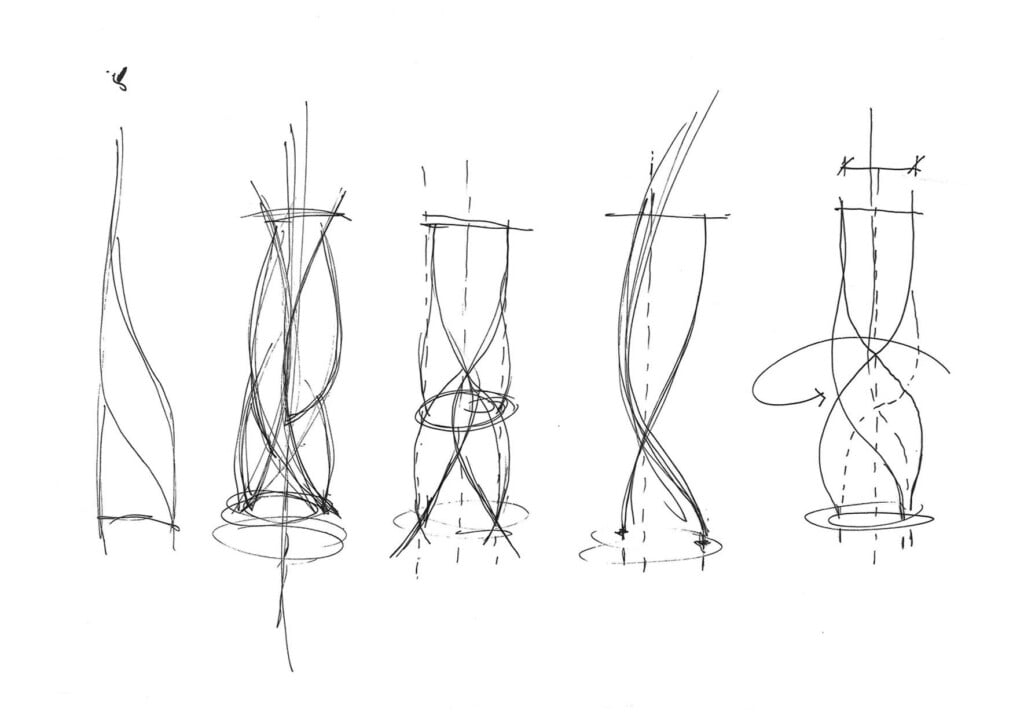
In the project for Christian Louboutin Beauté’s first fragrance line, Heatherwick explores perfume packaging for the first time. The starting point is a simple yet radical gesture: taking a rectangular bottle and “opening” it in the center, inserting a void and then twisting the form inward. This creates a structure in which the glass seems to fold into itself, generating a continuous flow around a central opening that becomes the heart of the design.
The result is a gradient glass bottle, with tones ranging from amber to red to violet, where the material appears to move even in stillness.

India Mahdavi — Dior J’adore
India Mahdavi, a Franco-Iranian architect and designer, is known for a design language strongly tied to color, the sensuality of forms, and an idea of intimate, decorative space that blends craftsmanship and modernity. Her interiors and objects are recognizable for the balance between geometric rigor and organic softness, often expressed through curved surfaces and warm, vibrant tones.
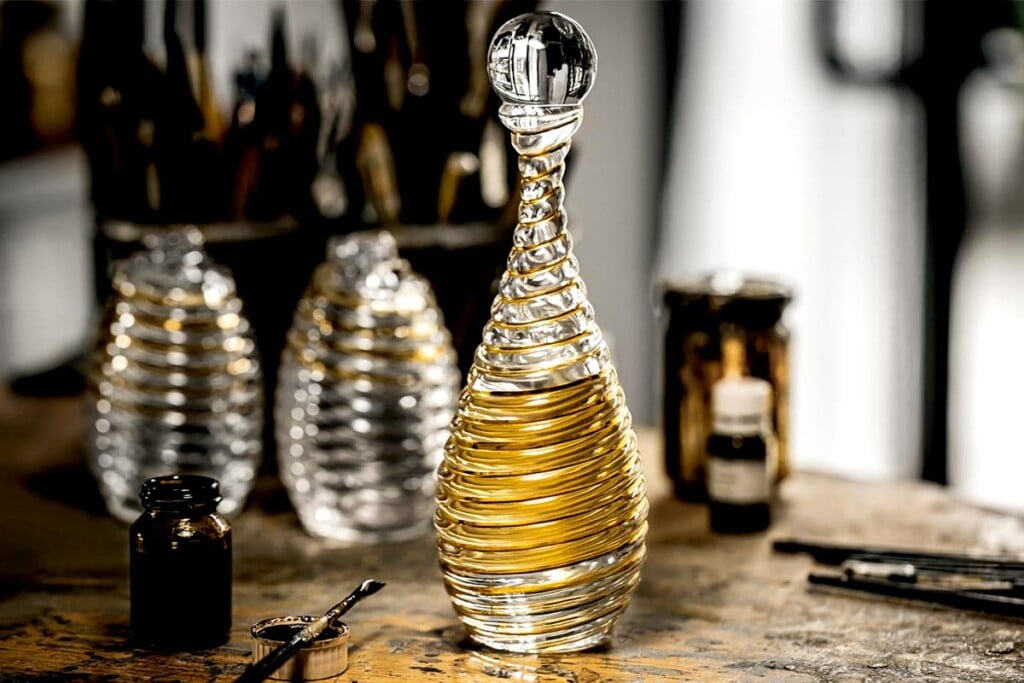
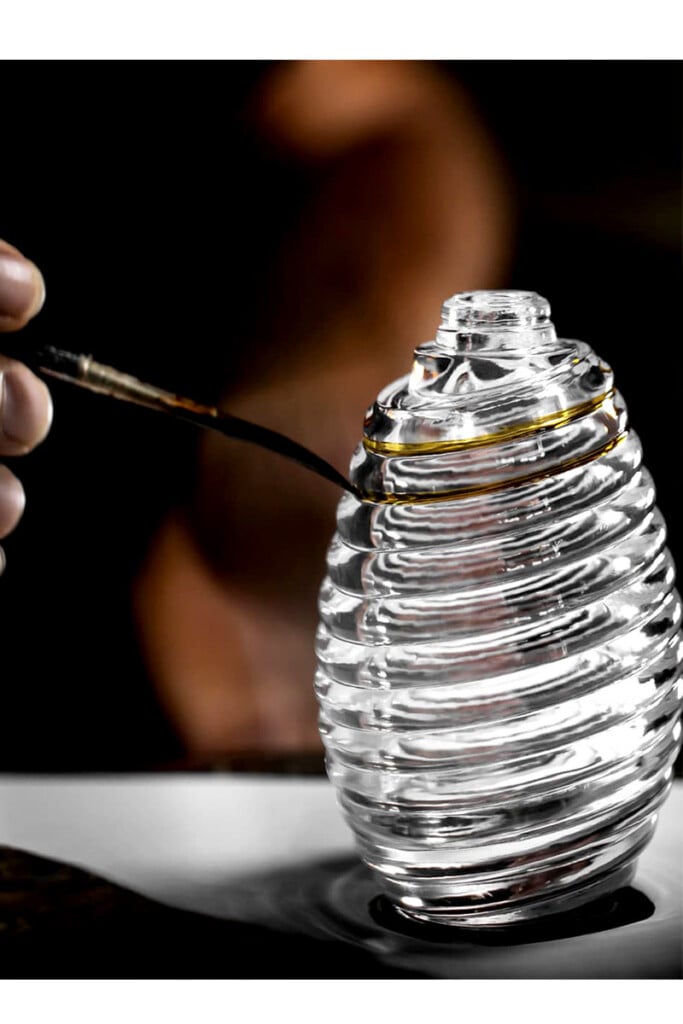
In the Dior project, Mahdavi reinterprets the iconic J’adore bottle without altering its original structure, but introducing a new material and sculptural dimension. The result is a limited series of 1,000 numbered pieces, handmade in Murano by the master glassmakers of Salviati.
Her intervention focuses on a delicate twist of the glass that wraps the classic silhouette of the bottle in a continuous, fluid motion. The golden surface seems to follow the gesture of blown glass, creating an enveloping effect that enhances the perception of a living object in transformation.
Ron Arad — Kenzo
Ron Arad is known for his experimental approach to materials and industrial forms. His curved steel chairs and deformed objects made him a central figure in radical design from the 1980s onward.
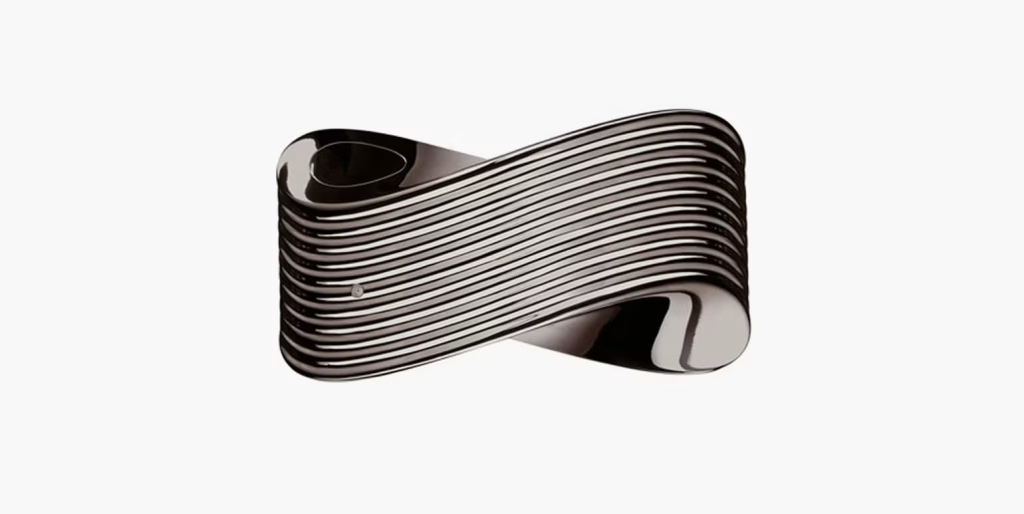
For Kenzo, he designed an ergonomic bottle shaped like a deformed figure-eight, with thin lines emphasizing the movement of the metallic surface. Made of Zamac alloy and hand-polished, the bottle has an almost mechanical appearance, yet remains highly sensual to the touch.
The dispensing system is also unusual: the perfume is sprayed by pressing a nearly invisible thumb button integrated into the body of the object.
The fragrance, created by perfumer Aurélien Guichard, was conceived as a “skin perfume”: intimate, ambiguous, difficult to define. Arad translates this idea into an object that feels more like a technological device than a traditional bottle.

Nendo — Totem by Kenzo
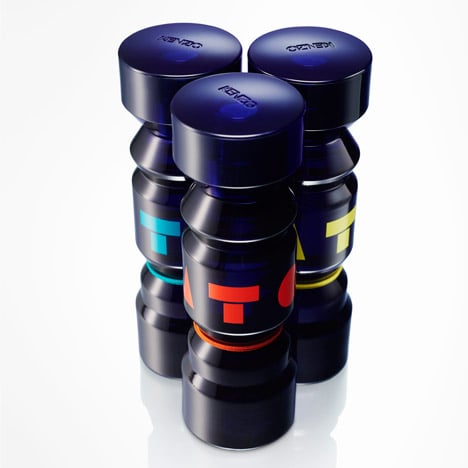
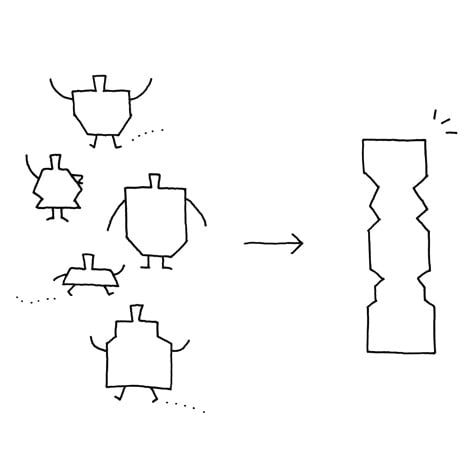
The Japanese studio Nendo, founded by Oki Sato, has always worked on extreme simplification of forms, subtraction, and the ability to transform everyday objects into essential and conceptual visual systems. In the Totem project for Kenzo Parfums, Nendo develops the bottle and logo design with the end consumer in mind. The underlying idea is that of a contemporary “new tribe,” where traditional cultural differences fade in favor of a shared sensibility shaped by digital language and online connections.
The bottle is made of dark purple glass and constructed as a stack of simple volumes, recalling the vertical, segmented structure of a totem. The cap and body merge into a single monolithic object, eliminating the traditional separation of parts and reinforcing the idea of formal unity and compactness.
Each fragrance in the line is identified not through traditional labels but through a simple color code: a colored thread wrapped around the bottle distinguishes the three variants. Even the logo follows the same logic of extreme reduction: three fundamental geometric shapes (square, circle, and triangle) become an essential symbolic system designed to represent an open and instantly recognizable identity.
Jean-Michel Frank — Salut, Schiap and Soucis for Elsa Schiaparelli
Jean-Michel Frank, a French designer and decorator among the most refined figures of Parisian modernism, had an aesthetic language based on subtraction, balance, and a form of silent luxury. His works are distinguished by the use of unusual materials for the time—such as parchment, wood, plaster, and upholstered surfaces—treated with radical sobriety that deeply influenced 20th-century design.
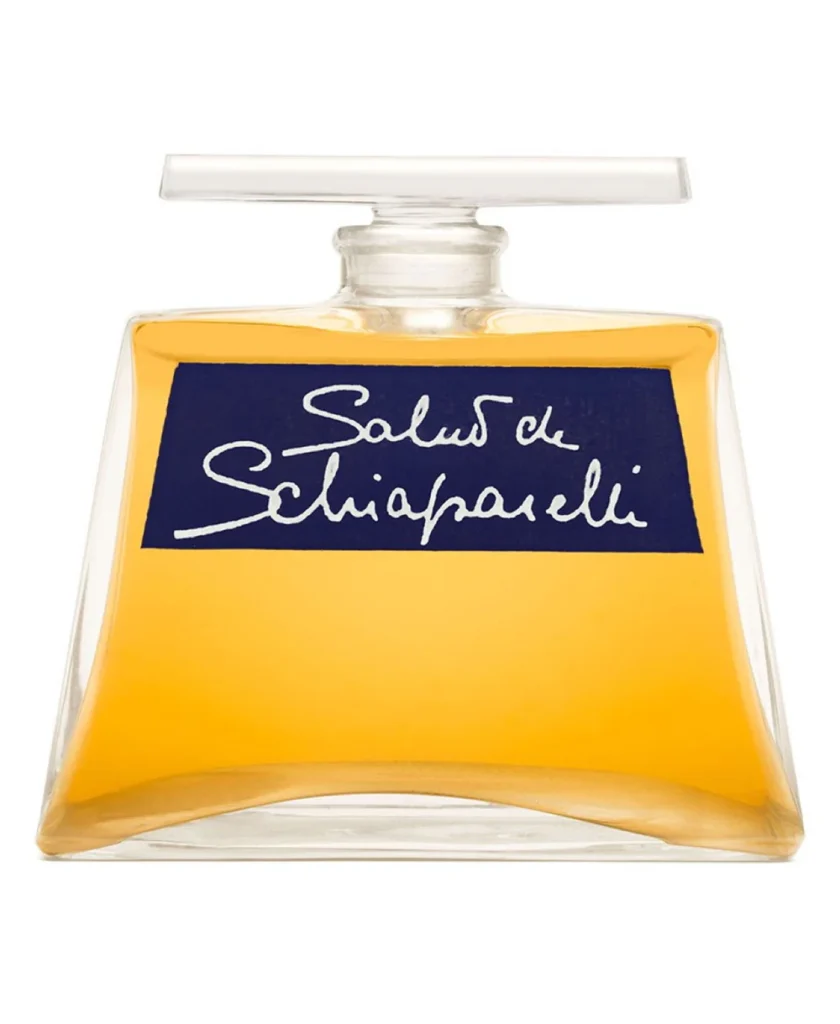
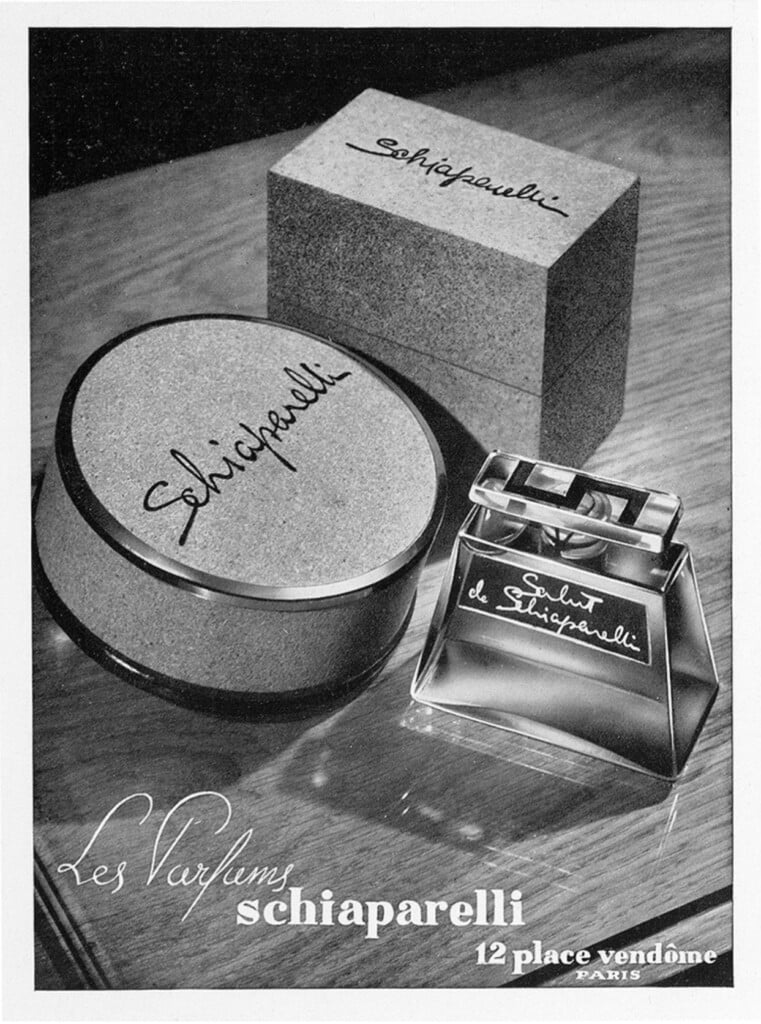
In the 1930s, Frank worked closely with Elsa Schiaparelli, who in 1934 commissioned him to design the bottles for her first perfume collection, Salut, Schiap and Soucis. The bottle was conceived as an essential, rigorous object, characterized by a trapezoidal shape and very clean graphic lines, consistent with Frank’s reductive aesthetic.
The project involved not only the bottle but an entire vision of the perfume space: the packaging was paired with unusual materials such as cork, used for the case, contrasting with the traditional luxury codes of the time.
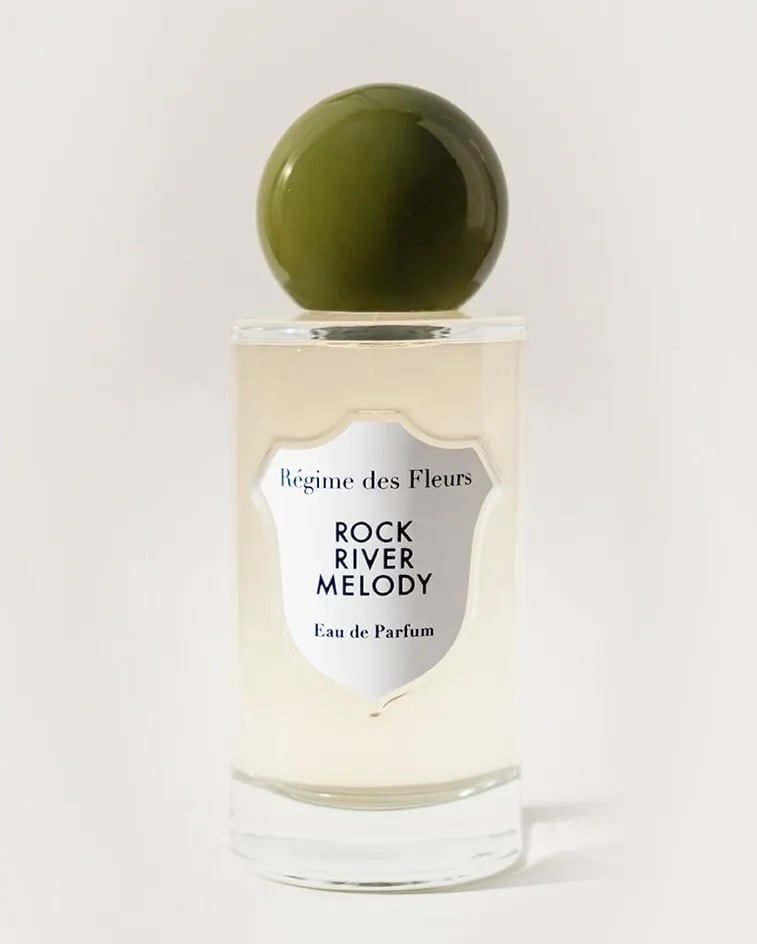
New Affiliates — Rock River Melody for Régime des Fleurs
New Affiliates is an architecture studio based in New York that stands out for a practice intertwining design, landscape, and infrastructure, often working on spatial systems rather than isolated objects.
For Rock River Melody for Régime des Fleurs, the studio approaches perfume bottle design for the first time, translating its architectural language into a reduced scale. The result is an essential object built on sober geometries and rigorous proportions, where glass becomes a silent mass rather than a decorative container.
The bottle reflects the idea of perfume as an atmospheric and narrative system rather than an autonomous object: a discreet, almost infrastructural presence that leaves space for the fragrance without overloading it with formal signs. In this sense, the project aligns with a broader contemporary trend among architects and designers working in perfumery: reduce, abstract, and shift focus from decoration to structure.

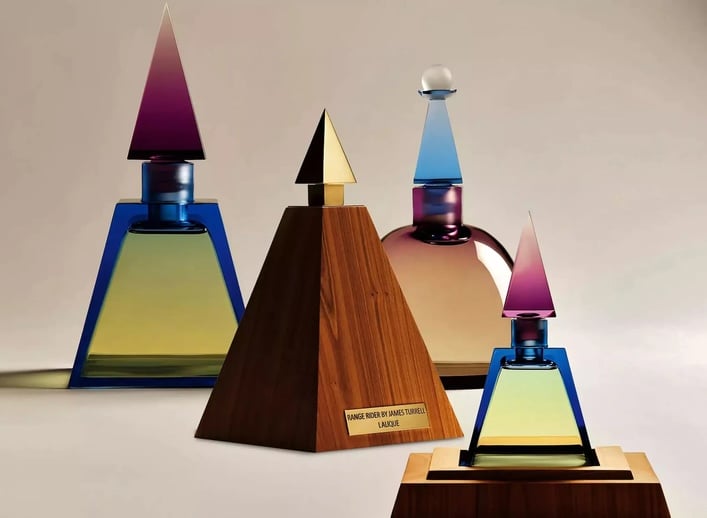
James Turrell — Range Rider and Purple Sage of Lalique
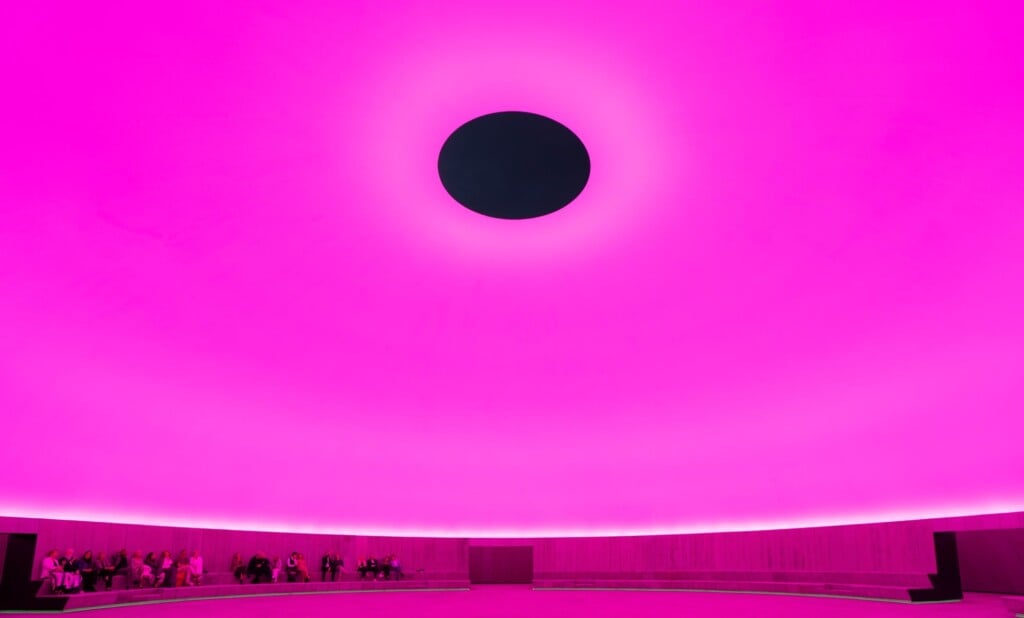
James Turrell, an American artist among the most important in the field of perception and light, is famous for his environmental installations that transform space into pure sensory experience.
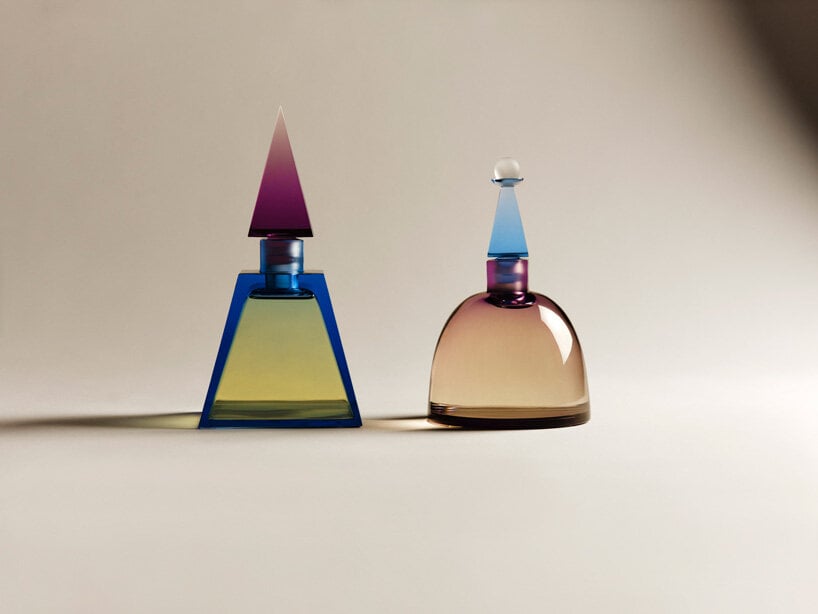
For Lalique, Turrell created two perfume bottles for the first time, Range Rider and Purple Sage, conceived as true architectural objects in miniature scale. The bottles are produced in limited edition and entirely in colored crystal, handcrafted by the maison’s master glassmakers.
The forms are inspired by monumental structures such as Egyptian pyramids and Asian stupas; the result is an object that does not simply contain perfume, but transforms it into a luminous presence: the crystal acts as a prism that diffuses and refracts light, turning the bottle into an “active” volume in space.
The two fragrances are built as complementary interpretations of the same imaginary world: Range Rider evokes the landscapes of Arizona through accords of leather, pepper, amber, and citrus, while Purple Sage interprets the same landscape in a more delicate, vegetal key, inspired by the desert plant from which it takes its name.