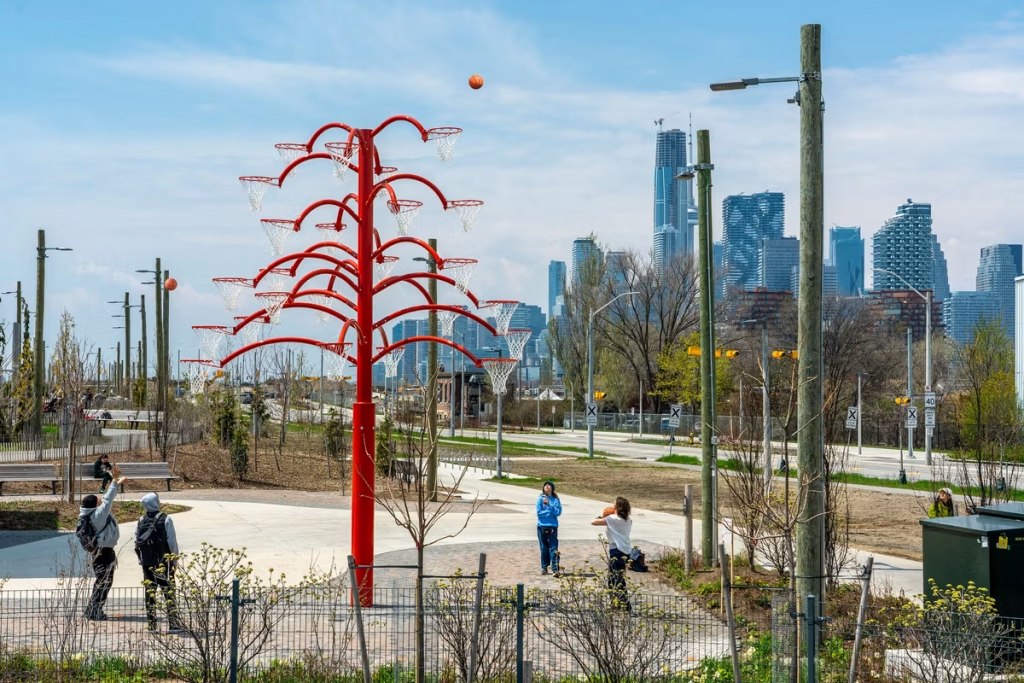
Orange Functional by Alexandre Arrechea initially looks like a monumental sculpture, but you only need to get closer to realize it isn’t made just to be looked at.
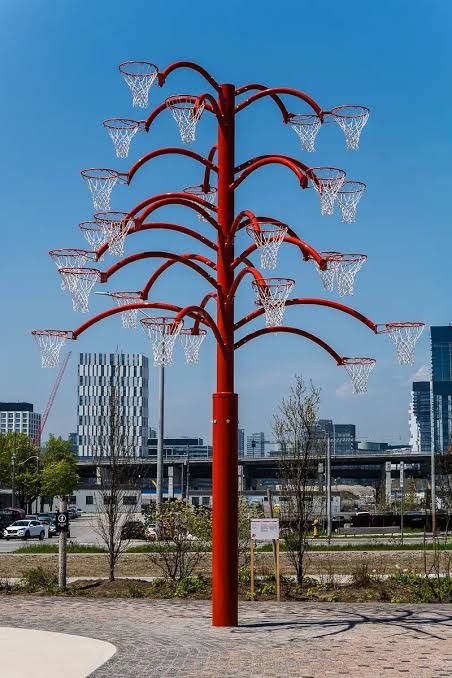
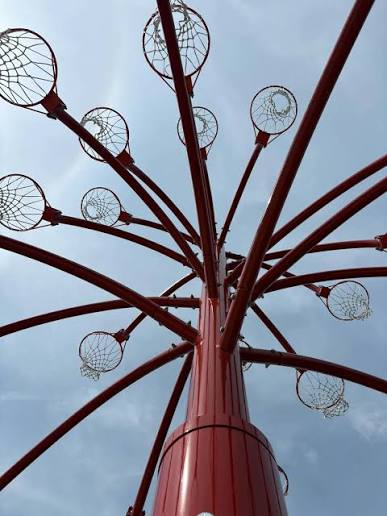
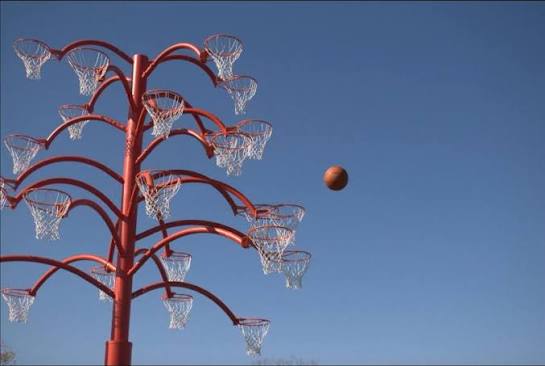
A tree with metal branches, more than twenty baskets, and a ball moving through the air. Created in 2022 and now part of Toronto’s Lassonde Art Trail, the work stands at the entrance to Biidaasige Park, in the square of Old Firehall 30. The steel structure takes the shape of a tree, turning its branches into basketball hoops set at different heights. The reference to nature is therefore not only visual: when a ball passes through the net and falls to the ground, the gesture of play echoes that of a fruit dropping from a tree.
The most interesting part of the work, however, lies in its being functional. Arrechea takes a recognizable element of public space, the basketball hoop, and completely alters its structure, forcing whoever plays to change perspective, distance, and movement. The rules of basketball remain familiar, but the playing field no longer is. The work thus becomes something to move through and use, rather than a sculpture to be observed from a distance.
This is an approach that recurs throughout the research of Alexandre Arrechea, a Cuban artist born in 1970 in Trinidad. After studying at the Instituto Superior de Arte in Havana, in 1991 he was among the founders of Los Carpinteros, a collective he worked with until 2003. In his solo practice he has continued to focus on architecture, memory, urban space, and the power relations hidden within the structures we use every day.
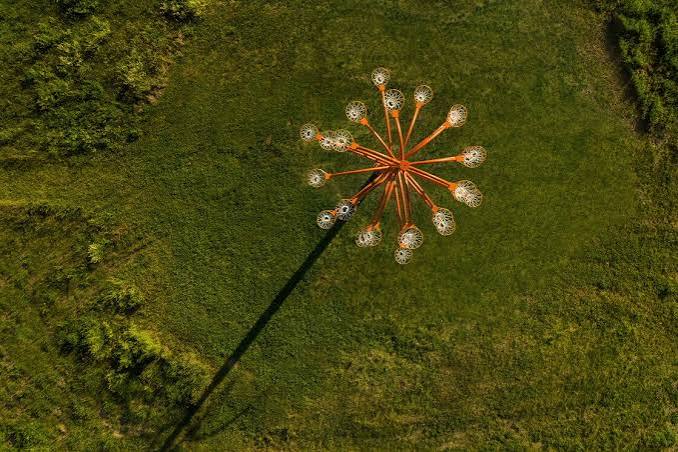
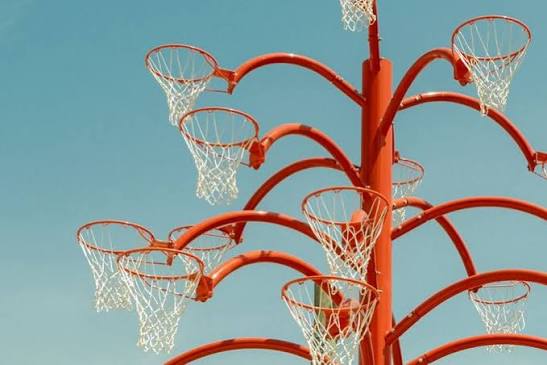
From the monumental NOLIMITS, which reinterpreted some of New York’s iconic buildings, to the installations dedicated to basketball, Arrechea works on already familiar forms to change their meaning and the way they are experienced. In Orange Functional this research takes on a particularly direct dimension: the work does not simply ask to be interpreted, but invites you to pick up a ball and try to play.
The result is a sculpture that moves between public art, architecture, and play. A seemingly simple object becomes an opportunity to change the way we occupy a shared space, turning passersby, for a few minutes, from spectators into participants.