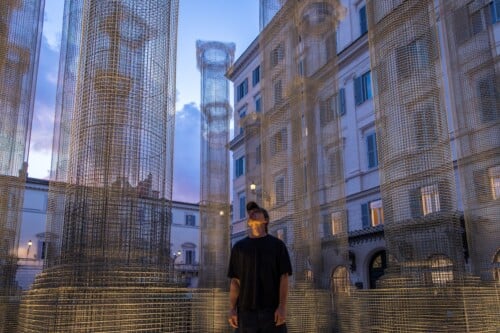
Despite the restrictions and the current situation, the RGB Light Experience, the urban festival of light art, urban design, and video-mapping, is back again this year.
The RGB, born in 2015 and now in its 5th edition, is produced by the company Luci Ombre and directed by Diego Labonia, and for 4 days will transform the Roman nights into an unmissable show.

Through 18 site-specific works of light, signed by as many artists, four places in the capital will be illuminated and come to life from 18.30 until 22.00, curfew time. The show will obviously be enjoyed by passers-by, but to give everyone the chance to admire its beauty, the event will also be streamed on Facebook and YouTube.
“Naturare” is the theme chosen for this year’s edition, which invites the public to rethink the places, the impact that man has on Nature, inviting him to find a solution, even through art.
To know more about all the details of the RGB Light Experience 2020, we at Collater.al asked Diego Labonia a few questions. Read the interview below and to discover this year’s artists visit the official website.


Hi Diego, before talking about RGB Light Experience, let’s talk about you. Tell us about your path, how did you approach light art and how did you get to where you are now?
Hi, I started playing with lights in 1992 at a course as a technician and light designer in the theater in Treviso. Back in Rome I started working in a service that allowed me to touch all the technology of the moment. I have always worked with research theater companies such as Corsetti-Fattore K, Accademia degli Artefatti, Punzo, Cecchi, RicciForte and many other experimental theater companies. Since 2006, with AREA06, we have conceived and organized the festival SHORT THETRE, now in its 15th edition, where I take care of the technical organization and staging. Since 2007 I have my own company, LUCI OMBRE, which deals with the design of stage settings and we take care of lighting, video, audio and set design. Since 2014 I started to write cultural projects and we realized RADIOLASER for the New Year’s Eve 2014 of the City of Rome, various evenings for the Night of Museums and Museums in Music. In 2015 I conceived and realized the first edition of RGB Light Experience. In those years I begin to make installations such as SOTTOVUOTO, ETHER’O’, NEAR DEATH and others.
If I have to say how I got here, the only answer that comes to me is with the work always conditioned by a single thought, always look at the flap that is not seen, in that bag is a totally personal world that we can fill as we want, a free space that can only be filled by our imagination. As Bruno Munari said: “with logic, and therefore with technology, you can prove something that you already think is there, while with intuition, with imagination and creativity, thanks also to this randomness that the Orientals call Zen, there is a different contact with reality that allows you to discover other qualities that do not lead to a practical result but cognitive”.
Five years ago, in 2015, RGB Light Experience was born. How did this project come about and what does it consist of?
In all these years I have always found the lack of the culture of light, only in the last decade has begun to give real importance to light and the relationship between it and the human being. The first time I thought about the festival I had never seen a live light art festival, so I based it mainly on my needs.
To create a supportive union between the work and the space that hosts it, a bidirectional exchange that allows the survival of both, the environment accepts the intervention of the artist and sends back an amplified meaning, many times distorted and surprising even for the artist himself, a site-specific that generates unconscious art and at the same time generates a code similar to music.

It is precisely this code that people are able to decode in a very simple way and especially to recognize in a completely unconscious and natural way at the same time, a bit like what happens with music, I do not have to know the notes to appreciate it.
RGB Light Experience, an acronym of Rome Glocal Brightness, is the first free urban exhibition of light installations and video installations in Rome.The protagonist is light art, a current of contemporary art related to visual arts and various applications of light, thanks to which the city becomes an open-air museum.

In each edition, for four days, from sunset to late night, the experience offered by RGB allows the public to immerse themselves in hidden and unconventional corners of Rome, creating an artistic path dedicated to sharing experiences and exploring the material and immaterial heritage of the city.
The path of the exhibition, about 4 kilometers long (not this year) winds along the historic streets, architecture and landscapes of the eastern Roman suburbs, in the triangle of land that has as its vertices the pedestrian island of Pigneto, the Acquedotto Alessandrino of Parco Sangalli and Piazza Malatesta.A cosmopolitan place made of coexistence of peoples and mixing of different realities, where colors, customs and traditions are intertwined, influencing each other, creating, unwittingly, new worlds. In this historic suburb par excellence, in fact, next to a strong indigenous popular matrix, for many years many communities of different ethnic groups have settled and fully integrated. At the same time, the neighborhoods of this area are undergoing a real repopulation by young people, families and students, in addition to the flourishing of new clubs, meeting places and cultural spaces.
In a context so characterized, in order to enhance the cultural diversity that characterizes the area and contribute to the development of the ability to live together and the sense of belonging to an open community, able to welcome and integrate, RGB is proposed as an initiative that creates an opportunity for collaboration between the different realities that inhabit the area.

The choice of places has fallen on this area, first of all for reasons of belonging and secondly, for its archaeological and architectural richness and its strategic location. These conditions, together with the described anthropological, social and historical value of this territory make it the right place to host such a multiform artistic experience. RGB is an innovative experience of urban space; the exhibition proposes artistic urban lighting as an alternative language that can open the confrontation with the other and involve the local community and visitors, showing the city in a new light. The installations create a strong connection with the environment: the work becomes part of the neighborhood and the neighborhood is part of the work, enhancing each other in an exchange that tends to symbiosis.


RGB, following a glocal model of enhancement of the territory, is an opportunity for redemption for the suburbs that in the common imagination is often synonymous with degradation. The exhibition allows citizens and tourists to discover and explore the area, who otherwise would not have the opportunity, thus helping to counteract the prejudices and distorted reading provided by the media, which often tend to exaggerate the degradation, actually limited to certain areas, and treating immigration exclusively as a problem, instead of enhancing the value of multiethnicity. RGB’s activity, therefore, contributes to creating a media resonance that can positively influence the appeal and territorial competitiveness of the suburbs where the exhibition takes place.
Despite the current situation, you managed to organize this year’s edition as well. What changes compared to past years?
The other years we only had the problems dictated by bureaucracy, the inefficiency of the municipal administration and trying to untangle inadequate and excessive laws. This year we also had the pandemic, a virus necessary to the historical moment, a wake-up call, indeed a real explosion that I hope everyone heard! The pandemic allowed us to change our plan in the process. It was a stimulus and not a brake, it made us think of new solutions and gave us the opportunity to experiment with a new format. In January I thought about the title of the fifth edition and “NATURARE”, a verb I stole after watching a documentary on Neri Oxman, turned out to be a more apt word than ever, how can we use art to create a building, a parking lot, an elevated railway or an aqueduct?

Compared to past editions, there will not be the usual walk, but we have identified 4 sites where artists will make interventions of video lighting, all events will be filmed and streamed on our Facebook page and YouTube. Obviously, all those who pass by will be able to see the installations live.
We have chosen 4 locations. The Alessandrino Aqueduct, surrounded by the buildings of speculation and saved by the shacks of the Borghetto of the same name that once demolished have left space for the current park Sangalli. A parking area between via del Pigneto and via Pavoni that represents what can happen when you build without any urban planning, but simply leaving space for the mere random juxtaposition of buildings 4 times as tall as the buildings that were present on the site. The elevated East Ring Road on Via Prenestina, a high-speed road designed by architect Kenzo Tange in the ’60s, but which was already provided for in 1909 by the master plan. A road created to unite the northern and southern parts of the city. In this multiple elevated crossroads, the artists will create scenarios and visions using the curved lines of the roads and the pylons that support them. Finally, the complex called Rampa Prenstina that was built as a warehouse for the Opera House and that partially changed destination becoming a school in the late ’60s and a residence for needy families in the ’70s. Currently the circular part is abandoned, it would be a perfect site for a Museum of Light! This location has gone to replace the Ligini Towers at EUR that we had chosen but that the police forbade us.
“Naturare” is the title of this fifth edition. Why was this theme chosen and how was it developed?
“NATURARE” invites us to think of Humanity and all that belongs to it, not as the center of Nature, but as part of it. It asks to think and act with the awareness of belonging to a living place and being part of a closely interconnected whole.
Humanity acts in an invasive, irresponsible and selfish, capitalistic and anti-capitalistic way, deluding itself into believing that it governs the natural world and ignoring its responsibilities towards it. Humanity’s impact on Nature is such that it strongly threatens the quality of its own existence and radically affects the fate of its own and other species, destroying entire ecosystems.
«How can we use art to modify the existing and put it in harmony with Nature?»
It is necessary to introduce a rapid and radical change; we have the responsibility to take care of Nature, this is the thought that must govern our actions!NATURARE can be summarized with the following question: how can we use art to modify the existing and put it in harmony with Nature?
The main element of RGB Light Experience is obviously the city of Rome, and the link that is created between the work and the place where it comes to life is fundamental. What is the ultimate goal of this art?
The purpose, if any, is always that of all other arts, it starts from a stimulus of the artist, he turns it into a work that in turn is absorbed by the public. What happens next is a strong input for all of humanity, art speaks of the beautiful and denounces the ugly, satisfies us in aesthetics and makes us reflect on the present even if it usually speaks to us of the imminent possible futures.