July 2022, Tate Modern. The doors of a lift open, close, open again. Inside is a woman in a wheelchair wearing a red swim cap, goggles and a black full body swimsuit. She doesn’t speak, she doesn’t move, she gives not the slightest hint of what we are supposed to do. On the wall is a question: Are you comfortable yet?
It goes on like this from ten in the morning to six in the afternoon, eight long hours spent in an anonymous place where we usually pass the time pretending not to look at each other.
The reactions, according to the artist and those who were there, were every one that can happen in a space of a few square metres: people pressing themselves against the opposite wall to put as much distance as possible between their body and hers, people reacting with barely concealed horror, people ignoring her, people unsure whether she was real, and even someone who mistook her for a mannequin.
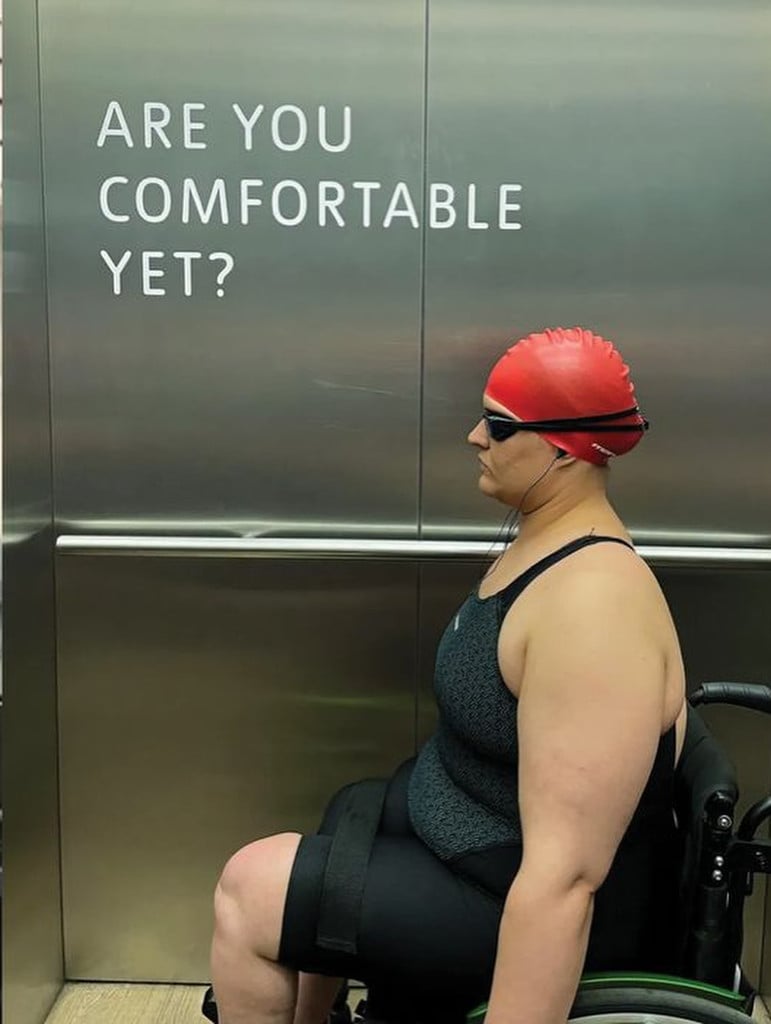
That woman is Anahita Harding, a British Iranian artist, and that lift is an artwork titled Are You Comfortable Yet?, presented as part of WAIWAV (We Are Invisible We Are Visible), a contemporary art project created to carry forward the spirit and aesthetics of the Dada movement through the work of disabled, Deaf and neurodivergent artists.
The swimsuit is no accident: it is the one worn by a Paralympic swimmer, because Harding wants to bring attention back to the London 2012 Games, whose media campaign was meant to change forever the way we look at disability, and to ask how it actually went, given that many people with disabilities continue to face enormous difficulties in the public spaces of our cities.
Instead of answering, she gets into a lift and puts the question to whoever she meets, without saying a word.
If you are wondering what connects Harding’s performance to my column Fuori Registro, here comes the answer: that lift, those eight hours of stillness and that uncomfortable silent question have become a book.
A book, yes, and not a magazine, so we drift a little from our usual canons, but a column named after print that fails to register and breaks the rules can allow itself a detour when the object is this beautiful!
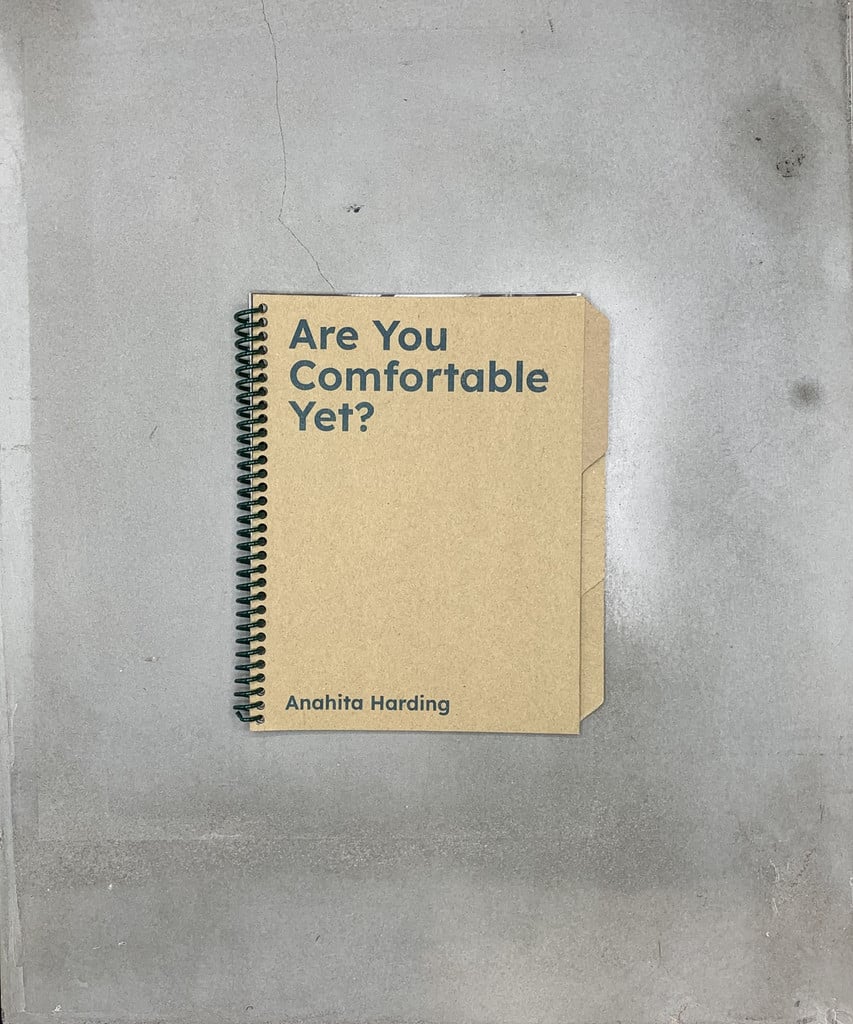
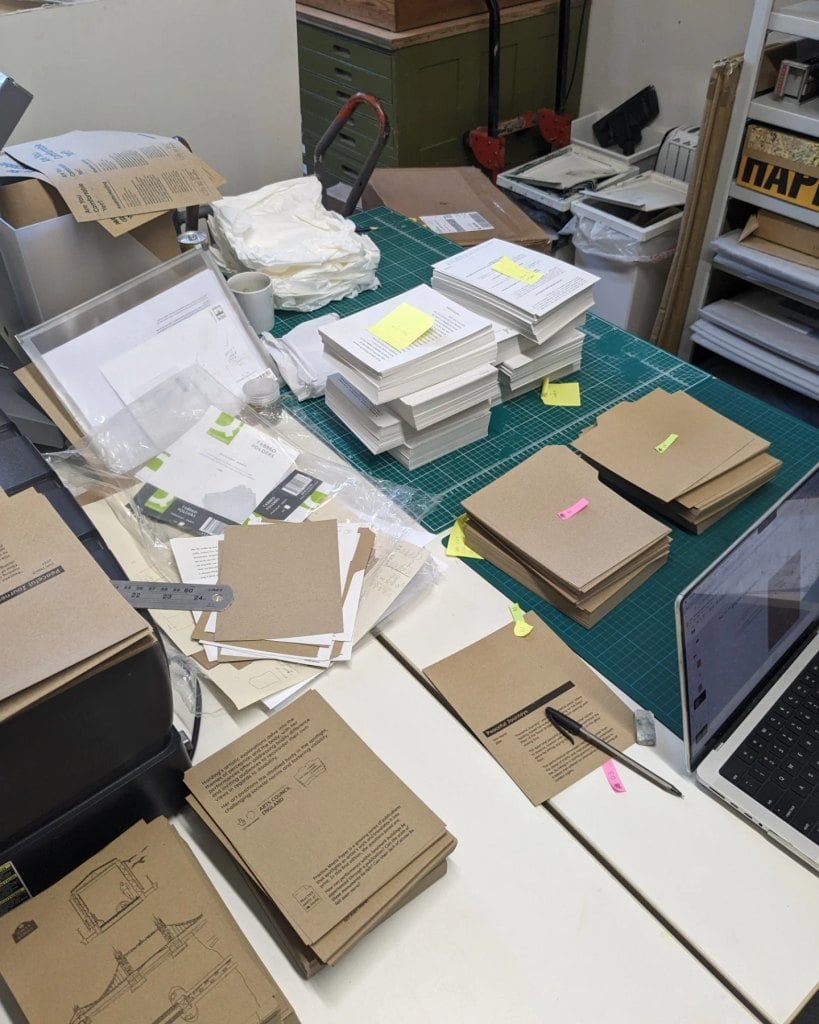
The 48 A5 pages are the work of Em–Dash, a studio and small publishing house in southeast London led by Aarushi Matiyani and Saundra Liemantoro, two young women who, having no print shop of their own, started out with risograph zines, posters and other underground productions.
The initial spark was cinema, given the passion with which both of them attended screenings at Brixton Community Cinema, which led them to print its annual programme, genuine little books halfway between an essay, a cookbook and a love letter to films. Are You Comfortable Yet? is the first release of Practice Meets Paper, their new series that takes an artist’s practice and translates it into print. It was Harding who approached them, after meeting them at a zine fair, and from there the collaboration was inevitable.
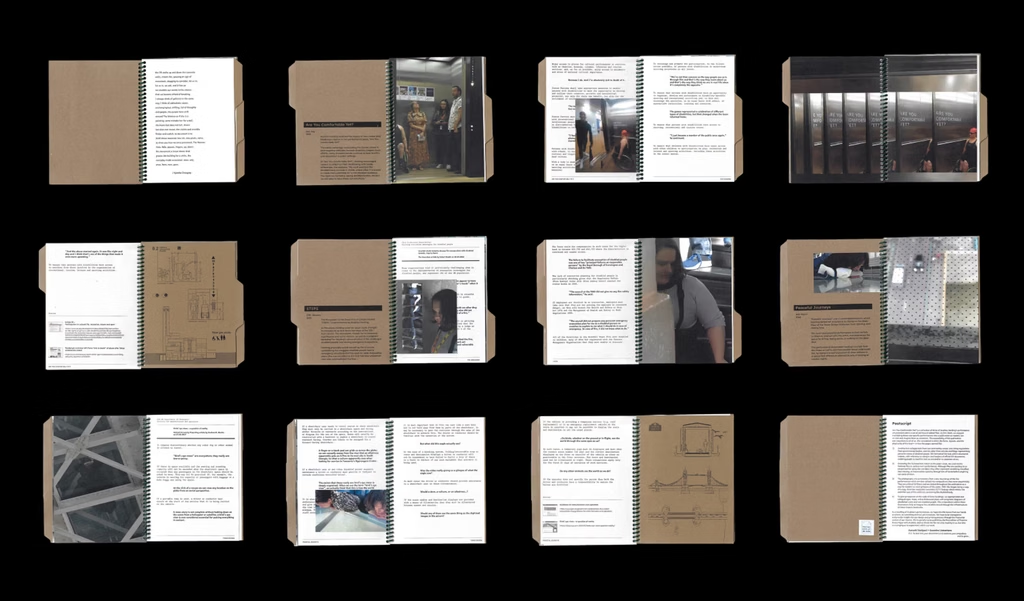
The volume contains three interventions made between 2022 and 2024, all in London monuments, all from the same conceptual family: a body, a building, a span of time.
After the lift comes Steps, at the Monument to the Great Fire of London: a column 202 feet tall (about 62 metres), with 311 steps, which Harding climbs and descends using only the strength of her arms. According to the review by Disability Arts Online, she is the first wheelchair user to manage it. Then Peaceful Journeys, in which the artist lies on the glass floor of the Tower Bridge walkways from opening to closing, for over eight hours, inviting visitors to interact. From there you can clearly see the Thames and the dreadful London traffic, including the buses, which are of course inaccessible to people with disabilities.
What struck me, though, is the layout and the content Harding chooses to include. Next to each intervention, the book sets the regulations of the government bodies dedicated to people with disabilities.
In Are You Comfortable Yet? she places extracts from the United Nations rights of persons with disabilities alongside the story of Will Perry, a Paralympic swimmer, and the daily abuse he suffered for years; in Steps she uses the fire evacuation rules, which take no account whatsoever of the difficulties faced by people with disabilities. Finally, in Peaceful Journeys she pairs the idea of a view from above with the rules on the accessibility of public transport. The result is an object in which disability holds the law to account while looking us straight in the eye.
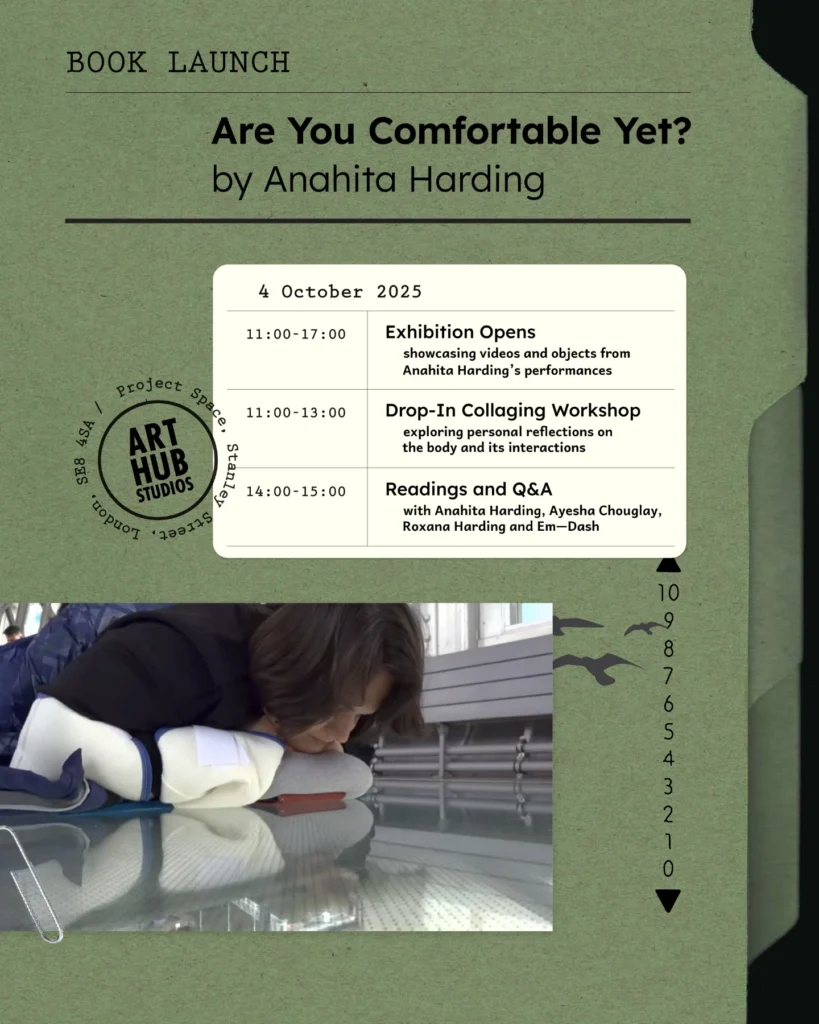
It is a very fascinating project overall, just think about it: an artist decides that the best way to talk about accessibility is to stay still for eight hours in a lift, and two designers decide that the best way to tell that story is to fix it onto an object made of paper.
On their website, it is the duo behind Em–Dash who put the question in black and white with three short, direct questions: how do you make a performative act live in a printed publication? Can you make people feel the effort of living and moving through those monuments? And above all, can you make their inaccessibility felt even more?
I will venture an entirely personal answer: the book does what Harding does. Think about it, on a table or a shelf a book is the most motionless and silent body there is and, like her in the lift, it simply stays there while we decide what to do with it: ignore it, step around it, mistake it for an ornament, or open it, read it, bend it. The possible reactions are the same, and this time it is we who open the doors. A portable lift, in short, in which we are the passenger and the question is waiting for us on the wall.
And then there is the staircase. Sixty two metres of column reduced to an A5 that fits in a pocket: an act of arrogance or of tenderness? Perhaps both: the monument shrinks, but its problem, inaccessibility, does not shrink at all.
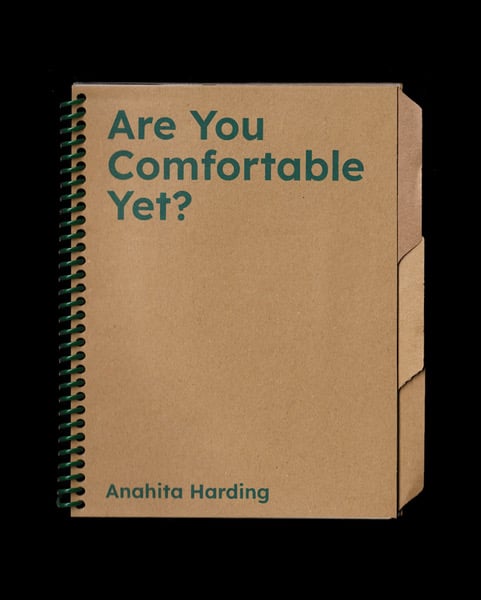
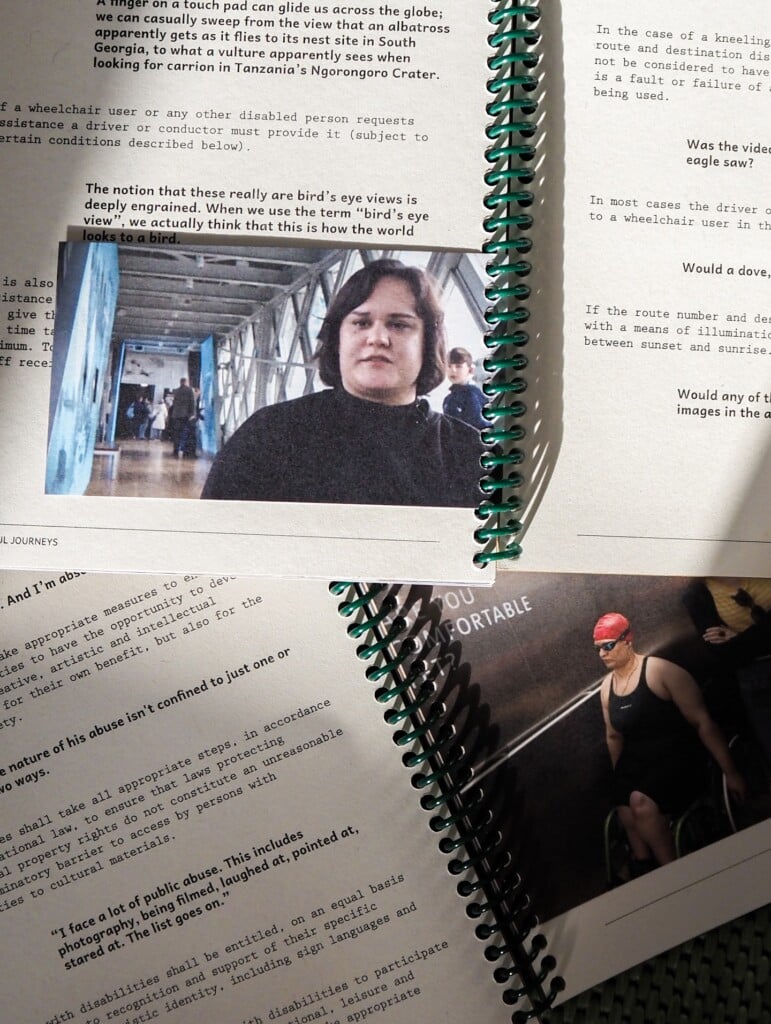
As an admirer of Em–Dash’s work, I am biased in saying that the book works even better thanks to its aesthetic choices. Printed on brown cartridge paper, with indents and ring binding, Are You Comfortable Yet? is an object that invites exploration. The layout is light and full of empty space, and the many colour screenshots of the interventions manage to bring the performances back to life. Texts, images and screenshots intertwine until they become a work in their own right. The cover, another gem dense with metaphorical meaning, recalls the court folders in which evidence and clues are gathered for trials.
Even the materials chosen tell us something: the dark paper and the spiral recall the technical office file, the typical rulebook of bureaucracy disguised as an object that wants to be touched and lived with.
The nice thing is that this device appears at once severe and welcoming. A book that talks about closed doors while trying to throw its own wide open.
So what struck me about Are You Comfortable Yet?
Three aspects that have nothing to do with the tedious and by now clichéd “nostalgia for paper”. Contemporary independent publishing is often reduced to pure fetishism of paper and ink, whereas Em–Dash clearly departs from this short sighted and truncated vision and treats it as a place in which to do politics in the most intelligent sense of the term. That said, let’s answer the question…
First: because it is an archive of three actions destined to vanish within a few minutes. Each of these interventions happened only once, in a specific place on a specific day: the Tate Modern lift for eight hours, the climb up the Monument in a single morning, the day on the glass floor of Tower Bridge. As Fluxus theory would have it, those who weren’t there can no longer see them. The book fits into this fold, not limiting itself to showing them with a few photographs, but presenting beside each performance whatever explains its meaning: the frames, the texts, the evacuation rules, the stories of those who suffered abuse or even died. In this way the performances remain readable together with their context and not only as images of a woman standing still in a strange place.
Second: because it is proof that editorial design can give form to what is missing. In this project a great deal is missing: Harding’s body, which is not there on paper; the live encounter with the public; the imposing scale of the staircase and above all denied access, which by its nature is an absence and not an object. Em–Dash makes them perceptible through design tools such as floor plans and signage that evoke the inadequate regulations that exclude.
It is the contrast between monumental scale and the absence of the body that makes us feel how closely design and access are linked; making people feel something that isn’t there, using only paper, layout and images, is no small feat.
Third and last reason: because it comes from a studio that, in the same shop, sells a poster zine of memes cut from its guests’ folders, a newsletter about the sexy librarian as a cultural figure, with texts half fanfiction and half theory, and a two colour risograph print whose original title is Attempt at Inventory of the Liquid and Solid Foodstuffs Ingurgitated by Em-Dash in the Course of the Month June Twenty Twenty-Two, a tribute to the genius of Georges Perec.
Finally, I like to underline how difficult it is to be rigorous without ever becoming solemn or, worse still, moralistic, and a book like Are You Comfortable Yet? could only be made if Em-Dash found this path, and so it happened.
At six in the afternoon, at the Tate Modern, the lift went back to being an ordinary lift. It is the fate of every performance after all, to end. The question, meanwhile, is still hanging on the wall. Are you comfortable yet? If the answer is yes, start again from page one.
Column by Francesco Ciaponi