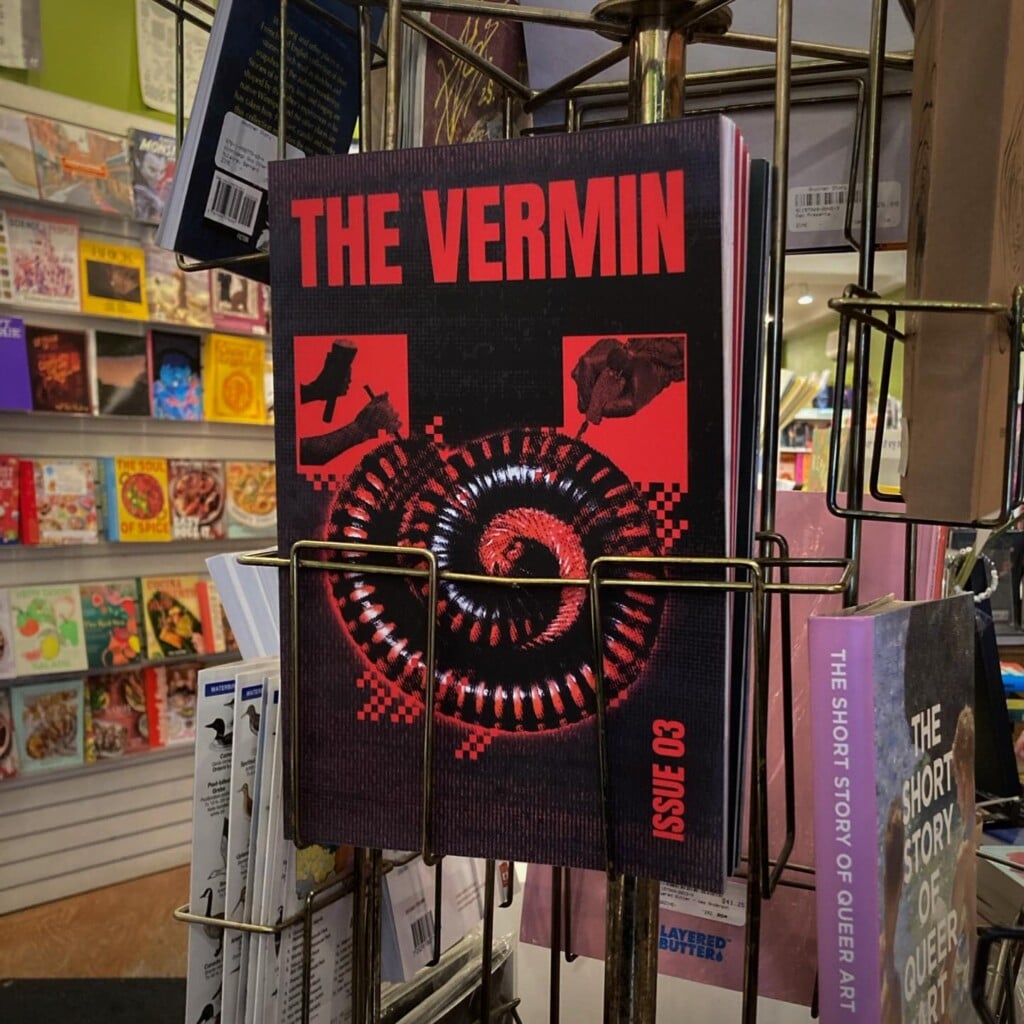
Between those who flee from vermin and those who build an entire editorial manifesto on top of it, The Vermin, an independent magazine born in Toronto around 2021, chose the second path without hesitation, defining itself unapologetically as a critical, experimental, subversive and peripheral publication — something it declares right from its name. In English, vermin refers to pests, to infesting creatures, to everything unclean and unproductive that we’d rather exterminate. That’s exactly where the magazine plants its flag: in the infested space, among the bodies, languages and practices that public discourse would prefer to look away from. It’s no coincidence the same logic applies to invasive weeds: they spring up in the cracks of asphalt, where urban tidiness never reaches, and there they proliferate without asking permission. Underground culture works the same way: it grows at the margins, invisible until it’s needed, only to resurface in the most unexpected places, with the same stubbornness as a weed pushing back through concrete right when you thought you’d gotten rid of it.
The collective describes itself as an entirely volunteer-run group, with a mission stated without mincing words: to build an anti-capitalist, genre-hybrid magazine capable of giving voice to the dirtiest aspects of our lives, the ones kept out of sight. No subject is off limits, and every profit goes straight back into the magazine’s own production costs — a small detail that says a lot about the project’s attitude.

Vermin was born with very little money and a lot of stubbornness. A crowdfunding campaign launched on Donorbox to finance the launch aimed for three thousand Canadian dollars and raised just 617. A figure that says more than any statement of intent about how fragile, materially speaking, publishing outside funded circuits really is. And yet the first issue came out anyway: printed in colour, sixty-four pages, thread-bound, designed by Fahdad Atin and Monica Chung; a genuinely well-crafted physical object that carves out its own originality within the landscape of so-called indie mags.

Issue one is titled Acknowledge the Cockroach, and the image is anything but decorative. The cockroach — the creature that survives everything, that moves through the darkness of household walls and that we usually just want dead — becomes, across these pages, the stand-in for bodies, stories and languages, through essays, short stories, poetry, photography and painting. Contributions include Notes on the Swarm by Alex V. Green, Cicada Sex/Death Ritual by Nick Taylor, and a piece titled IT’SMYPARTY!!! by R.A. Dempsey: titles that, on their own, already convey the magazine’s tone, one far more interested in raw emotional discharge than in composure.

The second issue, Against Pleasure, shifts its target without losing any intensity. It opens by citing theorist Elaine Scarry and her idea that pain has no voice until it finds a way to tell itself as a story, and from there builds an entire issue that speaks not just about discomfort, but about everything that denies pleasure — from consumerism to food, from language to psychoanalysis — in explicit polemic with what the editors call the feel-good culture of contemporary techno-capitalism. Contributors include Ricky Varghese, Anupa Mistry and Michael Deforge, the Canadian comic artist with an international following that extends well beyond independent publishing: a sign that The Vermin manages to attract already-established names into a project that remains deliberately underground.

The third issue, (Un/in)scripted, pushes the magazine’s obsession with writing as a physical act before an intellectual one even further. The theme grows out of a line from Jean Genet — «We are the ink that gives the white page a meaning», taken from Prisoner of Love — on the relationship between the blank page and the black marks on it, between what gets inscribed on a surface and what remains erased or unsaid. From there, the issue gathers reflections on archives and archival practice, on erasures and scattered traces, on the writing of the body, insurrection and political rebellion. Contributions include Indexing (Counter)Insurgency by Noa Sanders, What Gets Said by Alex Verman, and Flowers For An Old Shrine by Long Pham: a catalogue of voices that manages the difficult task of never losing the thematic coherence holding the project together.

What’s striking, in fact, is the theoretical solidity of the method more than of the tone: each issue has a precise, almost philosophical framing theme around which contributions that vary wildly in form, but never in intensity, revolve. There’s no anthology logic here; there’s the logic of the monographic issue, which earns the right to be heterogeneous in its languages precisely because it stays centred on its subject. It’s a model that demands an editorial team capable of saying no: today it’s made up of an editor-in-chief, three associate editors, one production manager and three copy editors.

In the end, the gesture that holds The Vermin together is taking what mainstream culture casts out — the cockroach and its other metaphorical relatives — and giving it back a physicality that’s hard to stomach, but precisely for that reason valued by readers for its honesty. This isn’t anti-conformist posturing for its own sake, but an editorial project betting that the only way to seriously talk about the “marginal” is to inhabit it, issue after issue, without ever asking permission. And that, more than any quote or manifesto, may be the real lesson of The Vermin: the right, proudly claimed, of anyone who still wants to print a paper magazine in 2026 to survive like a cockroach — and above all, to never apologise for it.

Column curated by Francesco Ciaponi