Luna Haverkorn‘s creations look like they come out of a lab for the materials of the future, with weaves that recall textiles, but also metal, plastic, leather or compressed paper. Only up close do you realize that none of these materials is really what it seems. The result is objects that slip out of traditional design categories and turn textile into something else entirely. The Dutch designer, currently pursuing a master’s in Textile Interaction Design at the Swedish School of Textiles, works in a territory suspended between art, textile and product design, where material is never a passive surface but a living element, capable of transforming through use.
What strikes you at first glance is the ambiguity of her creations, they look like textiles, but often they aren’t. They look like sculptures, yet they ask to be handled. Haverkorn experiments with yarns, metals, recycled plastics and unexpected materials, treating even non-textile elements as if they were fibers to be woven. The result is three-dimensional surfaces marked by folds, modules and moving details that keep shifting how the object is perceived.
In her hands, textile no longer just covers or protects, it becomes a device capable of suggesting behaviors. Some works invite you to compress, pull or rotate parts of the structure; others seem to change simply by shifting your point of view.
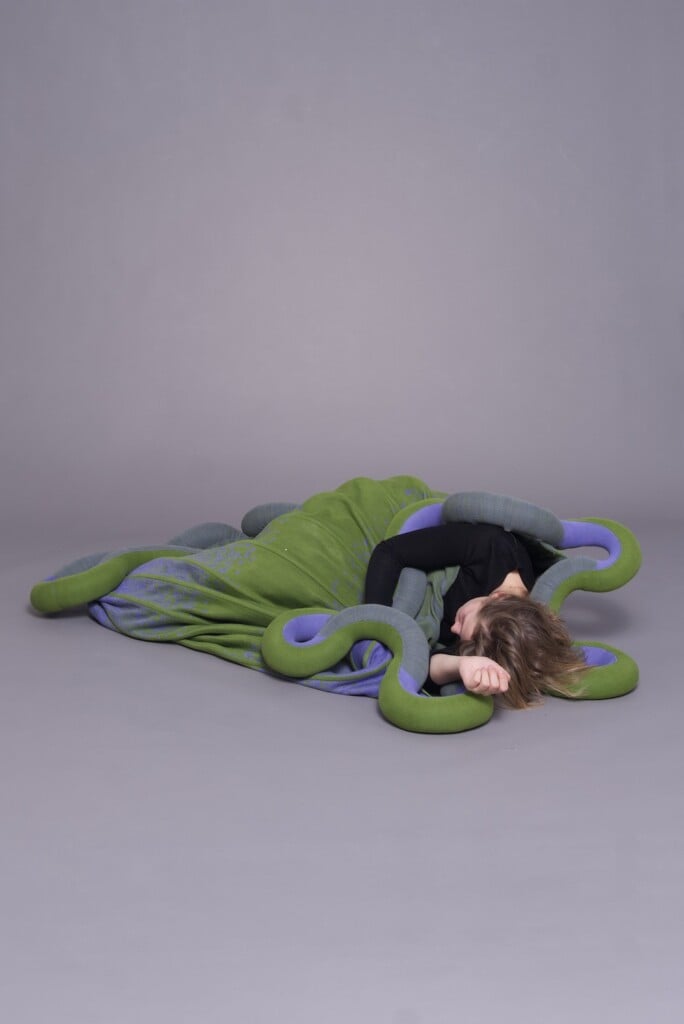
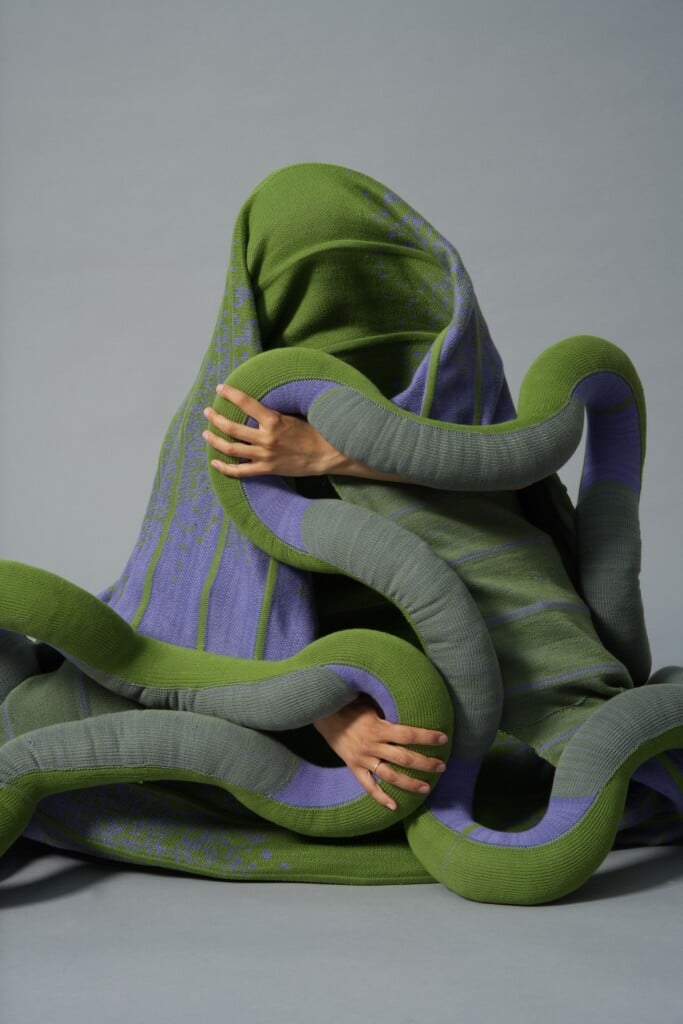

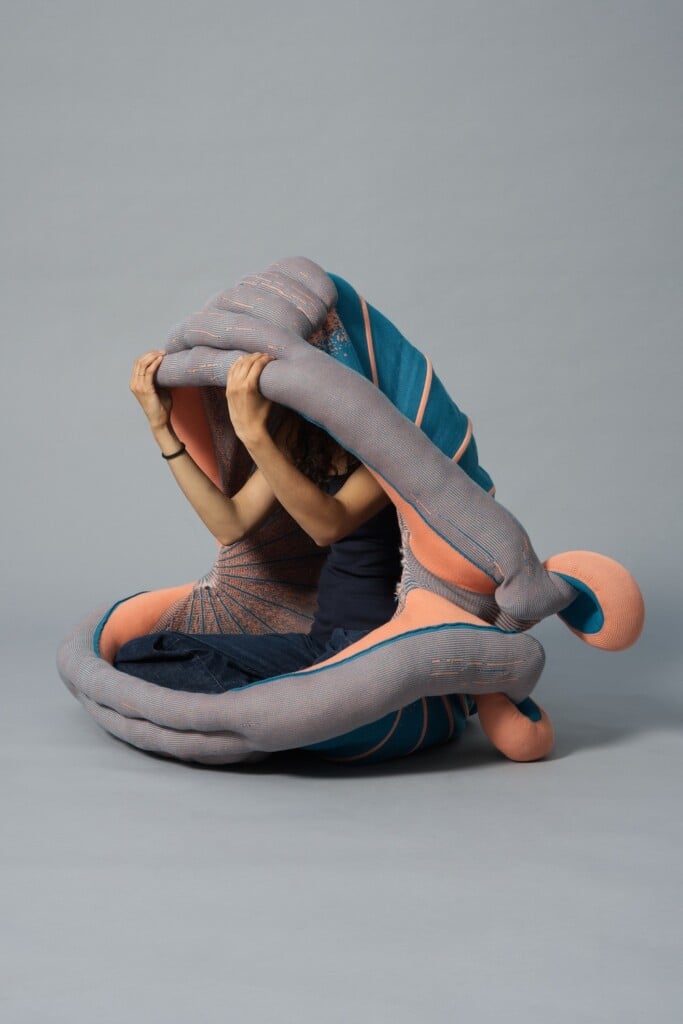
Interaction is the project’s founding principle. It’s an approach that borrows tools from cognitive psychology. Haverkorn observes how we react to objects, how much we’re guided by habit and what happens when a material behaves differently from how we’d expect. A textile as rigid as a sculpture, a metallic surface that recalls knitwear, a soft volume that deforms under the weight of the body: small perceptual short-circuits that turn design into an experience.
Even when she makes seating, dividers or installations, the functional side never overrides the research into materials. Some creations recall cocoons about to hatch, others look like marine colonies, fungi or woven nests, and seem to be moving through a metamorphosis. Her creations look like organisms in constant evolution, built through repetitive patterns, dense textures and modular systems that echo natural structures: cellular networks, coral, fungi, plant tissue. Nature is taken as an example, observed as a set of constructive logics to be reinterpreted.


Behind this experimental freedom is also a concrete attention to sustainability, since the designer favors small-scale production, artisanal processes and upcycling practices, working with durable materials and keeping direct control over the making of every piece. Each object keeps the traces of the process that generated it, turning imperfection into a design quality rather than a flaw to eliminate.
In a landscape where design is often asked to produce perfect, photo-ready images, Luna Haverkorn chooses the opposite direction. Her works don’t just ask to be looked at, they ask for time, curiosity and participation, and it’s precisely in the moment they’re touched, deformed or put to the test that they truly reveal their form.