Are Marvel films a contemporary epic? Yes, and we’re not exaggerating.
We almost always associate epic with the works of Homer and Virgil, but there are also poems that are lost in the mists of time or modern epics. This particular literary genre is based on ethics, that of the hero. But we will come back later on this.
The epic was born to collect knowledge, common experiences and create a horizon of values within which each person can recognize himself. The epic is inclusive in the form in which it wants to include society in its values – considered true by themselves – and wants society itself, through its reading, to live in accordance with virtue that high form of shared ethics, which turns out to be a tribal encyclopedia to hang on in order to live according to fixed and true values.

Unconsciously or not, even modernity has had the need to propose reassuring characters and themes able to embody values that can be shared.
Torquato Tasso, in his “Gerusalemme Liberata”, had already proposed a chivalrous poem sui generis, which was inspired by the medieval Chanson de Geste of the Carolingian cycle, where the protagonists were Charles the Great and his knights. Tasso does not set his poem at Roncesvalles, and the figure of Charlemagne is replaced by that of Godfrey of Bouillon, Christian captain of the First Crusade. His character in the poem is used to highlight the absolute perfection of his physique, his performance in battle and especially his severe, inflexible character that does not submit to temptation (a typical topos of Greek epic, that of kalokagathìa, the idea of physical and moral perfection of the hero). Tasso, to celebrate the Christian religion, wrote his masterpiece during the Counter-Reformation, and chose a perfect leader who would represent in every way the noble successors of Jesus Christ in the crusade. But Tasso’s unquiet soul, which we might call extremely modern, included in the poem knights who were far from being incorruptible. Tancredi and Rinaldo, the best Christian warriors, get lost, lose their way. Distractions become perturbations. At the end, after a long inner pilgrimage and several vicissitudes, Rinaldo is forgiven by Pius Bouillon and it will be him, having found the faith, to lead the Christians to victory.

It is clear how the epic is daughter and mother of its time and evolves over the centuries. In modern times, the idea of epic has changed and its fruition has been relegated to the cinematic world.
The United States of America, in the 1930s and especially during and after the War World II, felt the need to find and valorize its past. And being a young nation, they have identified in the West conquest their personal epic (because it was such); but Hollywood has transformed all this in a real epic story, where we can find, in many films, some typical topoi of the ancient epic tradition, such as the dressing of the hero and his preparation (El Dorado, 1967, Howard Hawks) or the Teiscopia (The Battle of Alamo, 1960, John Wayne).
But the main promoters of this epic created in Hollywood theaters were John Ford and John Wayne.
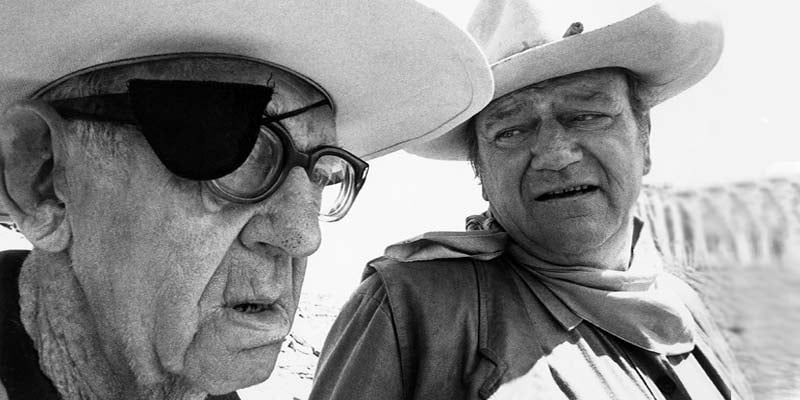
In their incredible partnership, the two have produced innumerable films (some of which are great masterpieces of cinematography, such as “The Searchers”) in which Wayne has embodied in his characters the image of an America that had found its own history, a foundation story where good prevails over evil. A clear dichotomy, which could not leave space for dubious interpretations. Evil and good were separate entities, and the characters that populated the West were statuesque, granitic, but at the same time they conveyed a comforting message to the public. Flat characters, where the exploration of the psyche was absent, because it was not necessary. We also have to think that in the post-war period this narrative was functional in order to present itself in the eyes of the West as the good guys in an unstable context of an imminent Cold War.

Let’s think of movies like “The Two Invincibles”, where Wayne, a Northern colonel, even becomes friends with a Confederate colonel and adopts a Native American boy as his son. Moreover, always in “The Searchers” (which is now absurd if not reread with the eyes of history) he wanders for years in search of his niece who had been sequestered by a group of Indians, represented, in the classic dichotomy good/evil, as bloodthirsty uncivilized. Certainly the story is full of racism, but to understand the meaning of this epic we must understand a different historical period and extremely far from us. In this era, which wanted to build a past and speak to the present, there is no room for grey tones. The world was divided into black and white, and only the winning white was the carrier of integrity, strength, wisdom and authentic American spirit.

The Marvel epic, on the other hand, is very different. It has adapted perfectly to contemporary times and gives the public what it needs: examples and models to imitate, which no longer have those characteristics of solidity and firmness. On the contrary. The new heroes are well-rounded human figures, who carry in their interiority complexities and inconsistencies typical of today’s society: although they are heroes, they are extremely human (and this is why we may love them). They themselves love, they fear, they are afraid of failure, sometimes they are not sure what is the line between what is right and what is not.
The Marvel epic is, and has been able to touch deeply the users of the movies because it talks about real men who have powers, but who are still plagued by the big or small daily problems typical of modernity. Their lives are often complicated and they are forced to endure the daily difficulties that we all have: difficult love relationships, conflicts between children and parents but also, as in the case of Natasha Romanov, a tragic past.
Being able to put these difficulties aside to fight for a greater good against enemies stronger than themselves instills a sense of hope and protection in those who have followed and continue to follow this incredible saga. They do great, great things, save the planet from cosmic destroyers and then return to their families, to their jobs, to assist a sick family member, to tuck in their children.

They are not solitary characters who have nothing to ask, upright and incorruptible. They live with doubt, with the guilt of the mistakes made (such as the destruction of Sokovia and its nefarious consequences among the Avengers). The doubt that they were wrong, the knowledge that they are not always right and not super partes makes them creatures sometimes weak, other times frustrated.
But returning to what was left unsaid at the beginning of this article, we can say that they are heroes, as well as Aeneas, as they are the bringers of a typical feature of the ancient hero: they are not granitic figures, but men who become heroes when they accept the difficulties that fate has placed in their path. And they persevere in their desire to cooperate for a greater good, by putting aside personal interests, individual loves, sadness or losses, in order to achieve a collective good.

They even go so far as to fight each other, to hurt themselves. They suffer losses that leave them vacillating (like Hawkeye after the sacrifice of Black Widow). The Marvel hero, like the ancient or western one, is a reassuring figure who wants to be an example, and the Marvel epic, with its extremely contemporary language, stands as a reassuring product that gives society an epic that builds and renews the present of new certainties.
Finally, the saga of Marvel Studios has been realized in the planning of juxtaposed films to create a long-term, wide-ranging narrative. With the Marvel films, we see the creation of a great choral story where the heroes move alone in films dedicated to them, as were dedicated chapters on individual heroes in the Greek epics, or in huge Colossals, which are the modern transposition of the choral moments of greater climax of the ancient poems, such as battles.

Words by: Francesco Fusi