In a country where everything is controlled, even the image becomes a form of governance. Every photo, every portrait, every poster is a silent statement: “The leader is everywhere, even where he is not.” Photography in North Korea is the regime’s most powerful medium because it turns an abstract idea — authority — into a visible, everyday, and tangible presence. It is the material proof that power exists, that it watches, that it endures.
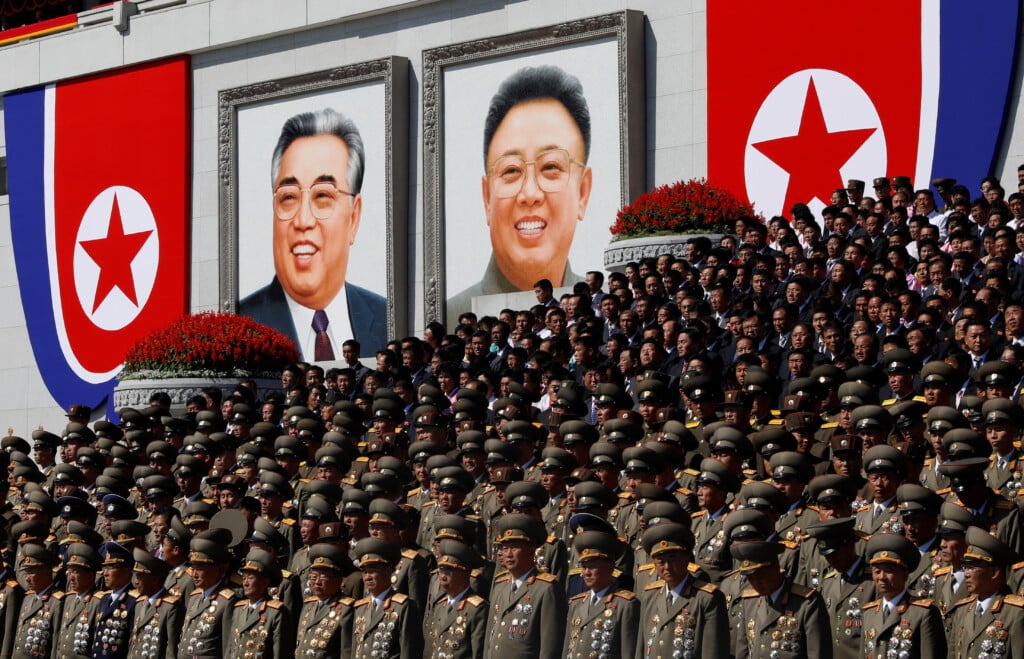
In this system, the image is never decorative: it is a form of political devotion. Every citizen must own and carefully preserve the official portraits of the Kims. The photographs must be hung high, perfectly lit, and kept immaculate. They cannot be moved or covered, and any damage or neglect can be seen as an act of dissent.

This strictness is no accident. In North Korea, the faces of the Kims do not represent individuals, but a sacred principle. The dynasty is the very face of the nation — the symbol of its continuity and the instrument through which the state manifests itself. Until a few years ago, the portrait of Kim Jong Un was not mandatory; since 2024, however, his face has been officially placed alongside those of his grandfather Kim Il Sung and his father Kim Jong Il, marking the full sanctification of the third generation of power.

Every time a photograph is hung in a North Korean apartment, the domestic space turns into a political one. The private home opens up to the presence of the regime: the leader’s gaze becomes an integral part of everyday life.

In this context, every shot is a carefully staged performance. Perfect lighting, rigid postures, calibrated smiles: official photographs leave nothing to chance. They do not represent — they impose. They do not tell — they command.

And it’s precisely from this conflict between image and truth that the power of Danish Siddiqui’s work emerges. The Pulitzer Prize–winning photojournalist often sought to restore the human weight behind propaganda through his images. His sensitivity in portraying reality — even when uncomfortable or censored — makes clear how photography can be both a tool of power and of liberation. His images, where control and blind faith intertwine with the faces of ordinary people, reveal what the regime tries to hide: the fragility behind the omnipotence of the image.

In North Korea, photography is not just an image: it is an extension of power.
Yet in the hands of those who know how to look, it can also become its opposite — a way to restore humanity where everything has been reduced to an icon.
This article was created in collaboration with Luigi Falanga aka @super8otto.