Andy Caraway has a definite idea about the meaning of the body, fluid and undefinable. On the occasion of her exhibition at Liquida PhotoFestival from May 5 through May 22, Collater.al asked the photographer to narrate her shots.
1. You are one of the photographers selected for Liquida Exhibition, tell us about the project you will exhibit in Turin.
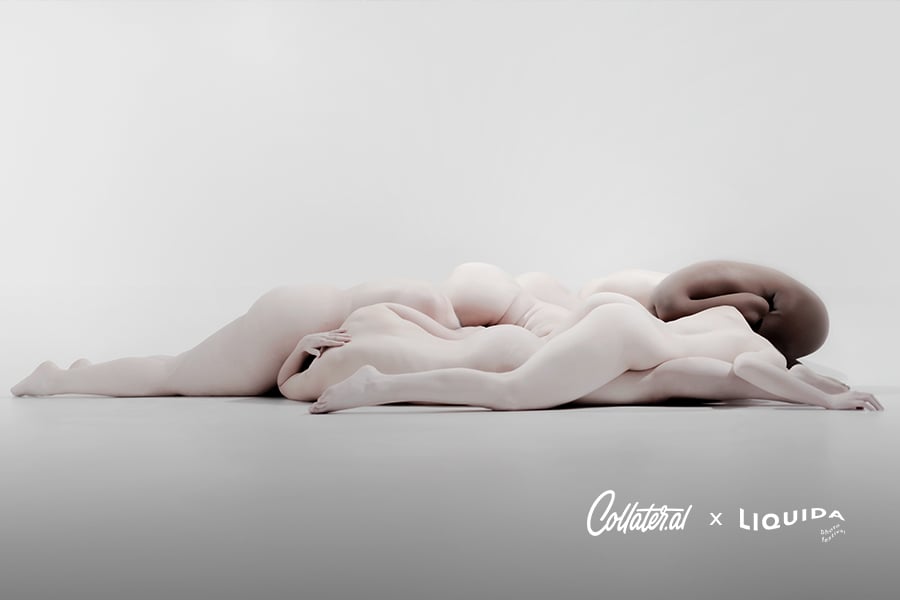
In Turin, I will be exhibiting two works from my “Sainte Victoire” series, a series of shots that I have been pursuing since 2018 and not yet completed. It is a shy homage to the work of Cézanne and his obsession with the mountain of Sainte-Victoire. The most striking feature is the minimization of all elements in the image, bringing the human figures into a totally clean and ethereal context. The bodies represented, compared to my first shots in nature, return to being canonically the subjects, but remain devoid of sexualization or precise gender identity. By obsessively reproducing the human figure, I hope to capture its essence, that is, just a cluster of atoms in perpetual motion but never really the same. The deepest need is to recognize a naked body as such and remove the role of taboo and sexual object imposed by a patriarchal heritage now dated and outdated. The message of Body Positivity is therefore fundamental, supporting the validity of every body and the merit of being represented regardless.

2. What are your plans after Liquida Photofestival?
I need to receive confirmation for an exhibition in Venice this summer. I’m working on some projects started with the first quarantine for a future solo exhibition (most likely in Genoa) and I’m looking for new spaces around the country to exhibit not only my photographic work.

3. How long have you been involved in photography? How did you get started?
I have been involved in photography for about 12 years. I wish I could say “in West Philadelphia born and raised” but it wasn’t as poetic and exciting a start. I started out like everyone else by taking pictures of puddles and little flowers with a compact. Then when the little Fujifilm stopped working, I got a Nikon D90 SLR and set out to learn how to use it in a semi-decent, professional manner as much as possible.
I’ve never attended any courses, or particular workshops, but only a lot of practice and studies on my own. I have always been passionate about all that is artistic and creative and I have always tried to “take” as much as possible from each discipline. Thanks to theatrical and cinematographic studies, but especially of art history, I have had the opportunity to understand the rules of composition in the round. In addition, I have always been passionate about 3D modeling and graphics, so I could not help but put myself to learn all the possible programs in order to make space where it does not exist. I’ve been working as a photographer for a few years now on a professional level, but I’m also a videomaker and before Covid I collaborated a lot with various influencers for the realization of videos.

4. At the center of your shots there is almost always the female body, what meaning does its representation have for you?
Legitimate question, but I want to clarify two things right away. As much as I recognize the sacrosanct emancipation, representation and exaltation of the female body, I want to distance myself a priori from any gender binarism. I don’t want the represented bodies to be associated with gender identities because I want to allow each person to feel what they are in their essence. However, there’s no denying that in the real world yes, “female bodies” are recognizable but really it’s just a matter of responses to the various “Open Calls” I make on Instagram. I literally ask for the availability of people willing to pose and show themselves as they are; the fact is that 90% respond to me women, white, cis and of course, nothing wrong with that but it makes a big chunk of representation that I would like to bring to my photos missing.
The representation of the female body is changing, I find that platforms like Only Fans and Patreon are giving the female body its rightful and deserved power. The fact that most of the photographs of women we see on social are conscious selfies that show their most hidden and intimate parts is no small progress.

5. How come you chose white as the recurring theme of your photos instead?
Still on the subject of ethereal and neutral in my shots I want them to have an impact of tranquility at first glance. I don’t particularly like colors because I find them to be a sensory distraction: too many stimuli all at once. As much as they can be interpreted in different ways, I want, at least for a moment, at least one person observing to feel at peace.