It’s the end of the 1980s when Pablo Ortiz Monasterio begins working on the photographic series La última ciudad, a black-and-white portrayal of Mexico City during those turbulent years, marked by economic hardship and profound socio-political change.
The urban reality of the capital that Pablo Ortiz Monasterio captures is the result of the political crisis that, for the first time since the 1930s, struck the country’s ruling party (in 1988) — the Partido Revolucionario Institucional (PRI) — whose authority was challenged by Cárdenas’s opposition and the demand for democratization; it is also the consequence of the economic and social disparity reflected in the presence of wealthy, avant-garde neighborhoods alongside extremely poor ones, and, last but not least, of the fracture caused by the 1985 earthquake.
It is precisely this last event that becomes the breaking point fueling the population’s desire for autonomy and detachment from the party, translating into independent grassroots movements to recover from the catastrophe, forming a front that was both united and independent from political power.
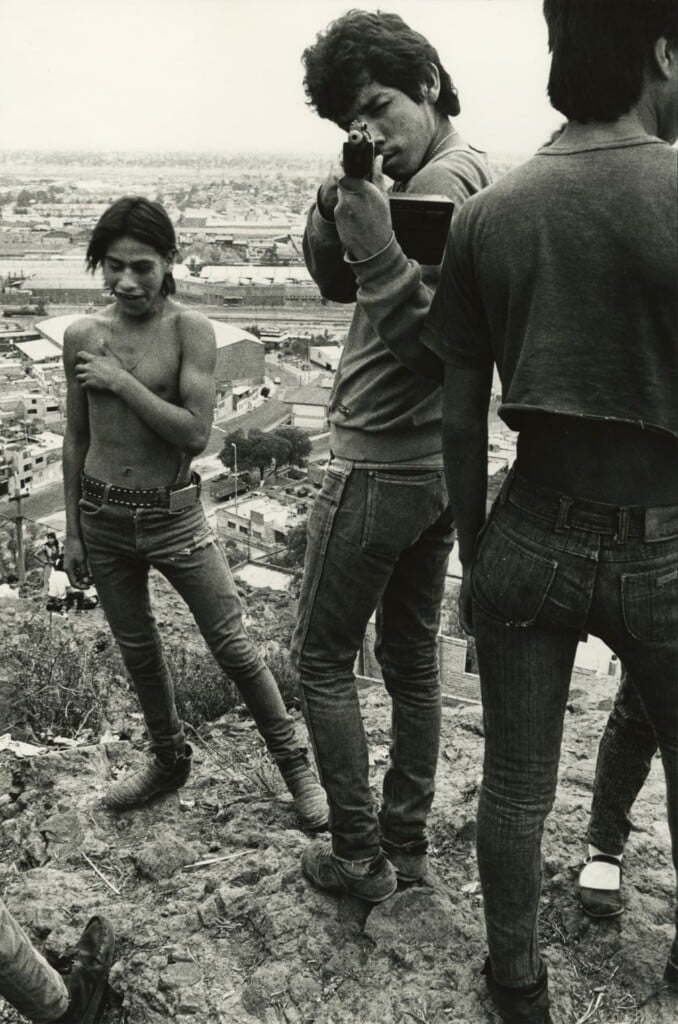
The emblematic shot of the series is a photograph with strong symbolic weight, evident already in its title: Si disparas, disparo (1989). The Spanish verb “disparar” identifies both the act of shooting a gun and — in photographic language — the act of shooting a photograph. This double meaning immediately places the photographer (the one who looks) and the subject of the representation (the one who is looked at) in close relation. But it is precisely this pairing that gets overturned in Pablo Ortiz Monasterio’s photograph, just as the hierarchy of power is overturned: here the photographer is literally held at gunpoint by the boy holding the pistol, just as he metaphorically holds the young man in his sights, erasing the hierarchy of roles between artist and subject, between observer and observed.
Everything in the composition of this photograph helps make it a mirror of the turbulent, revolutionary climate of those years: the framing of the shot captures a group of young men as they loom over the neighborhood below from a height, dominating it with the force of their youth and the revolutionary violence represented by the weapons they carry. They are as bold as the new reformist wave rising from the lowest classes of society, that segment of the population intent on making clear that it is now the one holding power, showing no fear or hesitation. The black and white of the photograph gives the scene even greater tension and intensity.
This photograph, like others belonging to the same series, speaks of a Mexico in transformation, marked by violence and suffering, yet fighting to build a new reality and a new phase in its country’s history. This is why, despite Pablo Ortiz Monasterio being the author of numerous series and photographs quite different from one another, he is recognized as one of the most representative artists of contemporary Mexican photography. He managed to bring to life a sequence of images that constitutes one of the defining moments in the history of Mexico City, without limiting himself to documenting major historical events or political figures, but starting instead from the ground up, from ordinary people.
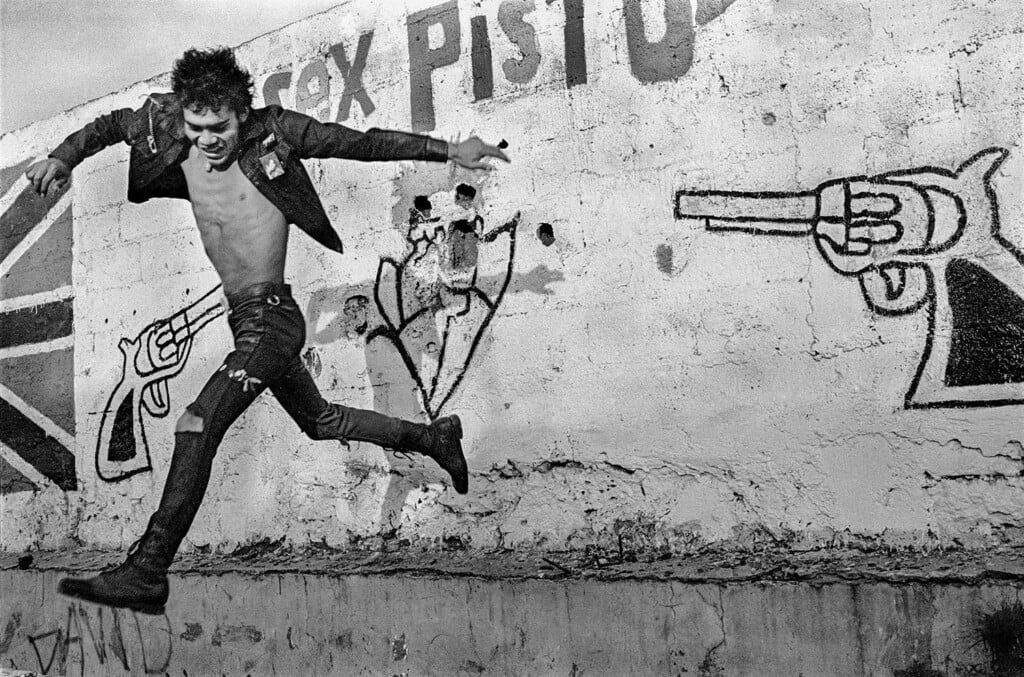
That spirit of rebellion, struggle and revolution that emerges so insistently in Si disparas, disparo is present throughout the entire series. Volando bajo is one example, the shot that captures a young man flying through the air in front of a wall, alongside a mural of a pistol: here too the common thread is the triad of poverty, struggle and change.
This article was produced in collaboration with Luigi Falanga and Gaia Forlin aka @superottomag