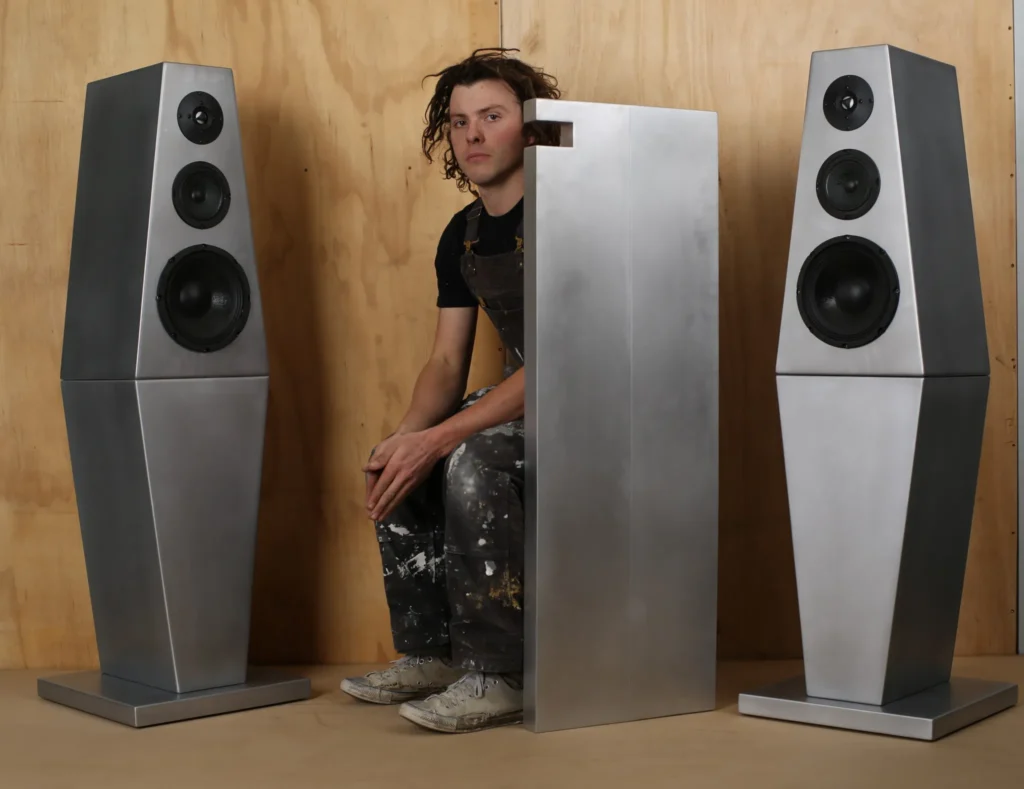
Thomas Mason is a New Zealand designer who has found in aluminium the ideal language to shape an aesthetic “of silence,” as described on his website. His work seems to revolve around an idea as simple as it is radical: reducing visual and mental noise through objects that encourage a calmer relationship with space. Chairs, tables and speakers thus become tools for cultivating calm, for taming matter without overloading it with meaning.

Aluminium, with its neutral tones and its ability to reflect light without ever fully retaining it, is the starting point of a research that balances rigour and sensitivity. Mason works it until it becomes almost anonymous, stripping away any superfluous decoration to make room for what really matters: the relationship between form, balance and atmosphere. In his pieces there is never ostentation, but a subtle, almost meditative presence that is felt more with the body than with the eye.
The BP1 Coffee Table is perhaps the most emblematic example of this philosophy. A 6-millimetre-thick aluminium top rests on four tapered elements that centre themselves on spherical tips, with a peened finish that breaks the metal’s coldness and adds a tactile dimension. The object occupies space without dominating it, imposing a measured calm.

With the RHL1 Chair, Mason explores structural simplicity. Clean join lines, visible notches and controlled proportions make the chair an exercise in precision rather than expression.


The same sensitivity can be found in the TF1, a project that pushes his research into acoustic design. Two mirrored forms join to create a negative volume, grounded by oversized base plates that provide stability and visual weight. It’s a technical object that nevertheless maintains a poetic coherence, continuing to reflect that tension between calm and control that runs through the artist’s entire output.

Thomas Mason therefore proposes a design that aims to give space back to breathing. Every aluminium surface becomes an invitation to quiet, every joint a moment of attention. His objects do not merely furnish: they modulate the air around them, creating pauses. A lesson in silence in a world that never stops talking.