Zhang Kechun, with The Yellow Desert, moves through a place where time folds in on itself, where history is compressed, reversed, and blurred into the present. The exhibition, which the Chinese photographer and visual artist will present at Huxley-Parlour in London on January 30, will bring together eleven new photographs. All part of a series begun in August 2025, these images take shape across the expanses of the Gobi Desert, between northern China and southern Mongolia, transforming the landscape into a critical device capable of speaking about memory, artifice, and human presence.


The Gobi, now an increasingly popular tourist destination, becomes in Kechun’s images an intrinsically surreal place: film sets repurposed as fake religious sites, abandoned cities, decommissioned oil extraction facilities, and tombs dating back to the Han dynasty coexist within the same visual field, often under the distracted gaze of visitors. It is a landscape born from a temporal short circuit, where the past is never truly concluded and the present fails to erase it.

Formally, Kechun works within the tradition of topographic photography: elevated viewpoints, muted color palettes, and the use of a large-format camera. What makes The Yellow Desert particularly dense, however, is its constant dialogue with Chinese landscape painting from the Song and Yuan dynasties. The soft lines of the mountains emerging from the sand recall the calligraphic brushstrokes of ink on silk, while the human figures—tiny and almost marginal—echo the symbolic scale of ancient paintings.
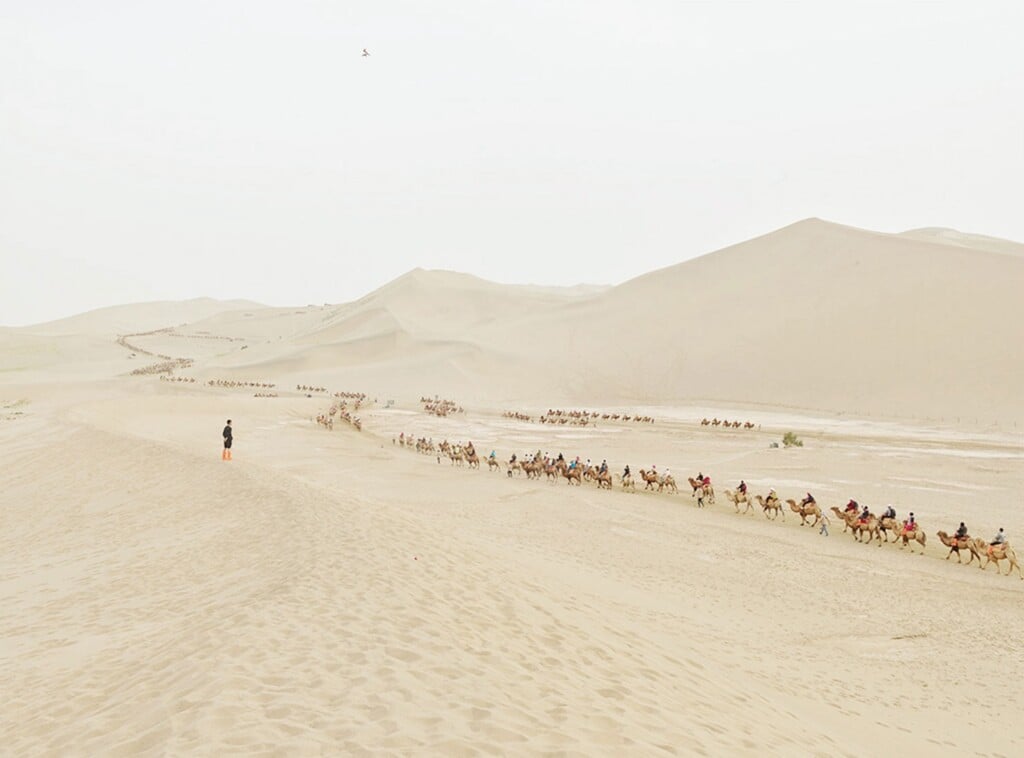
And yet, here, humanity is everywhere. If historical landscape painting was a tool for escape and harmony with nature, in Zhang Kechun’s photographs the desert becomes the stage for the impossibility of escaping the human trace. Fake monuments imitating the ancient, tombs buried beside crowds of tourists, relics of forgotten civilizations observed as attractions: everything contributes to a system of inversions in which authenticity and simulation collapse.
The Yellow Desert thus puts the landscape itself into crisis as we have learned to perceive it, transforming it into a fragile and unstable place, where history is revealed not as a linear sequence but as living matter, continuously rewritten by the passage of humankind.
The exhibition will be shown from 30 January to 28 February at Huxley – Parlour, 45 Maddox Street, London, W1S 2PE.

all images courtesy Huxley-Parlour