Casa Italia at Le Pré Catelan, an emblematic building in Napoleonic III style nestled in the Bois de Boulogne, the largest park in the city and just steps away from the Champs-Élysées, will host the athletes of the Italia Team and their guests during the XXXIII Olympic Games in Paris until August 11. Inside Casa Italia, an exhibition path has been developed that mixes art, architecture, and design, curated by Beatrice Bertini and Benedetta Acciari, and develops the concept of Ensemble.
In addition to the big names in Italian design who have provided their products to create unique environments, the itinerary is punctuated by the works of 19 prominent artists from contemporary Italian art.
The journey begins outside the Casa with a replica of the “Italia” sign found at the entrance of the historic Italian Pavilion at the Venice Biennale, paying homage to one of the most important international art events.
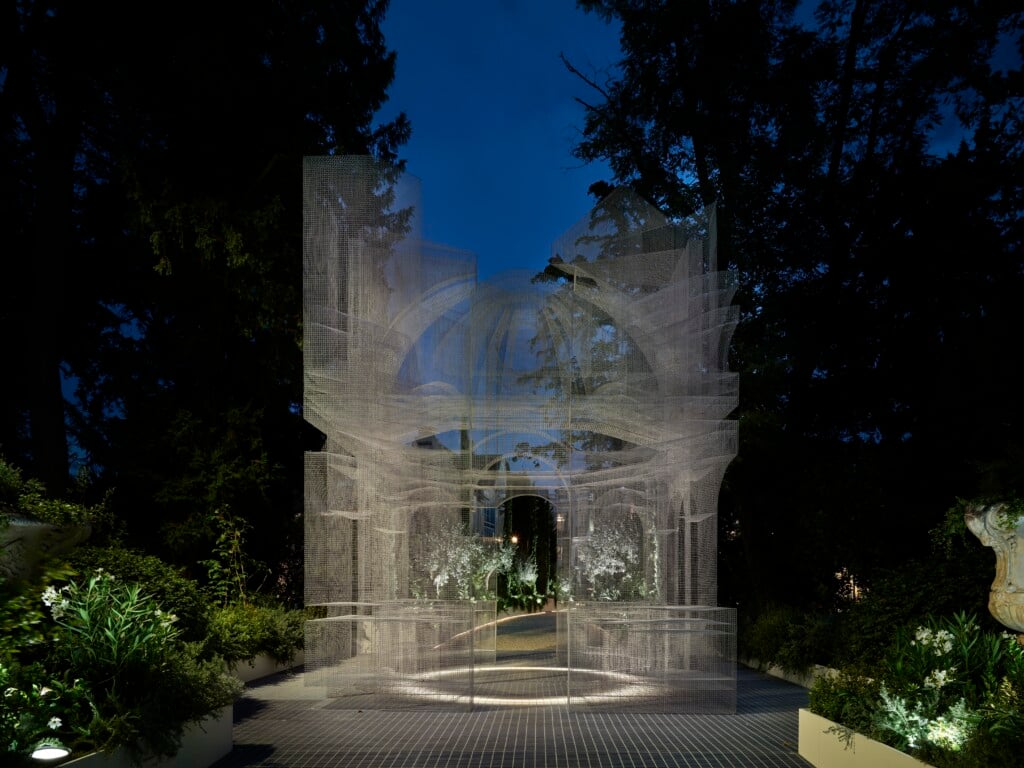
Continuing, visitors are greeted by the work Sacral by sculptor Edoardo Tresoldi, inspired by the forms of the Renaissance baptistery. This piece acts as a symbolic and physical gateway that, through an intricate mesh of metal wires, transports us into the chosen theme.


The facade of the main building features a large site-specific work by Agostino Iacurci titled Ensemble, which is a reinterpretation of the Tricolore in his typical floral and abstract style, blending natural images with a reimagining of classical aesthetics.

Upon entering, the Olympic medal tally stands out, which will grow during the days of the competition. It is encompassed and enhanced by the work Panorama Italia, a 30-square-meter tapestry by Giovanni Bonotto that covers all the walls, creating an immersive environment. This work highlights the concept of Ensemble through the cultural, historical, geological, landscape, gastronomic, and linguistic variety of Italy, making it unique in the world. The design was created with the help of Artificial Intelligence, and the materials are threads obtained from recycled plastic waste.


Marking the entrance to the heart of the Casa is also the luminous work by Marinella Senatore, We Rise by Lifting Others, which echoes a famous quote by Robert Ingersoll, “We rise by lifting others.” This piece speaks to the power of helping others and the positive impact it can have on ourselves.

The first is by a leading figure of the late 20th century, the conceptual artist Vincenzo Agnetti, who passed away in 1981. His iconic work Tra me e te l’infinito inesistente is displayed here. It is a rigorous structure in which the vague and elusive nature of meaning can only be grasped through the complicity of the viewer’s gaze.
Also in the Galleria is the work by the French-born, Rome-adopted artist Julie Polidoro titled Tutti i Paesi Grandi Uguali. This piece celebrates the Olympic spirit by erasing hierarchies between countries based on territorial size, presenting a map where various nations become a multitude of shapes and colors.

Another artistic connection between Italy and France is found in the sculpture Amore e Psiche by Fabio Viale. This is a contemporary reinterpretation of Canova’s Amore e Psiche, housed at the Louvre, where Venus is rendered black by an integral tattoo, serving as a clear homage to the love for diversity.


The connection between the two countries and between the dimension of sustainability and the concept of Ensemble is further reflected in the painting We Are All Collaborating by the Italian-French collective Claire Fontaine. This piece draws attention to social, humanitarian, and environmental emergencies, emphasizing the necessity of coming together to collaborate on important global issues.
The general concept of Casa Italia Paris 2024 is made absolutely clear in the large sculptural work by Margherita Moscardini. In (Ou la mort), she extrapolates the most overlooked word from the famous French motto to make it the most important, encapsulating the concepts of liberty and equality by repeating Fraternité, Fraternité, Fraternité, thus providing a new paradigm of togetherness despite differences.


In the spaces of the Galleria, the idea of relationship and connection shifts to the dual planes of the infinitely small and the infinitely large in Alberto Di Fabio’s work Vita Astrale. This piece introduces us to the mysterious and fascinating phenomena of nature, making forays into both the cellular world and the constellations, presenting a vision where everything is connected and a synthesis of the universe.

Among the most striking works displayed at Casa Italia is the Tappeto Volante, created by the collective Stalker in collaboration with the Kurdish refugee community in Rome, a group of activist architects, a Romani boy, and a person from Senegal. This piece features 41,472 hemp cords with copper terminals, replicating the muqarnas of the Palatine Chapel’s ceiling in Palermo. It symbolizes a millennia-old culture of hospitality that unites Greek, Latin, Arab, and Norman cultures.

Continuing through the spaces, we encounter the colored bronze sculpture Italiana by Paolo delle Monache. This work explicitly references Italy and its wonders, celebrating the uniqueness of our territory, which is defined by the variety of elements that make it memorable.
Nearby, in the lounge, is the second work by Paolo delle Monache titled Serendipity. This column features numerous Italian monuments and envelops an individual, protecting, supporting, and constituting them.


On the upper floor, visitors are immediately greeted by Fun with Flags, a series of works by Riccardo Previdi. The Milanese artist has fun overlaying and mixing various world flags to create unique and colorful patterns. The exhibition continues with the diptych Time Capsule by visual artist Patrick Tuttofuoco, which focuses on the theme of intertwining—specifically, hands intertwining to become a universal symbol of brotherhood.


On the first floor, the sinuous bas-reliefs by the artist Sergio Breviario, titled Bianca and Marion, aim to highlight the extraordinary complexity of each individual, which should be embraced with curiosity rather than judged.
In the main hall on the first floor are two paintings by Gabriele Picco, Lasciarsi attraversare dall’arcobaleno and Nuotando nel cielo. In both cases, it seems that joy and enthusiasm arise from breaking isolation, as seen in the figure that becomes a “condominium” or the person traversed by a rainbow.


Continuing the exhibition, for Francesco Jodice, mutual support and collaboration are not a given condition but rather an invitation, a hope, a tension that seems to burst forth from the photographic diptych The Surfers. In this work, numerous surfers, in the waters of a suspended and almost metaphysical sea, wait together for the arrival of the wave, a metaphor for an unknown that can only be faced collectively.


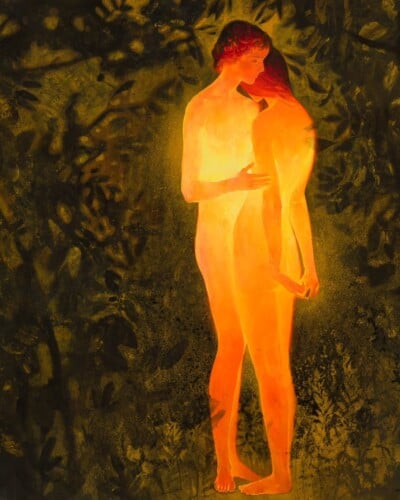
Among the artworks, we find Messa a Terra, a series of four wall sculptures in fabric by the artist Marco Bernardi. Inspired by Masaccio, Bernardi reinterprets the story of Adam and Eve as an archetypal form of brotherhood from which humanity originates. Also on display is his Monnalisa con barba di Van Gogh, an ironic piece in which Leonardo’s masterpiece is altered by adding Van Gogh’s beard from the artist’s famous self-portrait.


To conclude the sequence of spaces on the first floor, we find the Sala Riunioni, an oval room with richly decorated white walls against a blue background. Here, Il Giardino Perduto, a work by Matteo Nasini, encapsulates the entire concept of Casa Italia Paris 2024, Ensemble, and the universal values of the Olympic spirit. The colored columns, made of wool threads, reference the theme of intertwining and make explicit that there is no possibility of building without collaboration among individuals and respect for each person’s diversity.

Continuing through the exhibition, we encounter Panorama, part of a series of paintings by Julie Polidoro that connect natural cataclysms with human migrations. We also see Taksim Square, Istanbul, Turkey, 05.31.2013 and Innsbruck, Austria, 01.29.1964 by Margherita Moscardini, which depict collective moments where crowds, by gathering, reveal the essence of places.
Next is The Belle of The Ball, a series of collages and HB pencil drawings by Sergio Breviario. These works narrate stories populated by awkward chivalric figures, supposed nobles engaged in duels and courtships, or romantic, suspended scenes.
Toward the end of the path, we find Energie by Alberto Di Fabio, a large tapestry dominated by a vibrant yellow. The artist’s cosmic inspiration aligns with the ancient tradition of Italian tapestry, particularly referencing the Arazzeria Pennese, one of Italy’s main tapestry production centers.
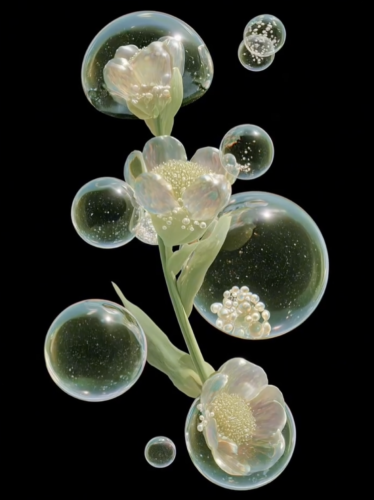
Finally, we encounter Agostino Iacurci with Of My Abstract Gardening, two floral paintings with a black background that explicitly reference the tradition of horti picti from Roman times—paintings of landscapes directly on walls.

For the first time, Casa Italia will not only host athletes but will also be open to the public as a true art gallery.

Ph credits: Pietro Savorelli