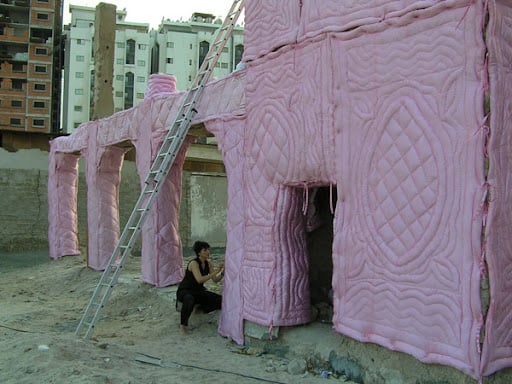
In 2007, at the height of urban transformation in Sharjah, in the United Arab Emirates, the artist Amal Kenawy created one of those works that seem simple at first glance, but in reality function as visual and political short circuits. Non-Stop Conversation is not just a performance, but a radical act of reactivation: a forgotten building suddenly brought back into existence.

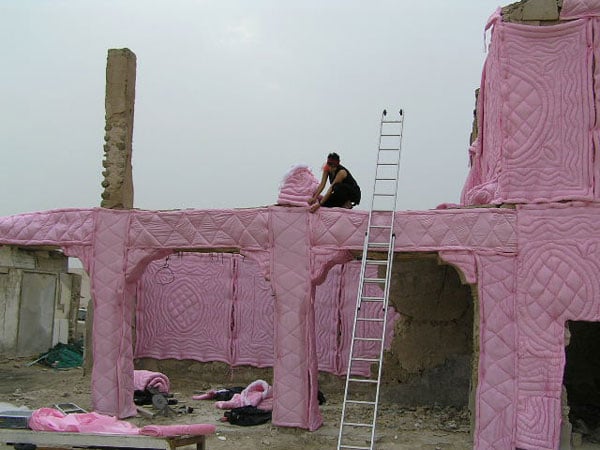
In the heart of Sharjah’s historic area, Kenawy intervenes on Bait Al Ansari, one of the oldest traditional houses in the area, transforming a structure marked by time and abandonment. She completely wraps it in a hand-stitched padded pink fabric, turning it into an almost unreal presence, soft and alien to its surroundings.
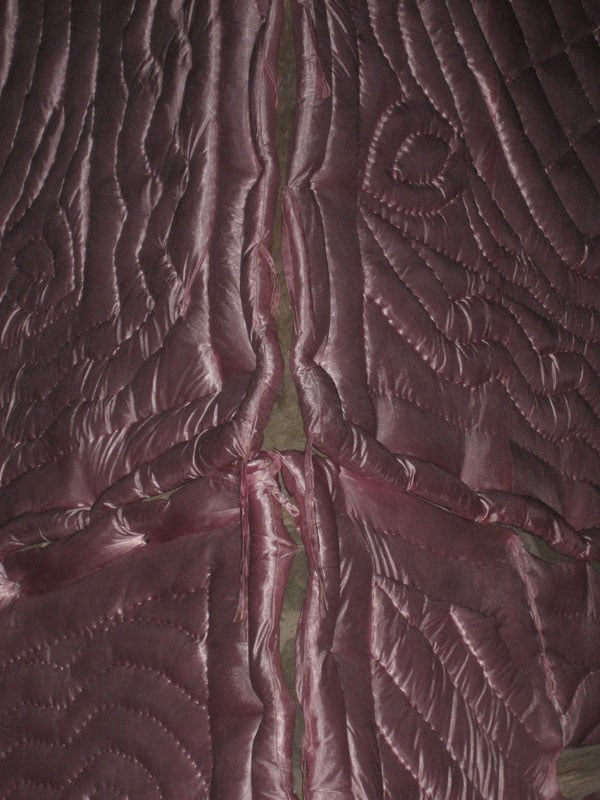
This gesture, seemingly aesthetic, reveals on one side the fragile vernacular architecture destined to disappear, and on the other the relentless pace of modernization. During the performance, in fact, the sounds of construction overlap and intensify, becoming an integral part of the work.
The pink is not accidental. It is a color that softens, almost infantilizes the ruin, while at the same time making it impossible to ignore. The building is no longer invisible: it becomes an emotional object, a presence that demands attention. In this sense, Non-Stop Conversation truly is a never-ending conversation — between past and present, between memory and progress, between what is preserved and what is erased.
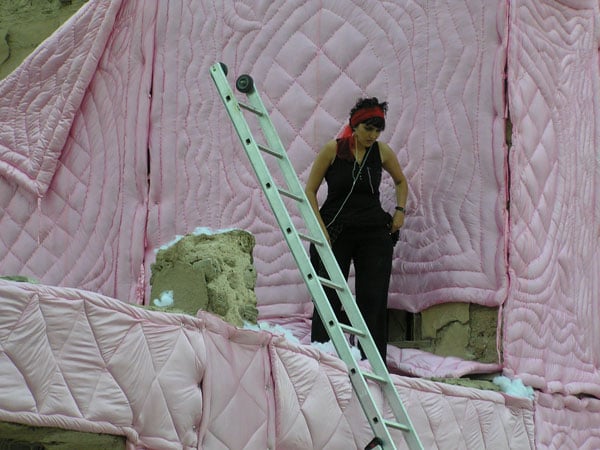
Amal Kenawy often worked on these short circuits: body and space, interior and exterior, memory and transformation. Here, however, the body disappears — or rather, it shifts into the architecture itself. The house becomes an organism, a skin, a sensitive surface. A vulnerable body that is covered, protected, but also exposed.
An Egyptian contemporary visual artist, active since the late 1990s, Kenawy was one of the most significant figures in the Middle Eastern art scene, known for her work across video, performance, and practices strongly tied to a feminist perspective. Her research earned her international recognition early in her career.
Her trajectory, intense yet brief, came to an end in 2012, when she passed away at just 38 after a long battle with leukemia. Despite her premature death, her work continues to be exhibited in museums and institutions around the world, and her figure remains a reference point for many artists and contemporary practices in the region.
The project, created for the Sharjah Biennial 8, earned her the first prize and remains one of her most iconic interventions precisely for its ability to activate urban space without the need for monumentality. What remains today is the image of a ghost house, suspended between ruin and rebirth. A minimal gesture, slowly stitched, capable of transforming an architectural relic into something alive. Not sterile nostalgia, but a poetic act of resistance against oblivion.