Calculating Empires: A Genealogy of Technology and Power, 1500-2025 by Kate Crawford and Vladan Joler is on display at the Osservatorio Fondazione Prada in Galleria Vittorio Emanuele II in Milan until January 29. From the minds of these two researcher-artists, this exhibition maps our technological present, making clear how power and technology have been intertwined since the 16th century. Joler and Crawford bring together research and design, merging science and art to develop a new framework for understanding artificial intelligence. They themselves question how we got here and what direction we are heading in the face of the current landscape.

«This is the year in which generative artificial intelligence has flooded global culture and dominated public attention. Millions of people have changed their way of searching online, writing, and developing images. However, these systems have already demonstrated their ability to concentrate power, produce ‘collective hallucinations,’ and disseminate misinformation on a large scale, challenging the perception of a shared reality. Generative AI also has a significant impact on our ecologies, requiring immense amounts of energy, water, and minerals» clarifies Joler. To complete this reasoning, Crawford adds that «all these forms of global impact, from political to material, have developed over centuries. However, they are hidden by the culture of industrial secrecy and technical infrastructures, complex issues related to colonialism, global production and distribution chains, the lack of transparency in labor contracts, and the absence of regulation in history itself. ‘Calculating Empires’ reflects on how to observe and analyze these systems over time».

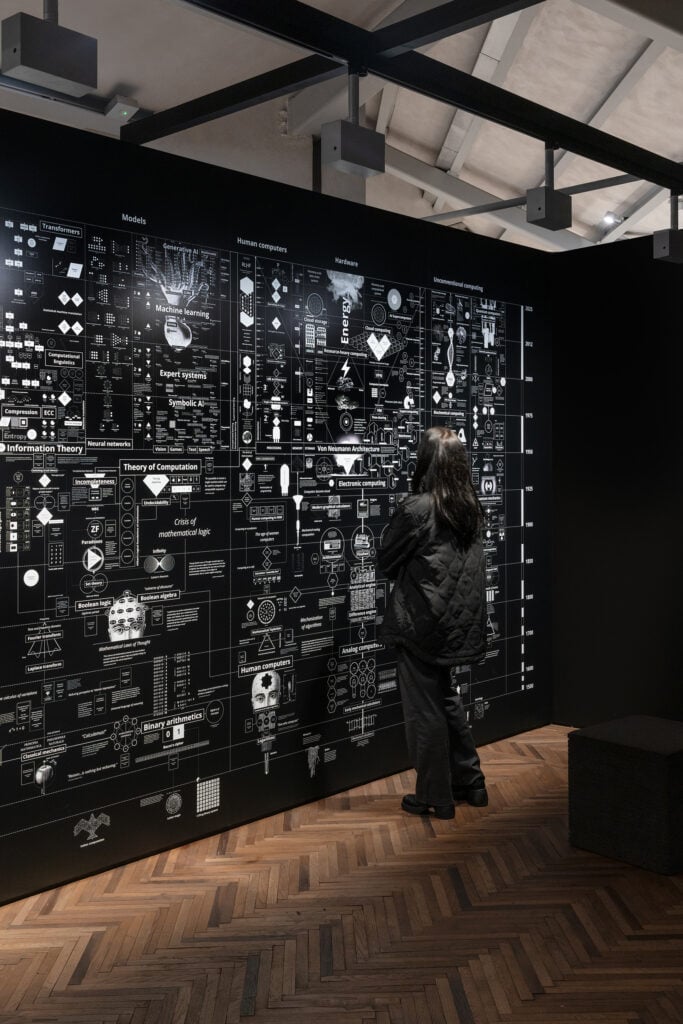
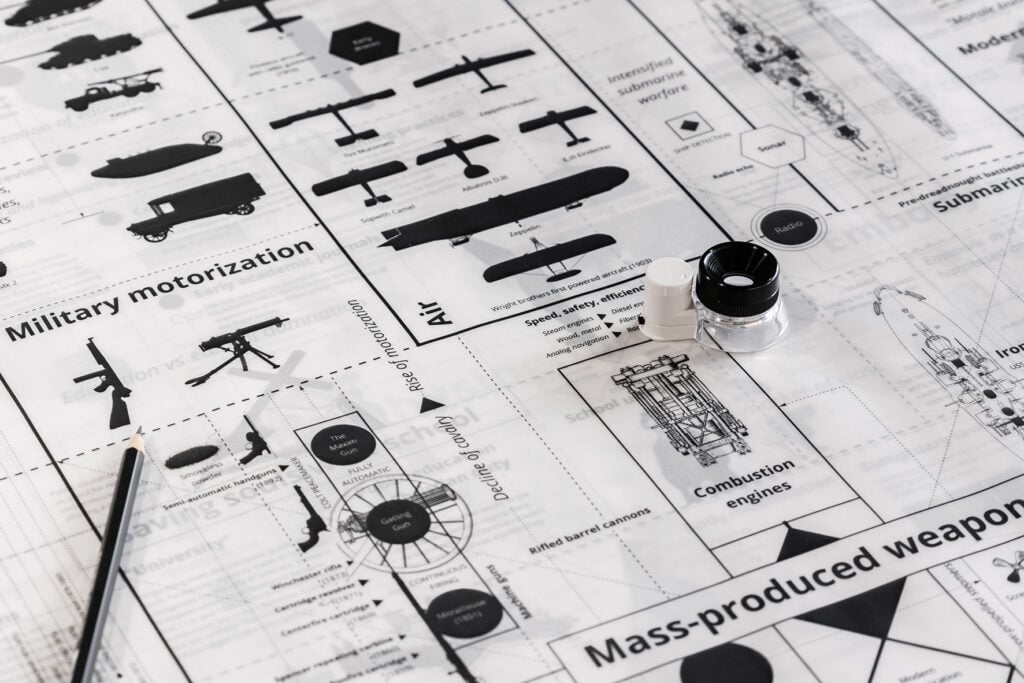
At the heart of the exhibition, we find a dark and immersive environment, the Calculating Empires Map Room; a diptych of maps that on one side addresses themes related to communication and computation, while on the other explores elements of control and classification. It is an intense physical experience, a dizzying encounter with five hundred years of history, designed to measure empires and explore how these empires have measured history. The inspiration for the concept of this exhibition draws from projects such as Aby Warburg‘s Atlas from the 1920s or the Eames‘ Mathematica from the early 1960s. It is a specific question: the development of large-scale visual representation languages capable of conveying complex ideas and historical narratives.
We then move to the Anatomy Room, dedicated to human labor, where we find a dissected Echo and a collection of all the individual minerals extracted to produce it, along with a series of patents illustrating Amazon’s corporate vision of AI. Finally, we reach the end where the exhibition concludes with a veritable wonder room where books, devices, and other objects dating from 1500 to 2023 seem to be there to make room for reflection.