Cristóbal Balenciaga, directed by Lourdes Iglesias, is the mini-series that narrates the story of the Spanish couturier, covering the Parisian years of the fashion house from its beginnings until the designer’s withdrawal from the scene. It encompasses everything: his creative process, Paris occupied by the Nazis, encounters with Coco Chanel, Christian Dior, Hubert de Givenchy, and more. Balenciaga’s story is meticulously told, both the positive and the negative, through the questions posed by Prudence Glynn, a renowned fashion journalist fortunate enough to interview Cristóbal a year before the couturier’s death at his home in Jávea in the Basque Country. Today, the Balenciaga house, part of the Kering group, is not what it used to be, and it seems impossible not to wonder what the couturier would think of the work carried out by Demna Gvasalia in recent years, which has garnered much attention, from Kim Kardashian wrapped in meters of insulating tape to controversies surrounding questionable advertising campaigns in late 2022. It’s a reflection that we carry forward, especially during this week, the Paris Fashion Week, where The Row – steering the ship towards an increasingly exclusive horizon – reminds us a lot of the fourth episode of the mini-series, which we will discuss later. In short, what better time to revisit the life and career of the man who – according to Coco Chanel – was the only true couturier of his time.
Prudence Glynn’s interview
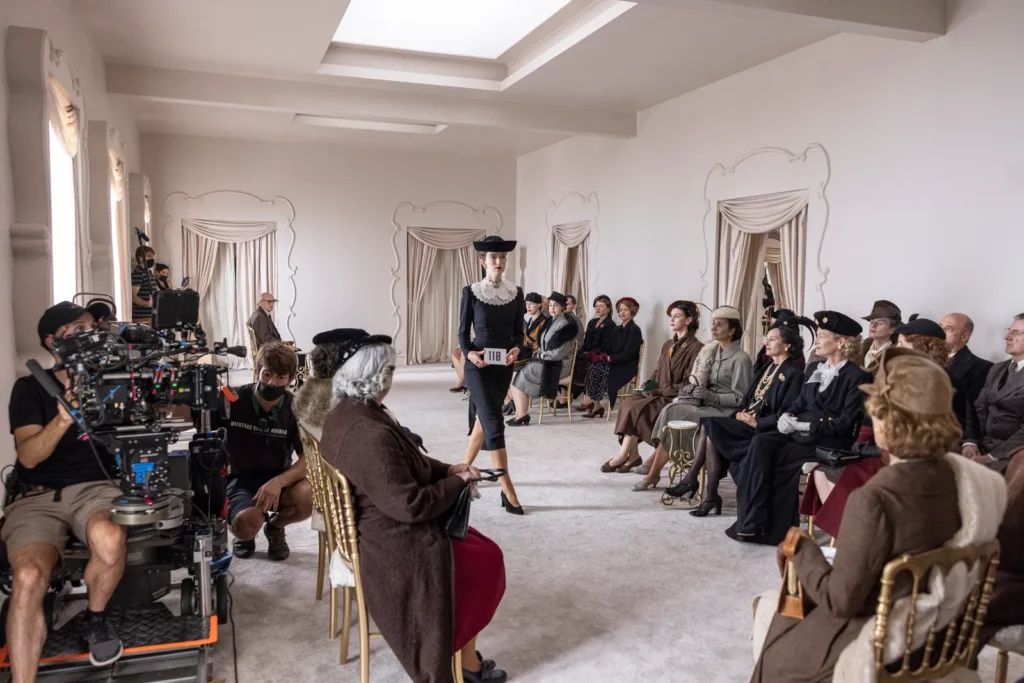
The mini-series follows all the stages of Cristóbal Balenciaga’s meeting with Prudence Glynn. After the encounter at Coco Chanel’s funeral, Glynn manages to convince the couturier to grant an interview, a rare occasion for Balenciaga, who had always refused to give interviews and was not inclined to communicate with the outside world. In the first episode, the early fashion shows of the house and the challenges after arriving in Paris are reviewed. Here we begin to get to know the protagonist, portrayed by Alberto San Juan, in various phases of his Parisian life. The work during the Nazi occupation and the friendship with Coco Chanel take center stage in the second episode, clarifying Cristóbal’s apolitical stance. In the third episode, we also get to know Christian Dior, the nemesis of the Spanish couturier in terms of communication skills. Prudence Glynn’s questions throughout the episodes prompt Balenciaga to reflect on his career and many contemporary issues.

Replicas, the fourth episode of Cristóbal Balenciaga that makes us reflect on the present
In the mini-series, Cristóbal Balenciaga also denies journalists the opportunity to publish sketches of his fashion shows, creating a real media storm. This operation makes us reflect on what we are discussing today about the choice made by The Row – one of the few fashion houses, along with Bottega Veneta, that does not need a strong presence on Instagram. The American brand has taken a counter-trend path compared to our times, one of exclusivity, asking guests at the presentation during Paris Fashion Week not to film the runway. But we will return to this topic in a moment.
“The Row looks forward to having you at the Winter 2024 Collection Presentation on Wednesday, February 28th at 12pm. We kindly ask that you refrain from capturing or sharing any content during your experience.” Oh. Ok.
— Vanessa Friedman (@VVFriedman) February 28, 2024
The last two episodes focus on the arrival of ready-to-wear, a particularly challenging endeavor for the control-freak couturier. Firstly, he initiates a collaboration with Air France, venturing into mass production, only to decide to retire from the scene after years of work, in 1968. Prudence Glynn’s interview – in reality as well – will be published by The Times under the title Balenciaga and The Life of a Dog. A piece that will make history in fashion journalism.