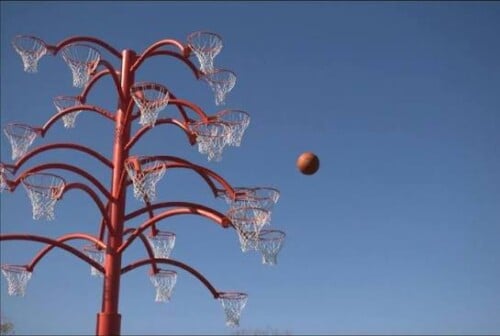
Giant pink rubber nodes where the lines never seem to touch, vertiginous pyramids of balloons, spheres composed of donuts and futuristic residences. For all this we need a fervid fantasy and audacity. Qualities that the architect/artist Cyril Lancelin (founder of the ‘Town and concrete’ studio) clearly has in abundance. His visionary and creative mind has no boundaries, as his domestic spaces without corridors where the limit between inside and outside is not understood.
Circles, squares and triangles: elementary forms that acquire volume and are multiplied. A repetitiveness that we also find in the installations where we feel immersed both visually and tactfully in a harmonious geometry from which we are pleasantly disoriented.
We spoke with Cyril before the opening of his last exhibition: ”Sphere”, open until April 29th at the MR80 gallery in Paris
The parametric design for us is: ”The search for beauty in the right proportion”. Why did you choose it for your buildings and installations?
When you design a building or an installation, the important thing, like having an original idea, is to find the right scale. The only way to find it is to experiment. With parametric design i can make 50 attempts when I could only do a maximum of 5 before.You decide the rules and then change the scale, shape and parameters. In this way i can design things that i could only have before in my head.
Have you made the same choice for the project of your house in Lyon?
Yes, I designed it so that it was open on the garden, keeping some walls and finding the right balance between inside and outside. I wanted every room to be able to see the next room and I tried to make the structure as simple as possible.
Besides being an architect you are also an artist. What was the motivation that made you start with art?
Art allows you to experiment ideas with more freedom than architectural construction in which you are more constrained by the cost dictated by the customer. In art it’s not necessary to have a client and you can propose ideas without restrictions. I imagine installations or “images” of installations without constraints. The installation can remain in the image stage or be realized, the idea in this way is alive. I started doing a lot of research and publishing some projects before they were built to get a pre-feedback. In this way I had less pressure and also the time to make adjustments. The luck is that many of my works, after their publication, have come to life.
What is the philosophy behind your immersive installations?
I’m looking for a space experience. The transition from one space to another must be like a discovery. The visitor will question his movements within the installation.
Who/what are your biggest influences?
I like the classics. Lately I’ve been to Marfa in Texas to visit the Donald Judd Foundation, it was really a great experience. I browse many websites, read a lot of magazines to get influences from different fields and discover new artists.
Which current art world trends are you following?
I look around 360 ° but in particular I love immersive installations.