The beauty of Design Week also lies in its annual recounting of the history of design, made up of visionary projects, reformulation of the present and year in which the way of understanding a product, perhaps of common use, such as coffee, changed.
For Lavazza, this sliding door was 1996, the year in which the history of the brand became increasingly intertwined with the world of design, after the first attempts in the 1950s and 1960s. Since then, more than forty professionals have collaborated with the Turin-based brand, for a series of projects collected in the volume Lavazza Design People. 1996 / 2020, published by Corraini Edizioni and presented in these days in Milan. The book is a timeline in which to appreciate design details, the study of forms, the search for functionality and the attempts to preserve the values of an almost liturgical ritual such as drinking a good cup of coffee. The Milan event was attended by architects, philosophers and designers, including Florian Seidl, head of the Lavazza Design department, who told Collater.al how to design a collection for Lavazza.

Hi Florian, why do you think Italians are so obsessed with coffee?
I think it’s very simple:
We drink it.
Often.
And we like it.
Here in Italy, coffee is really part of life. For many, it represents a small daily ritual. For a very long time it has been linked and intertwined with the culture, traditions and habits of many Italians, which is why coffee has become an institution and part of the Italian identity.
In Italy, we all know that coffee is a pleasure. (If it is not good, what pleasure is it?)

1996 was an important year for Lavazza. What has changed since that date?
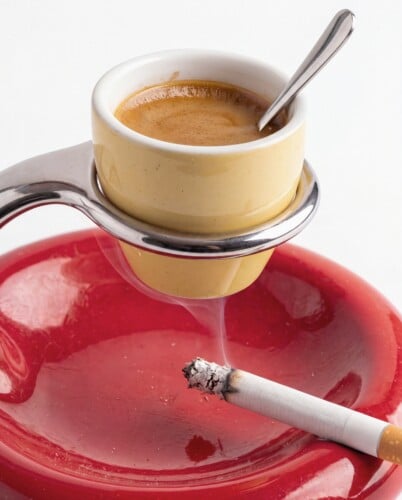
It was truly an important year for us! Obviously, I wasn’t there yet, but in 1996 Lavazza organized a competition to design a line of products for bars and restaurants. The competition was won by Claudio Caramel. The collection, known as Segno Lavazza, featured about forty objects, including the cup: his masterpiece. The shape of the cup echoes the slant of the central A in the Lavazza logo and is still an important icon for us today.

How difficult is it to find the right design for an almost religious ritual like drinking coffee? Is it difficult to combine the functional component with the more “intimate” gesture?
It’s very difficult. But maybe that’s because designing something good, right and relevant is never easy. Usually an idea takes time. Time to mature it, explore it and make it concrete.
Otherwise it remains a dream.
Dreaming is easy.
Designing a good product usually isn’t.

Collaborations are an important tool for brands to renew their aesthetic and open up to new projects.
and open up to new projects. At Lavazza, you were the founder of Team Lavazza Design.
explain what it is and how it is helping to improve the brand?
I can say that it was a wonderful experience to found this design office, but also a real challenge. Before Lavazza didn’t have a dedicated internal structure and when I arrived we had to develop the design direction in all its parts. Now we follow the whole process of product development, from the initial idea to production. This requires a lot of attention and it’s extremely important to make sure the final product is true to the initial intent. Through it all, the brand’s Italian identity and open, collaborative spirit have not changed. We now have a creative direction
creative direction that aims to tell a coherent story through design, so we help build brand identity – project after project.
Finally, mocha or coffee maker?
Mocha always for breakfast. For the rest, the coffee maker as well.