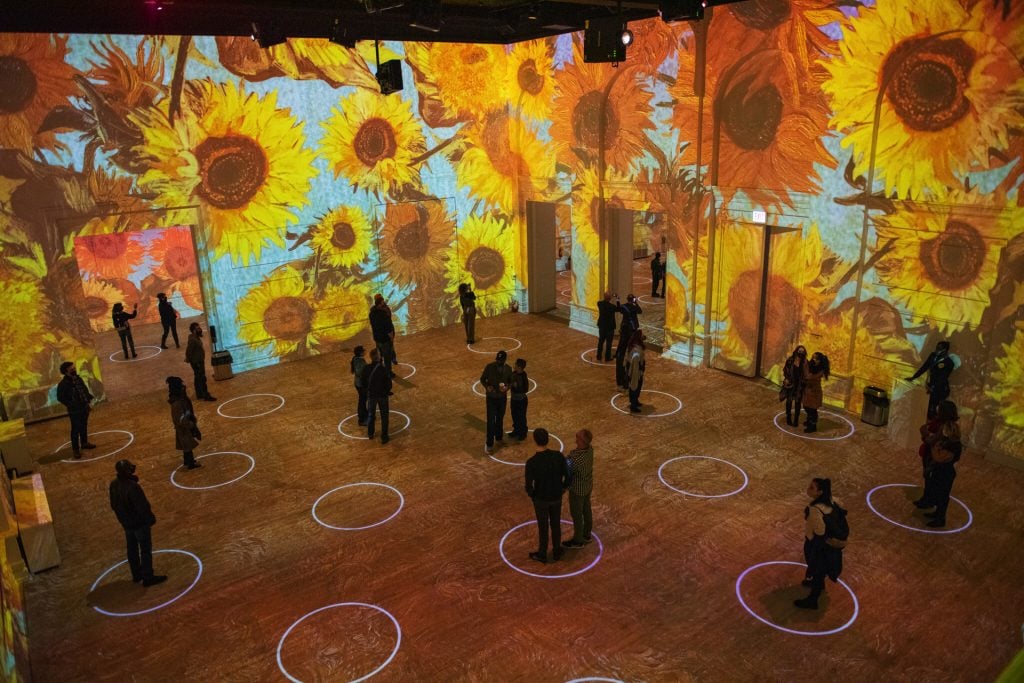
There is a place where art, performance and music come together to become a single thing capable of enveloping the viewer. They are called immersive shows and among them we can say that the Immersive Van Gogh and Immersive Klimt shows are the best.
For almost two years now, more than 3 million people across North America have bought tickets to be transported into the imagery and works of these masters of art. Sitting under the stars of Starring Night, stepping into Van Gogh’s bedroom or taking a walk in a field of sunflowers: thanks to the work of Massimiliano Siccardi, author and director, and Luca Longobardi, pianist, composer and sound designer, all this is possible.

On the occasion of the reopening of Immersive Van Gogh in New York scheduled for tomorrow, November 17, we had the opportunity to speak with Luca Longobardi, starting of course from the creation of the soundtrack and musical direction of these shows and coming to analyze the relationship between places and music.
Read on to find out what he told us, follow him on Instagram so you don’t miss his upcoming work and on Spotify to listen to his compositions.
Tell us who you are, what your background is and how you got to where you are now.
I started playing the piano when I was 4 years old, thanks to the foresight of my parents who, as non-musicians, supported my passion from the beginning. My training path has been quite “classic”: diploma in Piano and Composition at the Conservatory, Bachelor in Piano Performance in NY, Second Level at the Conservatory and then a PhD in Digital Audio Restoration at La Sapienza in Rome.I started very young as a concert pianist, it was what I imagined for me when I grew up, but when I later came into contact with the reality of traditional theaters and independent productions of contemporary dance I discovered a passion for directing, digital visual arts, installations and experimental composition. This is how my research of a total performance started, finding in sound and visual multimedia the language I prefer.
In 2012 I started my journey in immersive art by signing the musical direction and the original soundtrack of the immersive performances of Carrières de Lumières in Baux-de-Provence, Atelier des Lumières in Paris, Bunker de Lumières in Jeju (South Korea), Bassins de Lumières (Bordeaux) and Kunstkraftwerk in Leipzig.

In this period, my artistic relationship with Massimiliano Siccardi, video artist, director and guru of immersive art to whom I am also linked by a deep friendship, has been consolidated becoming more and more productive. This has allowed me to undertake in this field an authorial path even more precise and experimental. This is how Immersive Van Gogh Exhibit was born, which debuted in Toronto at 1 Yonge Street in the middle of the pandemic in July 2020. After a year and a half, the show has become the most popular entertainment show in North America with 3.5 million tickets sold.
What are your go-to artists and musicians?
Beethoven is my first choice. During my years of study in New York, I took a monographic course during which I had the opportunity to analyze his works almost in their entirety and also to read a lot about his life and approach to music. His concepts of musical writing, of “thinking by parameters”, of cohesion and timbral division have been a real epiphany and have strongly influenced my approach to composition over time. In the contemporary scene, I would say Arvo Pärt, for his minimalism and expressive purity, and Murcof, who handles the concept of noise and silence in such a way that they become structural in the creative process.
You took care of the sound design and original compositions of the immersive shows on Van Gogh and Klimt. What is your creative process? What do you start from and how do you develop the compositions?
Immersive art is a very complex concept, it’s not just a technical way to represent A/V in huge spaces. The word “immersive” indicates a deep engagement of intentions that connect images and sound so that the audience may be able to experience a different perception of art. The music should not “overpower” the images but, on the contrary, should allow for a different, more personal and intimate yet collective approach. For example, the soundtrack assembled for Immersive Van Gogh Exhibit develops following two main narrative concepts: the human and emotional condition of the artist and his way of expressing his sensitivity through creative action. The clear image of Van Gogh is that he often looks for understanding in other artists, even if he ends up finding solitude as the only possible condition – both in a positive and negative sense – and this is the constant that links the two concepts.

Whether it’s the introspection he often indulges in or the isolation in nature to paint it in all its power, Van Gogh is alone in his uniqueness and psychic fragility. A feeling that unfortunately became easily shared when the show debuted in July 2020, in the midst of the disorientation due to the pandemic. In this case, original pieces in which I made extensive use of soundscapes or very famous songs such as Edith Piaf’s “Non, je ne Regrette Rien” invoked that involuntary memory (to use Marcel Proust’s concept) that allowed people to generate new and specific attachments to the experience, a new madeleine moment.
For Immersive Klimt Revolution, however, the discourse changes. Klimt’s art communicates a different concept, his paintings are revolution, rupture, eroticism, concepts that explode in the eyes of the viewer thanks to an impeccable technique that leaves you breathless. The soundtrack, in this case, is more dense and textural, very complex and articulated, with large proportions and quite different from the other immersive works created so far, probably because there was a strong need to recreate the time for a transformation, for a clear perception of freedom and novelty brought by the revolution. It is a slow construction of an emotional tension that explodes in the final 8-minute techno track during which some details of the works completely fill the space as in the visuals of a rave. It is for all of us the moment of reaction, of rebirth and with this choice, I thought to give voice to a dance that could allow everyone to perform an act of initiation, a tribal ritual of liberation, to dance until feeling part of a sociality that unites us, where distance is only the space that our reinvigorated aura takes to shine again alive and without fear.
The immersive shows for which you curate the musical direction and soundtrack are staged all over the world and in different countries, with different musical traditions. Do the places they are staged in influence your work?
It’s definitely something I keep in mind especially in the choice of already published songs, both pop and classical, because some characteristics, such as the language of a song sung or its success in a country, contribute in a fundamental way to the construction of the emotional attachment that the public creates with the show. Music is a cultural fact, music is identity, it is belonging, and although it objectively “belongs to everyone” it creates a very subjective emotional relationship because it shifts its perception to a more intimate sphere, pushing us all, despite cultural or age differences, towards a wider sense of belonging.
Tell us three tracks that could never be missing from your perfect playlist.
Stand by Me in the version by Florence and the Machine, Says di Nils Frahm and Doomed di Moses Sumney, strictly in that order.