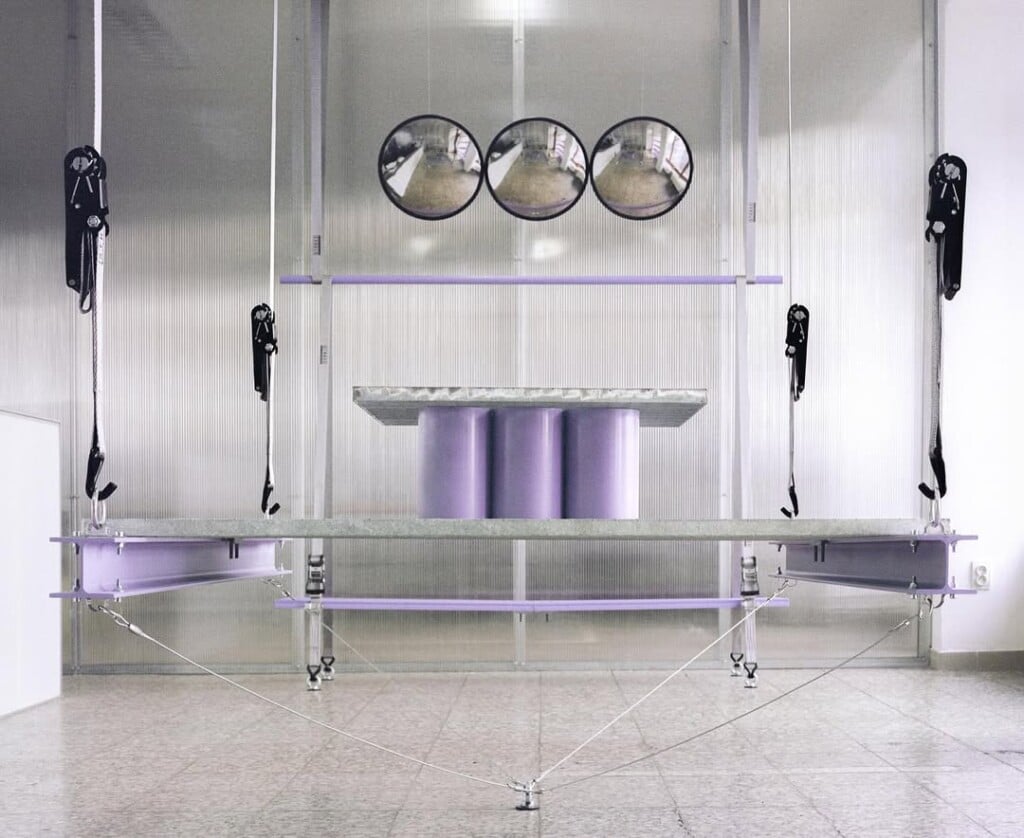
In Bratislava, there is an analog photography studio that seems to have been designed not so much with furniture, but with physical forces. In the Minulle Lab Showroom, designed by spatial designer Adam Terlanda, beams, metal grates, bars, and industrial straps are suspended, stretched, and balanced until they become light, almost floating furnishings.

The project was conceived within a lab dedicated to analog photography, a space that includes a photo studio, film lab, office, and showroom. With a limited budget, the idea was not to add traditional furniture, but to build the identity of the space through industrial objects transformed into functional and sculptural elements.

The result is an environment where heavy materials behave in unexpected ways. Steel grids become suspended tables, metal rods turn into minimal supports, while cargo straps are used to create tension and stability, making the relationship between weight, balance, and force visible. Terlanda constructs a spatial narrative based on contradiction: industrial, raw, and heavy objects take on an almost delicate quality. Every element seems to find its balance in a precarious yet perfectly calibrated way, as if the project were closer to a physics experiment than to classic interior design.
The language is essential and structural. Forces become part of the project: tension, gravity, compression. The result is an industrial aesthetic that does not aim for brutality, but rather for a form of unexpected elegance. The Minulle Lab Showroom, inaugurated last year, fits into Bratislava’s young creative scene as a hybrid space between photography, music, and independent design. More than furnished, the studio appears suspended, as if weight had been transformed into balance.