Noor Riyadh will close on December 6, but we like to think that the five installations and artworks we’ll talk about today are the ones we truly wish we could have seen in person. Because the fifth edition of the festival, part of Riyadh Art – the largest public art program in the world – seems to have outdone itself: more than 60 works spread across historic sites, new urban hubs, and even the metro network, all tied together by the theme In the Blink of an Eye, a tribute to the rapid transformation of the Saudi capital.
Among the works that impressed us the most is DICE by Iregular, an interactive cube that places the theme of luck at its core. The audience enters the piece through its own shadow, which breaks apart and reassembles in real time thanks to tracking systems and generative software. Every gesture creates new luminous drawings, every movement rewrites fate: a work that is never the same, capturing the idea of an organized chaos made of coincidences and possibilities.
Visualizza questo post su Instagram
Very different in nature, yet just as engaging, is Love Difference by Michelangelo Pistoletto, which takes on a new form in Riyadh. A constellation of neon signs repeats the same phrase in different languages, making visible the cultural mosaic that brings the city to life. Here the artist weaves together poetics and politics, reminding us how difference can be a bridge or a distance, a way to recognize one another or to feel lost. A simple message, yet powerful in its universality.

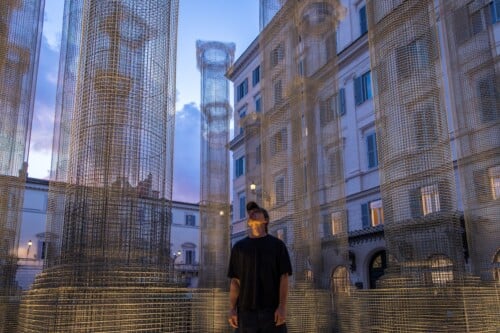
At the STC metro station, Center by Ivana Franke takes shape—an installation that isn’t just observed: it’s experienced. Transparent threads suspended in space create forms that appear and disappear depending on how you move, turning perception into an active, almost meditative act. The space becomes a mutable organism, where the line between the real and the imagined shifts with every step.

In the heart of the King Abdulaziz Historical Center we find Atmospheric Seeing by Studio Above & Below, a work that draws on environmental data—air quality, invisible particles, atmospheric conditions—to build a luminous architecture in constant evolution. Walking inside the installation means moving through what we normally cannot see, becoming part of a visualization that responds to our movements. It’s a reminder that technology can make the invisible tangible, and that our bodies are increasingly part of the digital infrastructure surrounding us.

This selection closes with Moon 20190901 by Wang Yuyang, a painting that overturns our perception of the moon. Accustomed to the black-and-white images of space missions, we tend to store it mentally as an object without color. The artist challenges this preconception by using digital goggles that turn everything he sees into shades of gray: while painting, he perceives no color at all. Only when he removes the headset does he discover what he has created—a moon in impossible hues, vibrant, almost extraterrestrial. An exercise in trusting the creative process and an invitation to question what we think we know.

Five very different works, yet united by the same intuition: when light becomes language, it forces us to look at the world—and at ourselves—in a different way.