Our five questions keep on spreading through the artists of the Outdoor Festival 2018.
Other 3 of them (actually 4) are ready on the starting line.
Ready? 3,2,1 go!
Tell me five words you love and five you hate.
Tony Cheung: Usually I don’t hate or love some specific words, they are just tools for human being, but I kind of dislike terms as ”positive energy” or “healthy mind/thought”. The words I like: communication, possibility, exchange, pleasure, pain.
Quiet Ensemble – Fabio Di Salvo: The words I love the most, considering both the meaning and the sound, are: Polyphonic, Essai, Labile, Glossing Over, Pajama. I don’t like: Banned (in Italian: Interdetto), Conventional, Stratagem, Artifact, Whatchamacallit (in Italian: Vattelapesca).
Quiet Ensemble – Bernardo Vercelli: Fruit, Chloro, Mango, Clay, Crystal. The five I can’t stand are words and expressions: Home-made, Photo Opportunity, Roll!, Studio Visit, LoL.
Mathieu Tremblin: <3 Urbanity, Nomadism, Humility, Curiosity, Empathy. 8 Domination, Profit, Competition, Spectacle, Vainglory.
What is the best thing about the city you came from?
Tony Cheung: The food. Cantonese food is absolutely exquisite and unbelievable.
Quiet Ensemble – Fabio Di Salvo: My city is Naples and the best thing about it is certainly the sea. It’s the thing I miss you the most here in Roma, the city where I live in.
Quiet Ensemble – Bernardo Vercelli: Countryside, sunflowers’ fields, the riverbed and the abandoned mill.
Mathieu Tremblin: The favourite city I lived in is Arles: lack of control was and still is the main interesting thing. People let it go. And the fact that power is not constraining you to do anything but actually let you take your own responsibility is a motor for getting involved in common good.
How and When did you start “making art”?
Tony Cheung: My art career started while I was in college with a book design course in which I drawn lots of illustrations with these freaky characters playing around, and then I put them altogether into a book. After my graduation I made some merchandises out of those illustrations, like phone cases, postcards and shirts, selling them in the art&design market. The feedback was really good, my works amused and shocked some people. So I’ve abandoned merchandise stuff and I started working on lots of new ideas and cool works. The turning point has been my participation to Crack! Festival (2013). It was a total mind blowing, was the first time I realized it’s not important what kind of media you work with or how well known you are, what matters is the passion and a kind of utopian pure idealism about art, as long as the critical thinking. These European artists’ works not only inspired me, but also granted me sense of confidence, joining this big family as an underground artist. Then I had tried so many different medias and subjects: porcelain, Chinese painting and acrylic. In 2017, I had my first solo exhibition in Rome at Nero Gallery.
Quiet Ensemble – Fabio Di Salvo: “Making Art” is an abstract concept, I don’t know if I’m making art or if I never did, I’ve always tried to satisfy my curiosity and to transmit to the others the results of my searching, halfway between the conceptual and my interiority.
Quiet Ensemble – Bernardo Vercelli: I don’t there was a moment when “I started”, I think is easy to get lost.
Mathieu Tremblin: I assumed I was doing art when I suddenly realised that the urban experience I was sharing with my friends, based on urban exploration and graffiti, was leading me to a deeper understandement of everyday life interaction between citizens and the built part of the city, that any theoritical essay could ever make me felt: the power of the living.
What are you proposing here for the Outdoor Festival?
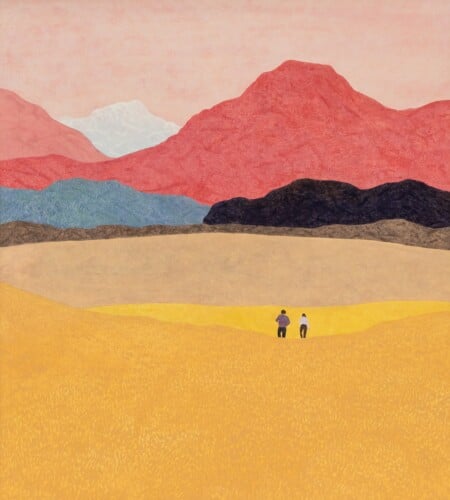
Tony Cheung: I am proposing Chemical happiness Project, which is a 7 meters long horizontal digital painting I specially did for Outdoor Festival. In this project I’ve tried to bring provocative subjects like suicide, school bullying, sexual slavery. All these elements are being captured and reproduced in a pretty subtle method and attempting to hide any social judgement and critical orientation from the vision. Meanwhile, the devision (or we can call it contradiction) between aesthetic form and content had created this ironic effect. I’ve used a “fake” Chinese landscape and a figure painting form to represent all these subjects, so that the visual impact is to look at a miniaturized diorama, that you can bring back home taking with you the fold-out reproduction of the scene you can find at the festival bookshop.
Quiet Ensemble – Fabio Di Salvo: A new installation called Prefórma. It’s a kinetics one in which we have investigated the Heritage concept, central theme of the Outdoor Festival. We have developed our interpretation, following our poetry, and presented a work showing an abstract vision of what come just before and right after the creation or the destruction of an Heritage, a reflection upon something intangible that strengthens and builds the heritage of every community.
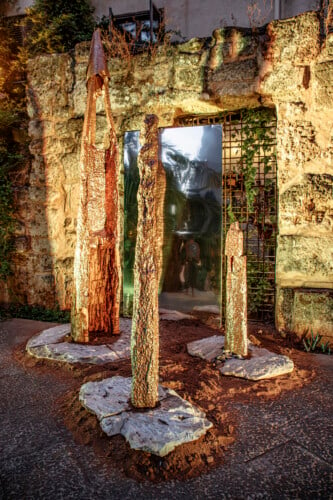
Quiet Ensemble – Bernardo Vercelli: A new installation, the result of a formal study on stone, on drawings on the rock, a macroscopic vision of the dust speck. A work that, through simple geometric shapes, suggests the never ending changing nature of things, a reflection upon the apparent stillness of the shapes.
Mathieu Tremblin: Related to the topic of cultural Heritage and disobedience, I gathered a Rome stickers collection. This collection is spread among prototypes of urban furniture where some selected stickers that I pilled off and stick back are displayed, as a manner to move these from urban space to exhibition space and enhance new interactions. The selection I did is balancing in a different way the numbers of each type of stickers in presence in Rome streets: in Mattatoio, there’s only Roman slang, Serrande and Traslochi and Football supporters stickers on view—almost not art, street art, graffiti or brands stickers. The empty space between the stickers (because some categories of stickers were discarded in the process) might gives the envy to the visitors to add their own stick. That’s my way to highlight this everyday small disobedience move that stickers in urban space can be—specially in Rome right now. And also to find a way not to conserve it like fetish, but push forward its obvious logic by provoking citizens to add more stickers and to embrace sticking gesture as a form of immaterial patrimony—reenacting the energy of it instead of focusing on its artifacts.
What do you see in the future?
Tony Cheung: I am so honored and privileged to work and live as an artist. The process of creation had provided me an exclusive way to let out my personal feeling and thought. Playing around with different aesthetic forms and ways of interpreting reality in my own vision is the thing that really enrich my life. It’s quiet hard to find the balance between artistic pursuit and the real life issues: my works are way too provocative and sometimes disturbing. The balance between these tensions, my work, the art market and the commissions I’m often involved in, the totally different experiences of art&work in Europe and in China makes me feel I’m living a kind of a double faces life, and also this is the interesting part of the game. My next move in Europe is having an exhibition in Holland and attending Crack! Festival in Rome this June. After that, me and my friends are organizing the 2nd edition of Singularity Festival in Canton (the city I live in), which is the very first underground art festival in China. I feel quiet excited about the concept of building a bridge between Eastern and Western culture through art.
Quiet Ensemble – Fabio Di Salvo: I see a faster and faster evolution of our culture and artistic products. A contamination between various disciplines that will give birth to new whole schools and new audiences. We’ll keep on searching observing and listening to everything that surrounds us.
Quiet Ensemble – Bernardo Vercelli: Wrong choices’ results, right paths, random situations. I’m ready to be surprised, from the next 30 years and from the minute that will come right after this quote I’m writing.
Mathieu Tremblin: More inequality and tension between the super wealthy and the casual poor that hopefully won’t lead to a total collapse of society, but will bring some balance between the aliving and stimulating part of it (the nomadic minded part of the citizens that is actually minored) and the control obsessed part of it (the land and real estate owners and city planners or governants part).