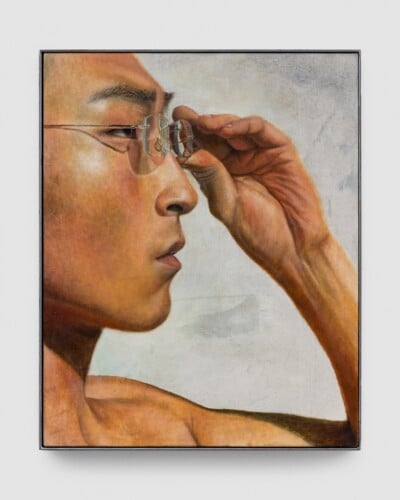
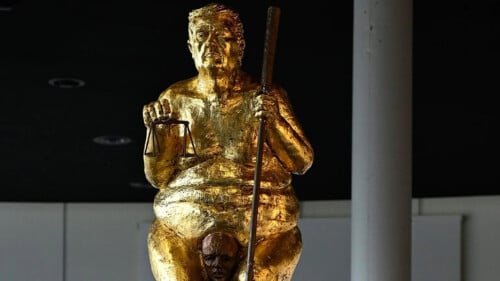
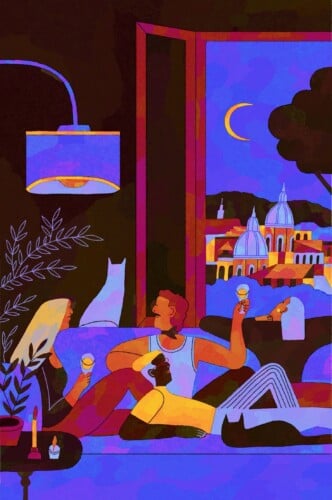
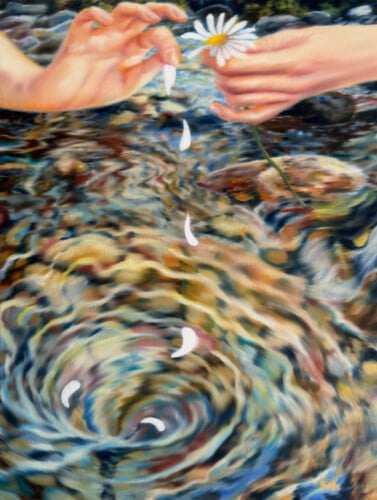
It often happens that ancient walls, such as churches, castles or basements, host contemporary art exhibitions, thus fostering an atypical artistic dialogue different from the one created inside classic white cubes. In the province of Bergamo, precisely in Pagazzano, there is a hidden gem: the Visconti Castle, now the host site of the group exhibition “Petricore,” which can be visited until May 1, 2023. Within the medieval walls of the castle, which at times is reminiscent of the Sforzesco castle in Milan, the exhibition of eighteen young artists is articulated and curated by Riccardo Vailati, Giulia Mariachiara Galiano and Lorenzo Valota.
The striking building allows to accentuate the magical experience that the viewer has in discovering the contemporary artworks located inside. In fact, the artists involved create works in strong connection with the host site, allowing the creation of a dialogue between the contemporary and the ancient. The common thread that unites all the works is insinuated in the title of the exhibition itself – Petricore – an uncommon term for the smell that arises from the contact of rain with other materials, such as stones or asphalt. The exhibition itinerary celebrates the intimate and sensory connection established between places and the human being who lives and transforms within them.


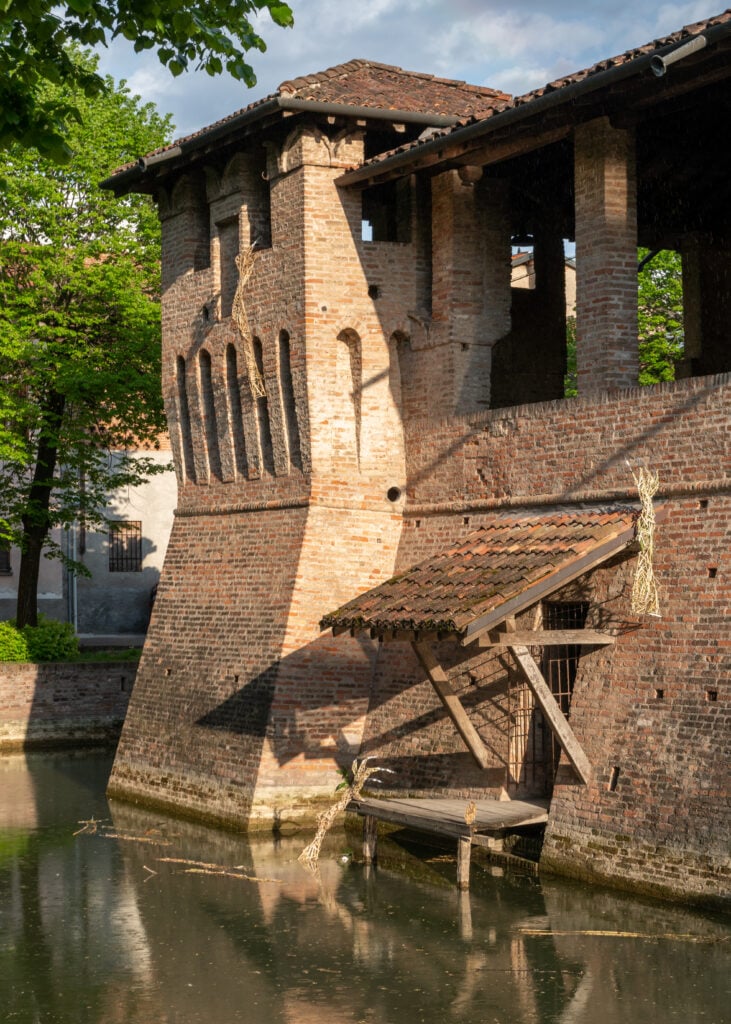

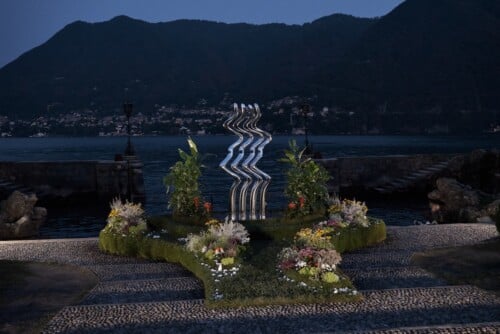
Even before crossing the large entrance gate, one is confronted with the installation by the Chora Collective (formed by Stefano Ferrari, Giorgio Mattia, Carla Nigro and Matei Vladimir Colteanu), which takes advantage of the moat and exterior walls to install the site-specific work “The advent of (re)mixing power dynamics.” The work retains a celebratory nature towards the work of the peasant families of the area, who in past centuries worked to maintain the structure under exploitative conditions. The choice of the moat occurs for purely semantic reasons: by definition it is an area of separation, pushing the outside world away from the fortress, creating a physical and psychological barrier.
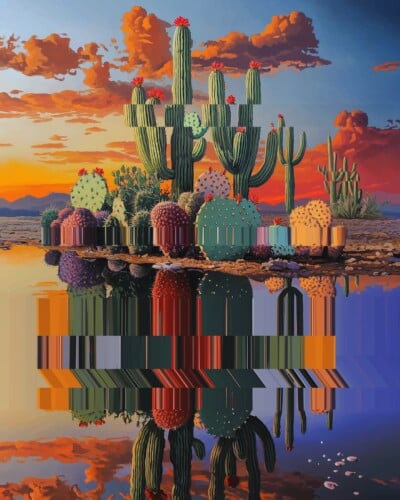
Entering the first room – the Torchio Room – one finds the works, sculptural, audio-visual and pictorial, of Ettore Morandi, Daniele Di Girolamo, Arianna Greci, Gabriele Longega, Gregorio Vignola, Anna Marzuttini and Matteo Messori. The latter creates the site-specific work “Nigredo” modeled after a portion of masonry. The effect is that of a throne on which falls a “universal” rain capable of decomposing matter to bring it back to its primitive state.


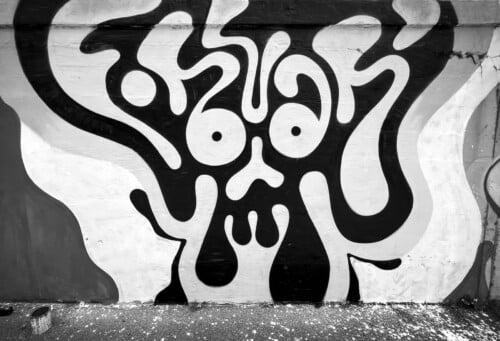
Continuing inside the Scuderie room, one finds instead in dialogue the works of Luca Campestri and Lorenzo Manunta that create a dreamlike and at times ghostly environment, both based on the concept of memory. Campestri’s work is in fact titled “Spettri” and projects shadows on the walls of the room that evoke a past reminiscence; in front of these looped images is Manunta’s totem work titled “Don’t swim in the dark lake.” A transposition of an object of memory, no longer ethereal and intangible but now petrified and exposed like the fossil of a past creature.

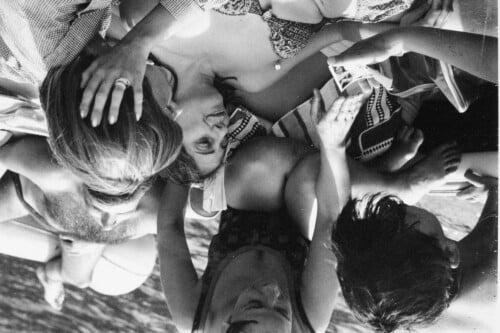
Scattered among the different outdoor areas of the castle, however, are the works by Matteo Bianchini, Tommaso Fraschini and Vera Lanciato. On the staircase leading to the last room, that of the Granary, is instead the work created by Lorenzo D’Alba and Alice Fiou. An interlude that the artists have re-semantized by affixing a tapestry to the ceiling, on which the photographic image emerges. The tapestry invades the space of the viewer, forcing him to divert the path to avoid its incumbency.
Upon reaching the last room, one is plunged into a lavender-scented environment, part of Nera Branca‘s work entitled “Expansion of Dominion.” The work is installed in the center of the room and immerses the viewer in a parallel dimension made of worn deer skins, earth and mosses, lavender, branches/roots and bones, all of which come from the Valdostan mountains except for the deer skins, recovered directly from the artist himself.


Photo Credits: Erik Falchetti