Yeast Photo Festival represents a true gem within the landscape of photography festivals in Europe: it is in fact one of the very few (in Europe) to have built its identity around a single theme: food.
Food, a catalytic topic and a source of contemporary visions and suggestions, is not analysed as a mere aesthetic object/subject, but as a complex system intertwining production, consumption, environment, economy and social relations. Born in Salento, in the village of Matino, a territory with a strong agricultural tradition and marked by profound contemporary transformations, Yeast has presented itself to its audience for four years with a programme of diffused exhibitions, hosted both in institutional venues and in non-conventional locations, and with a programme that invites viewers to look at food as a critical device, even before a visual one. Guiding this vision is the artistic direction of the creative duo Flavio&Frank, magnificent hosts, and Edda Fahrenhorst, a curator active between Italy and Germany, who with her international outlook helps define the festival’s curatorial identity.
In this interview we delve into the Yeast Photo Festival project to understand what makes it a specific case within the panorama of photography festivals and how its cultural vision is built over time.

Yeast Photo Festival was born from a radical curatorial vision, almost unique in the world of photography festivals, namely focusing the entire project on food, not simply as a visual subject but as a true field of investigation capable of telling us much more: a genuine gateway to social, cultural and environmental issues. What is the vision behind this focus and what questions do you truly aim to raise through the images?
Food is a universal and essential theme. In combination with photography – probably the most immediate communication tool with the greatest cultural impact – the theme and the festival’s exhibitions are designed to be accessible to people of all backgrounds and ages. This is a very important aspect of our work, as we invite everyone to join us on our journey.
The questions we raise are based on the current situation and concern climate change, political trends and social phenomena. But in such a way that – at least this is the intention – they do not encourage people to distance themselves, but rather invite them to reflect on themselves and their own role in all of this. We therefore move from the universality of the general to a more individual perspective: the more intensely our guests engage with the topics, the more complex the connections to their actions and thoughts can become.
This is another principle underlying our questions: how can we create a programme that satisfies a wide range of interests and, ideally, enriches people’s thinking after visiting the exhibition?
However, this does not only include the seriousness of the problems we are facing as a society: it is equally important to give beauty, photography, community, fun and, above all, food a prominent place, both within and around the exhibitions. As festival director Veronica Nicolardi summed it up this year: work that turns into ENCOUNTER, a project into HUMANITY, an event into COMMUNITY.
Moreover, the idea for the entire project originally came from the other two festival directors: Flavio and Frank Sabato.


Today food is practically everywhere: from social media feeds to the new rhetoric of wellness, to reportages that attempt to reveal its dark side, generating a visual bulimia in which it is easy to get lost. How do you select projects that go beyond aestheticisation and are able to offer truly critical, deep or unexpected interpretations?
In general, to be selected for Yeast Photo Festival, projects must meet several criteria: photographic quality must be very high (regardless of genre), the work must have high density and continuity (in simple terms: there must be enough strong images to sustain an exhibition), the fundamental question underlying the project must be at least two-dimensional and, very importantly, the project must challenge the viewer emotionally or intellectually (and may even be uncomfortable) or surprise them. Ideally, it should do all of these things. Ultimately, the individual projects must fit together like a large puzzle, so that both an overall narrative of the theme and the narratives of the individual exhibitions are effective.
Each year, the festival identifies a different aspect of the food system, addressing it through ever-evolving photographic and theoretical perspectives. This selection requires a precise sensitivity. What criteria do you use to determine which issues are urgent enough to deserve the focus of an edition, and how do you guide the choice of projects?
The criteria derive from the continuous observation of numerous channels: authoritative information platforms, magazines (yes, even those still in print), Instagram, the world of our children, exhibitions, festivals and debates in various institutions – which social and political trends are currently being discussed, which issues are more urgent than others.
From this, and with a certain degree of speculation about future developments, the corresponding annual theme emerges. Naturally, each thematic focus must also follow a certain rhythm in order not to become redundant.
Once the focus is defined, the large thematic puzzle I mentioned earlier opens up. In this puzzle, each project must first of all have a connection to the theme, which may not always be obvious. And then, above all, each theme always needs a counterpoint, both in terms of content and emotions.
Selecting projects is almost like a recipe with many different ingredients.

Salento is a complex territory, rich in agricultural traditions and marked by often conflicting economic and tourist dynamics. Introducing an international photography festival into this context also means taking on a cultural responsibility. How does Yeast Photo Festival interact with this ecosystem, and what reactions—expected or unexpected—have you encountered within the local community?
The festival was originally created to stimulate tourists’ interest in the culture of the territory, particularly that of inland Salento. But also to engage and inspire the local population. The reaction of the local community is characterised by great openness and willingness towards the visitors and guests of Yeast Photo Festival. Every year we consciously strive to achieve this type of interaction.
Working within a territory means making it part of the festival’s identity. To avoid a cultural project appearing as an intervention “imposed from above” or reserved for a few (as the photographic community might be perceived), it is necessary to build concrete relationships and involvement. What activities do you implement to make the community feel that Yeast Photo Festival belongs to the territory and was created with—rather than above—the people who live there?
First of all, most of the team comes from Salento and has had excellent relationships since childhood. This is, of course, an advantage for such an exotic project as launching an international photography festival.
Then there is another particularity of the festival: it is spread across the entire Salento territory and, although the two main locations, Matino and Lecce, host most of the activities and exhibitions, the festival is also present in several other towns in Salento—and the trend is growing. It is as if we are moving towards the people.
Furthermore, the festival extends invitations to all residents of the region. For example, on the Friday evening of the opening weekend we organise a large party for everyone: every year I am struck by how people of all ages come together to celebrate.
Since 2024, the festival has also commissioned a photographer from the region to work on a site-specific local project, and we always propose a campaign that actively involves citizens. In 2023, for example, we asked for photographs from family albums related to food, which resulted in a truly delightful exhibition. This year, for instance, we organised a large banquet open to all residents, visitors, newcomers and locals.
Creating something like a festival is always a process, but the hospitality and interest of the region are tremendous and represent an important bridge to the years to come.


The different spaces – from masserie to historic buildings – are not mere containers: they shape the gaze, construct narratives and alter the audience’s perception. Exhibition design is never neutral. How do you work on the relationship between content and place to create a coherent, legible and immersive exhibition experience?
For the exhibitions, we deliberately use locations in Salento as a backdrop to enhance the projects: the venues become stages for photography.
Each exhibition space is unique and individual, far removed from any white-cube situation. Light, space, sense of space, function, smell: all factors that must be harmonised with the works on display.
Once a year we all meet in Salento and visit together the spaces that may be available: some are confirmed, while new ones are added year after year. Much of the decision-making process for assigning the different projects to the various locations happens intuitively, on a very spontaneous emotional level: can I visualise the project on the walls, among the olive trees, in a cellar? From the very early stages of planning and practical implementation, Andrea Isola, the exhibition designer, and I are required to maintain a balance between feasibility (many venues are historic buildings and, for example, it is not permitted to intervene on the walls) and vision. Planning a festival’s exhibitions in this way requires great flexibility, a willingness to compromise and an extremely high level of precision and focus, because despite all the spontaneity, a coherent visitor route and good lighting are of course essential—along with respect for the budget, attention to sustainability, efficiency in meeting installation deadlines, and much more.
In 2025, you launched your first open call for curators under 35 and over 30. This opportunity reveals a specific idea of the photographic ecosystem, suggesting that you are not only seeking new artistic perspectives, but also new ways of interpreting, reshaping and contextualising food, with a more horizontal, dynamic and participatory vision. What kind of critical perspective do you feel is missing in today’s debate on food, and what do you expect an emerging curator to add, modify or challenge within the festival?
Oh, there are still several aspects that can be viewed critically or discussed—the theme of food and food production remains a very broad subject. For example, there are only a few large-scale, epic and complex reportages that examine production methods, globalisation and so on, of individual foods or the interrelationships between them. Or the production conditions for the people working in different countries. Or the impact of different cultural eating habits on health, ecosystems, culture, and so forth.
That said, while photographic reportage and documentary are excellent tools for telling precisely these kinds of stories, the festival is completely open to welcoming all photographic genres. From our guest curators’ programme, we expect exciting facets, compelling photography, a clear point of view and a coherent mindset.

Each open call is a mirror of its time: it reveals trends, vulnerabilities, obsessions and blind spots. Analysing what comes in also means understanding how food photography is changing. What recurring elements have you observed in the submissions, and how have these observations reshaped—if at all—your curatorial vision?
What surprised me was the high number of submissions addressing complex topics. Perhaps because a “festival about food” initially sounds innocent and playful.
Beautiful, simple and fun themes always have their own importance and justification, but in the context of a competition like this, they should at least offer something extra and, despite their lightness, not be carefree.
The Irinox Award, curated by Claudio Composti in collaboration with Mia Photo Fair, is an important recognition within the festival and helps define excellence in visual research on the theme of food. An award always reflects a vision. What role does the Irinox Award play in your project, and which qualities do you aim to highlight through this choice?
The Irinox Award results in an exhibition hosted during Yeast Photo Festival, and we are always happy to have this opportunity, which represents a true paradise for the selection of themes. We feel very privileged to be able to choose a theme each year (naturally connected to our annual focus), especially because the selection becomes more difficult year after year, as the quality and seriousness of the submitted projects continue to grow (and seriousness does not necessarily correspond to serious subject matter).

Working between Italy and Germany means engaging on a daily basis with different ways of producing, communicating and receiving visual culture. It is a privileged vantage point. What do you miss about Italy when you work in Germany, and what would you bring here from the German model?
My observations always focus on the audience’s reactions when they engage with projects and exhibitions: people are the reason why we do everything. This kind of observation is easier for me in Germany, because I have been able to interact with audiences more intensely and over a longer period of time.
Italian audiences, on the other hand, are always much more spontaneous and emotional. I find that wonderful, and I draw a great deal from it for my work on the next edition of the festival.
Beyond that, there are truly many differences between the two countries… but there are also similarities where you might not expect them. It would be fantastic to have a blend of both countries when it comes to the interpretation of time: a mix of hyper-punctuality and total laissez-faire would be a relaxing dream for anyone, in any profession.
Food photography is going through a phase of transformation: between climate, geopolitics, ethics and new aesthetic questions, the field is being rapidly redefined. What trajectories do you foresee for the future of this research, and what do you consider essential for Yeast Photo Festival to continue being a place capable of opening new questions rather than closing them?
As I mentioned before, there are still many topics worth exploring. This requires patience, courage, mindset and a point of view, both from photographers (by the way, at Yeast Photo Festival we are not limited to purely photographic works: moving images, texts, graphics, maps and more are also welcome) and from us as a festival.
To remain a place that raises new questions, we must stay aware and continue to ask ourselves these questions—even when they are uncomfortable.


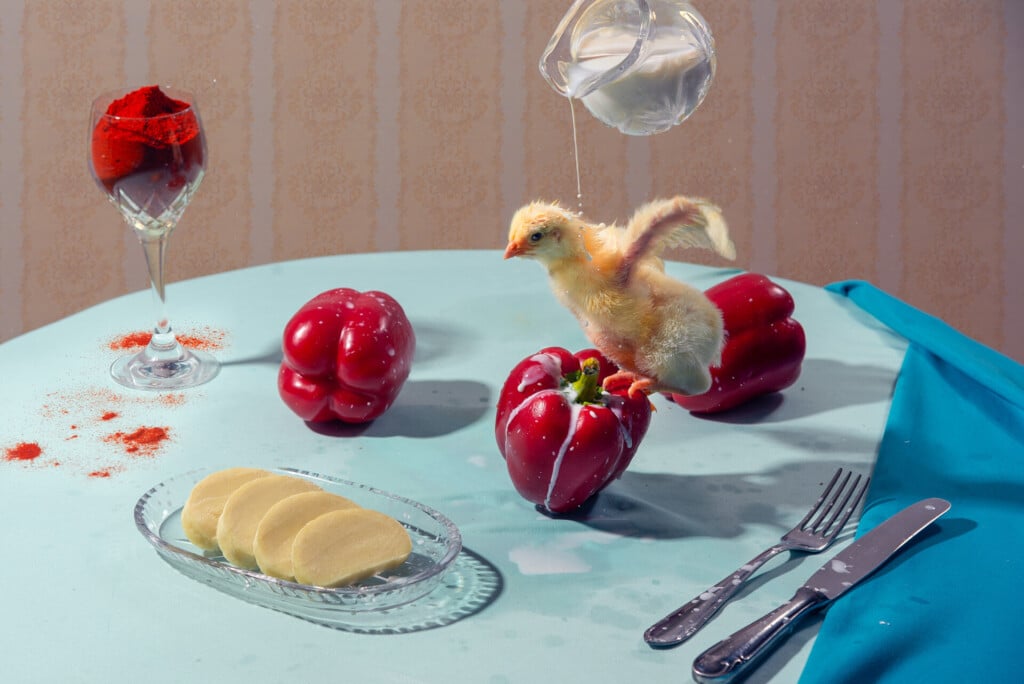
Cover image ©Katerina Sysova, Kukbuk (2024 edition)