The new photo book by photographer Robin Hinsch does not tell the story of war directly. Lonely Are All the Bridges is instead a layered portrait of Ukraine, built over the course of more than a decade, where landscapes, people, and symbols coexist in a suspended time between past and present. As the photographer himself states, the project was not created to document a conflict, but to observe a territory in which systems collapse, borders are redefined, and everyday life continues to exist amid instability and transformation.

Hinsch first visited Ukraine in 2010, drawn by the country’s political tensions and the figure of then-president Viktor Yanukovych, described as “the new dictator between East and West.” From that moment on, he returned several times, gradually building a visual narrative far removed from press imagery. His photographs convey a melancholic and silent vision, where the human dimension intertwines with a landscape marked by history, memory, and uncertainty.

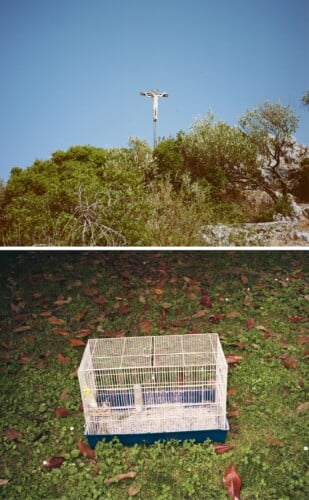
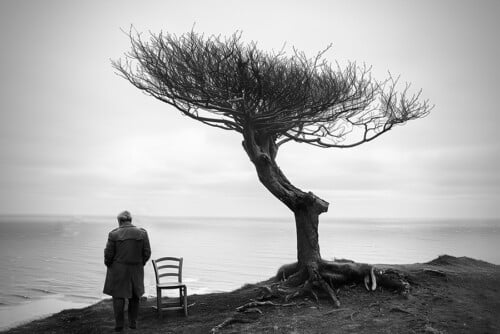
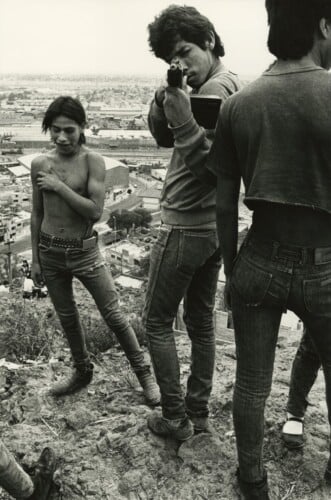
The images show Soviet ruins, historical monuments, countryside immersed in snow or rain, and abandoned industrial settings. The human figures — often isolated — are placed within these environments with careful, almost cinematic composition. The result is a visual sequence that escapes temporal linearity: color and black-and-white photographs alternate, while the absence of captions helps create a sense of indefinite time.

Some symbolic elements also recur throughout the book. Animals run through the entire project: horses, stray dogs, wild cats, and even a bear, a symbol associated with Russia, which appears both in a zoo and as a costume worn by a child. In the same way, the bridge — evoked by the title taken from a poem by Ingeborg Bachmann — becomes a central metaphor: a connection between two sides that, paradoxically, remains isolated and fragile.

In the final notes of the volume, Hinsch cites Mirror by Andrei Tarkovsky, a film built through a fragmented narrative in which memories, dreams, and different times coexist. This approach influences the structure of the book, which proceeds through visual associations rather than a linear story, allowing an emotional rather than documentary dimension to emerge.

The result is a project that reflects on the slow and often invisible transformations running through a society. Lonely Are All the Bridges seeks neither heroes nor antagonists, but observes the subtle forces that divide people and at the same time hold them together, turning the Ukrainian landscape into a narrative suspended between memory, the present, and an uncertain future.
Cover image: Bridge II, Gorochowatka, Oskil River, Ukraine, 2023 © Robin Hinsch